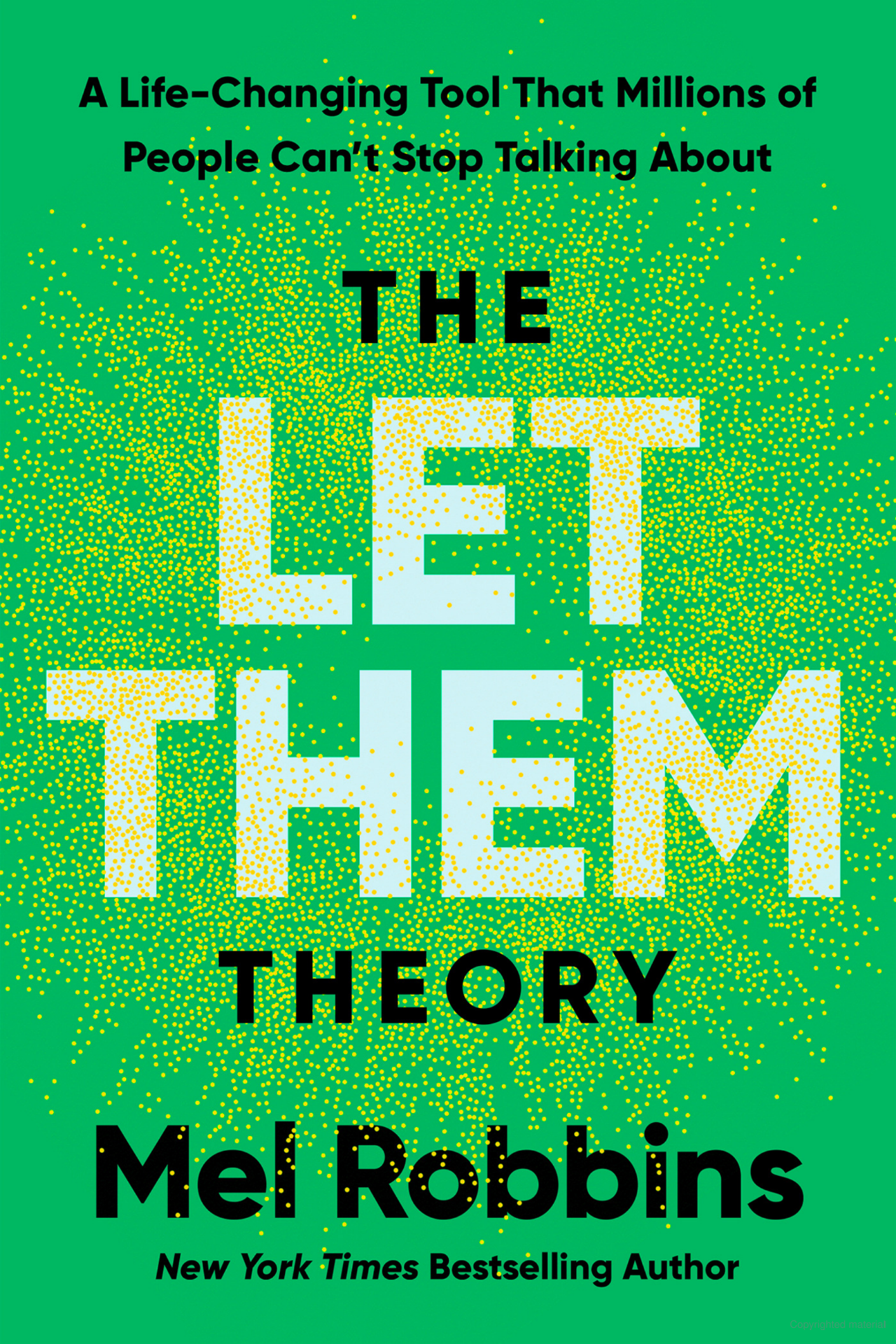
 The Let Them Theory boils down to: "Stop wasting your time, energy, and happiness trying to control things you can't control - like other people's opinions, moods, or actions - and, instead, focus on the one thing you can control: you." (p. 17-18)
This idea in itself is nothing new and has been packaged and re-packaged already; the author herself quotes Greek philosopher Epictetus: "It's not what happens to you, but how you react to it that matters." (p. 56) But what Mel Robbins offers is the phrase "Let Them", which can be used as a mantra and allows you to "reclaim your power by choosing how you respond" (p. 39), and the follow-up phrase "Let Me", with which you can "unleash your strength by focusing on your response." (p. 40)
The thing is, it's not like Mel Robbins coined the phrase "Let Them" - though she claims to have "discovered" the theory of it. (p. 30) In fact, I learned from other reviews that the phrase first went viral on social media in 2022 thanks to a poem written by Cassie Phillips and a photo of her "Let Them" tattoo. Mel Robbins does not mention Cassie Phillips in this book at all, but if she truly "spent the last two years researching the Let Them Theory" (p. 30), then unless she is a really inadequate researcher - which would undermine parts of the book (more on that later) - surely she would have come across references to Cassie Phillips and her viral poem "Let Them" as well as her follow-up poem "Let Me". Giving Mel Robbins the benefit of the doubt, it's not totally impossible to believe that two people could have independently built personal philosophies out of the phrases "Let Them" and "Let Me", but if so, at the very least, Robbins should have credited Phillips with being the first in the age of social media to show how instantly resonant the idea of "Let Them" is.
All that said, this book does offer good advice, and the author validates the emotions and thoughts that are common when feeling anxious, annoyed, excluded, or rejected. She also discusses the many factors that go into deciding what course of action to pursue in the "Let Me" part of the system. The book provides practical advice on implementing the strategy - like how at first you may have to literally repeat "Let Them" over and over until it sinks in (p. 36) - and it has pithy nuggets of wisdom, e.g., "emotions are like waves. They rise, they fall." (p. 125) I like that sometimes the tone is less gentle and more blunt, perhaps giving the reader a much-needed kick in the pants.
I really like "Let Them" as a powerful tool for managing emotions, but the book as an explainer felt repetitive. There were plenty of "I really did need to hear that!" type of statements, e.g., "When you let the world around you impact your emotional state and peace of mind, you become a prisoner to these external forces" (p. 56); and "anytime you try to control something that you can't, it just makes you feel more out of control and powerless" (p. 137) - but that same sentiment was re-worded and re-phrased again and again, ad nauseam.
Also, it seemed to me that Robbins sometimes oversimplified things. When discussing the impact of stress in our lives, she wrote: "If you're having trouble focusing, feeling happy, or taking care of yourself, the reason is stress." (p. 59) I mean, yes, it could be stress, but maybe you might have undiagnosed depression, anxiety, or ADHD? Of course, this book is about managing your relationships with other people, and Chapters 16 and 17 do provide really good advice on how to handle other people who are struggling with their own problems, which may include mental health issues, and how best to help them. Still, just a small section on how to figure out if your own unhappiness is due to "just stress" or when to seek help from a therapist, psychologist, or psychiatrist would have been valuable. (This omission became especially jarring later in the book when the author revealed that she herself has ADHD. (p. 275))
Similarly, Chapters 18 and 19 discussed using "Let Them" in relationships of love. The author reassures the reader that "the greatest love of your life is ahead of you" (p. 249), but seems to focus only on romantic love. I'm not fond of the idea that everyone needs or should be in a romantic relationship. What if you're aromantic? What if you enjoy your independence and don't want a partner? Again, Robbins offers some genuinely great dating advice and very solid, compassionate suggestions on how to deal with a breakup - there's even a notably candid section called "They Don't Like You. Wake Up." (p. 256) - but a few words about being confident in yourself and not needing a romantic partner to feel complete, or how one's "greatest love" could be a love of friendship or family, would have been nice. (She briefly talks about being single temporarily if you need to figure yourself out before getting into another relationship, but the implication is that being in a relationship is still the ultimate goal. (p. 263))
Finally, as a covid-informed person, I found one early excerpt particularly interesting. Robbins described flying on a plane and being seated directly in front of someone "coughing as if it were his last day on earth" and how she "could not afford to` get sick." (p. 58) She tried asking the man to cover his mouth when coughing, but of course, the whole point of this book is that you can't control other people's actions, and indeed the man "proceeded to cough openly." (p. 58) Her "Let Me" solution was to "cover my nose and mouth with my scarf." (p. 64) Given that the covid pandemic put airborne viruses and mask efficacy front and center, it is not at all difficult to do a quick online search to learn that a scarf is no substitute for a mask if the goal is to prevent the spread of illness. At best, a scarf can filter out large droplets from someone coughing directly in your face, but if she truly wanted to protect her health - and not just have a false sense of security - she should have used an N95 or KN95 or KF94 mask, which filters out tiny airborne viruses that can travel through and hang in the air any time a person exhales. For me, the lack of any scientific rigor in this one example put the quality of research that went into the rest of the book into question.


