Wednesday, August 26, 2026

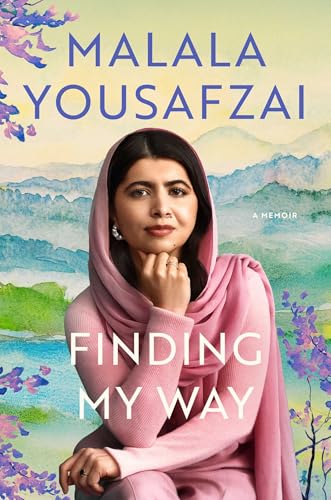
Finding My Way: A Memoir by Malala Yousafzai

★★★★

I'm a fan of Malala, which certainly made me partial to liking this book.

As far as I can tell, Malala has shown incredible grace and poise growing up in the spotlight, particularly considering she had a narrative imposed upon her when the Taliban shot her. Already a Nobel Peace Prize laureate, she was not your typical college freshman. But of course, in many ways, she was just another student, starting college like all other regular people, eager to make new friends and have new experiences - only she had to do it all in front of British Secret Sevice officers while dodging tabloid photographers.

Still, regular person or not, she was going through college - and life - under extraordinary circumstances. Even when falling behind in her studies, she was compelled to continue working (by giving speeches all over the world) during the school term not just to help her causes, but because she was actually the sole breadwinner for her entire family!! And when she finally extricated herself from work obligations during the school year and brought up her grades, PTSD from her shooting set her back again. (As an aside, I did wonder, where was her security team when she had her first alarming PTSD episode?)

We follow Malala's personal growth as she came to terms with her own identity as a native Pakistani who had grown comfortable with the English ways of her adopted country while continuing to feel a deep, longing connection with her home in Swat Valley. I teared up when she told of her first time returning to Pakistan since being forced to leave when she was shot.

Considering her role as a world-renowned activist, her personal life had been surprisingly sheltered - she had never eaten at a McDonald's before college! (p. 34) - and some of her friends teased her for being gullible. She was a good sport and rather matter-of-fact about her naivete; in fact, she seemed all the more self-confident in the way she showed no embarrassment or self-consciousness about lacking the common knowledge and experiences of her peers. She exhibited the same straightforward directness when she described her mental health issues; though cultural stigma against mental health care likely delayed her access to treatment, there was no shame in her account, only a clear, steady desire to find some answers and figure out how to help herself.

Though most of the book centered on Malala's college experiences, her mental health, and her relationship with her future husband, there is a remarkable section towards the end when she recounted events during the Taliban takeover of Afghanistan when the U.S. military withdrew. Many Malala Fund partners were in Afghanistan, and in her efforts to help them evacuate, she reached out to all the world leaders who had been happy to stand beside her for photo ops. Notably, none of the men stepped up. "Women, on the other hand, responded immediately, answering my calls and jumping into action." (p. 264)

An uplifting read, and I put down this book an even bigger fan than when I started it.

Thursday, June 18, 2026

The Let Them Theory by Mel Robbins

★★★

The Let Them Theory boils down to: "Stop wasting your time, energy, and happiness trying to control things you can't control - like other people's opinions, moods, or actions - and, instead, focus on the one thing you can control: you." (p. 17-18)

This idea in itself is nothing new and has been packaged and re-packaged already; the author herself quotes Greek philosopher Epictetus: "It's not what happens to you, but how you react to it that matters." (p. 56) But what Mel Robbins offers is the phrase "Let Them", which can be used as a mantra and allows you to "reclaim your power by choosing how you respond" (p. 39), and the follow-up phrase "Let Me", with which you can "unleash your strength by focusing on your response." (p. 40)

The thing is, it's not like Mel Robbins coined the phrase "Let Them" - though she claims to have "discovered" the theory of it. (p. 30) In fact, I learned from other reviews that the phrase first went viral on social media in 2022 thanks to a poem written by Cassie Phillips and a photo of her "Let Them" tattoo. Mel Robbins does not mention Cassie Phillips in this book at all, but if she truly "spent the last two years researching the Let Them Theory" (p. 30), then unless she is a really inadequate researcher - which would undermine parts of the book (more on that later) - surely she would have come across references to Cassie Phillips and her viral poem "Let Them" as well as her follow-up poem "Let Me". Giving Mel Robbins the benefit of the doubt, it's not totally impossible to believe that two people could have independently built personal philosophies out of the phrases "Let Them" and "Let Me", but if so, at the very least, Robbins should have credited Phillips with being the first in the age of social media to show how instantly resonant the idea of "Let Them" is.

All that said, this book does offer good advice, and the author validates the emotions and thoughts that are common when feeling anxious, annoyed, excluded, or rejected. She also discusses the many factors that go into deciding what course of action to pursue in the "Let Me" part of the system. The book provides practical advice on implementing the strategy - like how at first you may have to literally repeat "Let Them" over and over until it sinks in (p. 36) - and it has pithy nuggets of wisdom, e.g., "emotions are like waves. They rise, they fall." (p. 125) I like that sometimes the tone is less gentle and more blunt, perhaps giving the reader a much-needed kick in the pants.

I really like "Let Them" as a powerful tool for managing emotions, but the book as an explainer felt repetitive. There were plenty of "I really did need to hear that!" type of statements, e.g., "When you let the world around you impact your emotional state and peace of mind, you become a prisoner to these external forces" (p. 56); and "anytime you try to control something that you can't, it just makes you feel more out of control and powerless" (p. 137) - but that same sentiment was re-worded and re-phrased again and again, ad nauseam.

Also, it seemed to me that Robbins sometimes oversimplified things. When discussing the impact of stress in our lives, she wrote: "If you're having trouble focusing, feeling happy, or taking care of yourself, the reason is stress." (p. 59) I mean, yes, it could be stress, but maybe you might have undiagnosed depression, anxiety, or ADHD? Of course, this book is about managing your relationships with other people, and Chapters 16 and 17 do provide really good advice on how to handle other people who are struggling with their own problems, which may include mental health issues, and how best to help them. Still, just a small section on how to figure out if your own unhappiness is due to "just stress" or when to seek help from a therapist, psychologist, or psychiatrist would have been valuable. (This omission became especially jarring later in the book when the author revealed that she herself has ADHD. (p. 275))

Similarly, Chapters 18 and 19 discussed using "Let Them" in relationships of love. The author reassures the reader that "the greatest love of your life is ahead of you" (p. 249), but seems to focus only on romantic love. I'm not fond of the idea that everyone needs or should be in a romantic relationship. What if you're aromantic? What if you enjoy your independence and don't want a partner? Again, Robbins offers some genuinely great dating advice and very solid, compassionate suggestions on how to deal with a breakup - there's even a notably candid section called "They Don't Like You. Wake Up." (p. 256) - but a few words about being confident in yourself and not needing a romantic partner to feel complete, or how one's "greatest love" could be a love of friendship or family, would have been nice. (She briefly talks about being single temporarily if you need to figure yourself out before getting into another relationship, but the implication is that being in a relationship is still the ultimate goal. (p. 263))

Finally, as a covid-informed person, I found one early excerpt particularly interesting. Robbins described flying on a plane and being seated directly in front of someone "coughing as if it were his last day on earth" and how she "could not afford to` get sick." (p. 58) She tried asking the man to cover his mouth when coughing, but of course, the whole point of this book is that you can't control other people's actions, and indeed the man "proceeded to cough openly." (p. 58) Her "Let Me" solution was to "cover my nose and mouth with my scarf." (p. 64) Given that the covid pandemic put airborne viruses and mask efficacy front and center, it is not at all difficult to do a quick online search to learn that a scarf is no substitute for a mask if the goal is to prevent the spread of illness. At best, a scarf can filter out large droplets from someone coughing directly in your face, but if she truly wanted to protect her health - and not just have a false sense of security - she should have used an N95 or KN95 or KF94 mask, which filters out tiny airborne viruses that can travel through and hang in the air any time a person exhales. For me, the lack of any scientific rigor in this one example put the quality of research that went into the rest of the book into question.

Wednesday, May 6, 2026

Water Mirror Echo: Bruce Lee and the Making of Asian America by Jeff Chang

★★★★★

I find it amusing that this is the second book in a row that I've read with a title following the format "[List of Words]: [Famous Chinese Person] and the Making of [Asian Thing]", but that is neither here nor there. (The previous book being Chop Fry Watch Learn: Fu Pei-Mei and the Making of Modern Chinese Food.)

At times, the writing in Water Mirror Echo felt lofty, but then, Bruce Lee is a lofty subject. From our modern-day perspective, Bruce Lee is first and foremost a legend, and so it makes sense to start there, using his stardom as the foundation upon which we can start to get to know him in a way that "returns him to a human scale." (p. 6)

This is my first biography of Bruce Lee, and even without having read any others, it's clear Water Mirror Echo is a definitive source. This book is not just an accounting of Bruce Lee's life or Bruce Lee's teachings; it additionally places Bruce Lee into the context of Asian America, examining how he "navigated fascination and revulsion with 'the Oriental,' a corpus of distorted images that limited Asian American opportunity and mobility." (p. 5) The greater context provided for Bruce Lee's fight with Wong Jack Man was especially interesting (Ch. 22-23), as was the background on the racism of Hollywood and the common use of yellowface at the time when Bruce Lee came onto the scene. (Ch. 24-26) Bruce Lee had to fight for his own visibility and for the respectful representation of gung fu on screen, and in doing so helped bring visibility and validation to Asian America, a community just beginning to define itself towards the end of his life and around the time of his death. (p. 6)

All that said, of course the book starts at the beginning, and the early chapters quickly drew me in with a full, fascinating account of Bruce Lee's childhood growing up in Hong Kong, including important political and cultural context. Bruce Lee lived a life of opposing yet complementary existences - like the yin-yang symbol he adopted for the logo of his Jun Fan Gung Fu Institute - and we follow his evolution from child movie star and teen cha-cha heartthrob / street thug in Hong Kong to philosophical college student / local gung fu teacher in Seattle and Oakland to martial arts star / struggling Hollywood actor in Los Angeles. Even when his path came full circle and he achieved kung fu movie star fame in Hong Kong, his constant travels back and forth across the Pacific meant he had "to remember which side of the ocean I'm on, and whether I'm the superstar or the exotic Oriental support player." (p. 353)

When Bruce Lee finally landed a starring role in a film co-produced by a Hollywood studio - Enter the Dragon - he agonized over the script and the way Asians were portrayed; the American studio executives and writers offered up Orientalism and cared only about western audiences, but Bruce was acutely sensitive to how scenes would play out for Asian audiences. A representative from the co-production company in Hong Kong observed that Bruce "had to deal with the audiences who would be criticizing him and scrutinizing him. And so the weight was on him." (p. 405-408) Even on set, he was a bridge; while the American director and producers "yelled and cursed" (p. 409) at the Chinese crew, Bruce embodied gentle authority: "He took time to recognize the carpenters and plasterers. He ate with the crew members, stuntmen, and extras. He made sure that they received the same kind of box meal as him." (p. 410)

I especially appreciated that Jeff Chang rounded out Bruce's story by also giving us complex, fleshed-out portraits of those who profoundly influenced him and those he profoundly influenced, e.g., his father, Ruby Chow -- his primary guardian after he arrived in the U.S., who, I learned, was also writer Frank Chin's godmother! (p. 86) -- Amy Sanbo (his college girlfriend), and many, many fellow martial artists and students, including Kareem Abdul-Jabbar.

I enjoyed this book immensely, but towards the end, when the narrative reached the 1970s, just as Bruce Lee was beginning his ascent to international stardom, I found myself picking up the book with a heavy heart, and reading slowly with apprehension. I knew what was coming, and the anticipation of tragedy and grief gave poignancy to everything.

Random note: I read this book so carefully that a singular discrepancy stood out to me. On page 101, Takauki "Taky" Kimura is "sixteen years Bruce's senior", a detail repeated on page 102 where it clearly says "Takauki Kimura was born in 1924." But then later, on page 144, James Yimm Lee is reported to have been born in 1920, "the same year as Ruby Chow and Taky Kimura."

A comment on formatting: The book has many short chapters with many section breaks, making it super readable for someone like me who tends to read in short intervals. Also, I appreciated the photos printed in-line with the text. (Having to flip back and forth to a collection of photos in the middle of a book is a pet peeve of mine.)

Finally, a note to self: On pages 167-168, in a letter to Linda, there's an excerpt of a writing by 19th century Unitarian minister William Henry Channing called "My Symphony" which I love and will strive to adopt as my own life philosophy: "To live content with small means; to seek elegance rather than luxury, and refinement rather than fashion, to be worthy, not respectable, and wealthy, not rich; to study hard, think quietly, talk gently, act frankly; to bear all cheerfully, do all bravely, await occasions, hurry never."

Thursday, February 19, 2026

Chop Fry Watch Learn: Fu Pei-Mei and the Making of Modern Chinese Food by Michelle T. King

★★★★★

The back flap of the book's dust jacket says Fu Pei-mei's cookbooks "have become beloved emblems of cultural memory, passed from parent to child, wherever diasporic Chinese have landed." Indeed, like the author, I am of that particular slice of Asian America that can characterize myself as "Chinese American by way of Taiwan" (p. xxii), and I remember my immigrant mom having all 3 cookbooks, though only the first in the series was heavily used, with stains and handwritten notes. Consequently, I went into this book - a book that shines a light on the food-centered nostalgia of my childhood - feeling pre-disposed to adore it. (Thanks to my niece for recognizing my potential interest and gifting me this book!)

Michelle T. King offers up Chop Fry Watch Learn as a "history of Chinese food as seen through Fu Pei-mei's life and career... in all its global, gendered, political, and technological dimensions... [reflecting] multiple generations of families, connected across oceans by an abiding love of Chinese food." (p. xxi)

I especially appreciated the thread of discourse describing and explaining the use of the label "Taiwanese", which has evolved over the decades and has noticeably shifted in my own lifetime and experiences. (p. 15-16, 191) Equally fascinating to me was Fu Pe-mei's influence in worldwide gastrodiplomacy on behalf of the Republic of China, distinct from the People's Republic of China, a delicate, complex, and nuanced effort that continues today with those wishing to promote Taiwan and Taiwanese food as distinct from China and Chinese food. (p. 150-153, 186-187, 193) (Indeed, I was reminded of a recent trip to Taiwan when we had a delicious banquet-style dinner of what I would have called "Chinese" dishes but what the restaurant advertised as "Mandarin".) The author doesn't shy away from exploring current, less flattering, even scornful public perception of Fu Pei-mei, as seen in her examination of a TV series based on Fu's life that was not well received by those who thought it "only reinforced the hierarchical legacy of mainlander-Taiwanese relations." (p. 182)

I enjoyed the "East vs. West" contrast between Fu Pei-mei's general philosophy of cooking as "an act of energetic devotion to the family" (p. 28) and that of her contemporary Julia Child, who wrote that her book Mastering the Art of French Cooking was for those "who can be unconcerned on occasion with... children's meals, the parent-chauffeur-den mother syndrome or anything else which might interfere with the enjoyment of producing something wonderful to eat." (p. 29)

I loved this book for its presentation of modern Taiwanese history as seen through the lens of cooking - including Fu Pei-mei's TV shows, cookbooks, cooking classes, and their relevance to overseas Chinese home cooks and immigrant communities - and especially for its personal connection to my own family history, allowing me to see familiar dishes and even my own mother in a larger context. I'm inspired to break out those cookbooks and learn a new dish or two.

Saturday, November 8, 2025

Here Comes the Sun: A Last Chance for the Climate and a Fresh Chance for Civilization by Bill McKibben

★★★★★

Wow! As advertised, this book gave me HOPE! Serious, grounded hope. The worst possible outcomes of the climate crisis really can be averted, as long as we stay focused on solving the problem. 

Bill McKibben's writing is straightforward and concise, geared towards a wide audience of laypeople and perhaps as lighthearted as you can get while talking about a heavy subject. In fact, if anything, as someone with a background in science and engineering, I sometimes wished for more technical explanations.

In this very approachable book, McKibben brought the receipts for the argument Tom Steyer made in Cheaper, Faster, Better: How We'll Win the Climate War - that clean energy can save us from climate catastrophe. Specifically, solar and wind energy are right now already cheaper than energy from fossil fuels, and the use of renewable energy is growing exponentially. At this point, switching to green energy is just plain saving money, and saving the planet happens to be a nice fringe benefit. (p. 94)

There's an obligatory, sobering chapter describing what climate disaster currently looks like (e.g., heat waves and wildfires and record-breaking storms causing death, destruction, and human migration), how we got here, and why we need to take immediate action on a ginormous scale. 

The rest of the book describes various clean energy sources and technologies - e.g., solar cells, wind turbines, hydropower, batteries, heat pumps, electric vehicles, induction cooktops, etc. - their benefits, why it's taken them so long to catch on, the active opposition they've faced (p. 67-68) and are still facing (p. 73, 138-139), how they've improved significantly in recent years and are still improving and will continue to improve (p. 74, 130), why they are now so cheap, how they are already being used, how quickly they are growing, and what we need to do to enable even faster growth. 

In an overall sanguine book - he thinks we can achieve net-zero carbon emissions by 2050 (p. 56) and even the energy demands of AI can be accommodated (p. 39) - McKibben points out that though the transition to affordable renewable energy is already underway, an essential point is the speed at which it must be done. We've already crossed the 1.5 degree Celsius threshold in global temperature rise, and physical planetary systems like jet streams have already been altered (p. 6); to stop the total destruction of the earth, the pace of transition must be urgent and sustained. (p. 76-77)

Of course, Big Oil isn't about to just give up their oil and gas reserves that are worth "tens of trillions of dollars" (p. 34), and they've retained power partly by actively spreading misinformation about renewable energy. (p. 139) Even in liberal U.S. states, communities object to wind and solar farms solely on the basis of aesthetics. (p. 140) Fortunately, attitudes are changing - Rockford, IL is proud of their union-built solar farms (p. 147) - and the fight against climate change is global; in some parts of Asia and Africa, the reality of cheap and reliable electricity means individuals and corporations are installing solar panels on their own, independent of the government and their nation's electric grid. (p. 104-109) 

Mostly what's needed to enable more widespread implementation of green energy systems is money; there's certainly enough capital tied up by billionaires to fund the entire transition, and "the reallocation and redistribution of that money" - via a 2% wealth tax or a modest tax on luxury goods or the elimination of subsidies to the fossil fuel industry - "is now an existential necessity." (p. 112-113) Additionally, we need to support government policies and programs at all levels that will promote and make it easier for people and organizations to install and switch to green energy. (p. 169-172) Indeed, McKibben writes, "If fascism scares you...figuring out how to break the centralized power of the fossil fuel industry is a key form of resistance." (p. 5)

More than "just" allowing us to cut greenhouse emissions - which is immensely significant in itself - clean energy can help bring about more equitable and humane geopolitics; sun and wind are available for free everywhere, the sun being even more reliable near the equator, and they can't be hoarded like oil and gas. Already, renewable energy is "growing twice as fast in the developing world of the Global South as in the developed world of the Global North." (p. 5) 

Importantly, McKibben identifies the bulk of green energy growth as happening in China, where "seven Chinese companies... were by 2024 producing more energy than the Seven Sisters of the oil industry." (p. 57) Instead of connecting cars with Detroit, "increasingly we should be thinking Changchun" in China. (p. 58) Meanwhile, the Trump administration is intentionally propping up fossil fuels and choking any progress in support of green energy - he's put the breaks on the momentum of Biden's Inflation Reduction Act (p. 117-118) - and China is happy to benefit. With the U.S. sidelined, China is poised to "become the dominant player in international climate politics" (p. 118) and, unless the U.S. gets back on track, "it's entirely possible that the US could slide into a kind of global irrelevance." (p. 119)

But it's complicated. China's climate leadership is achieved in part by building solar farms on land where the indigenous Uyghur Muslims, Tibetan Buddhists, and Mongolians are oppressed. (p. 132-133) In the U.S., too, new mines for materials needed to build green energy equipment are often on indigenous land. (p. 133) "There's real harm that will come to real places and real people as we build out this new energy future." (p. 135) Ideally, responsible growth accounting for morality would include indigenous peoples as decision-makers on issues related to their land, or at least allow them to "extract some serious concessions from the government... But we don't live in a fair world" (p. 135) and, sadly, those in power are unlikely to start developing a conscience now.

Interestingly, McKibben weighs in on degrowth. (p. 50-53) He disagrees with the most extreme notion that even renewable energy can't sufficiently meet the future energy needs of the planet. He likes the "softer and smarter" idea to stop chasing after ever-growing GDP and instead "reorient ourselves around measures like 'gross national happiness' that attempt to balance lots of different goals," but not as a solution in itself. (p. 50) He is worried about too much attention being given to efforts to live more modestly to reduce energy demand, because though it's reasonable and desirable to try to reign in consumerism and increase sustainability, it's just not at all likely for all of humanity to make drastic, self-sacrificing lifestyle changes, especially not in the short time frame we have to head off the worst-case outcomes of the climate crisis. (p. 53) The hope is that "a clean energy transition will buy us some time to do these things." (p. 132)

Truly, if you want to feel hopeful about solving the climate crisis, read this book! 

Wednesday, October 1, 2025

The Secret Ingredient by Paul Castle

★★★

A cute follow-up to The Pengrooms, with a lot more going on than just the custom-made cakes. 

This time, Pringle and Finn are baking birthday cakes. When they deliver the cakes to birthday parties, they find they need to rely on a particular personal quality - a "secret ingredient" - in order to properly celebrate with the birthday family. For example, they must have courage to play an intimidating crocodile game with the crocodile family.

Once again, the author-illustrator challenges gender norms, this time drawing a "Birthday Boy" in a pink tutu. Another cake is delivered to the "Birthday Gull", with no gender specified. Illustrations are lovely, with many fun details to notice. 

While again featuring same-gender couples, this book goes even further and normalizes same-gender parents. The birthday sloth has 2 dads, and the birthday gull has 2 moms.

There is a happy development at the end when Pringle and Finn celebrate "a different kind of birthday" upon the arrival of their own newborn baby.

Again I wondered if there is any basis to the same-sex animal pairings that were depicted. A brief online search said female-female seagull pairings do exist, and close bonds between same-sex sloths may be possible in captivity. 

Thursday, September 25, 2025

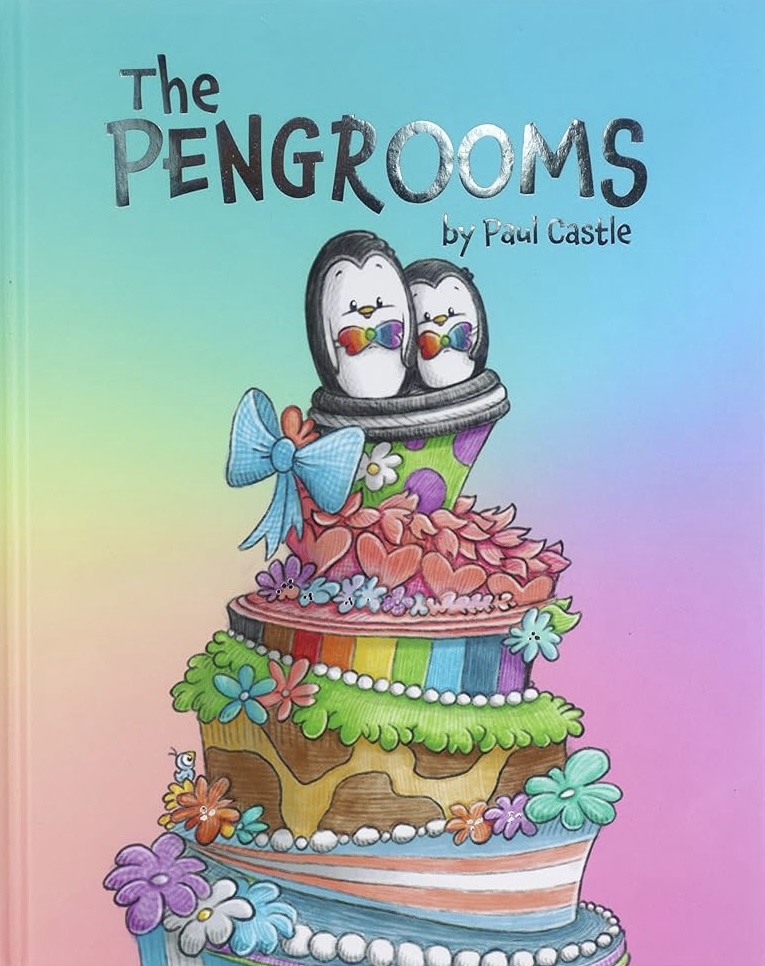
The Pengrooms by Paul Castle

★★★★★

I love the inclusivity of an LGBTQIA+ children's book, especially one that doesn't feel heavy-handed. This book is just a cute story about a pair of penguins - presumably both male based on the title - who make and deliver custom wedding cakes to other animal couples, culminating in the penguins' own wedding.

Some of the couples just happen to be same-gender: the flamingos are both grooms, the giraffes are both brides, and the genders of the mice are not specified. (I think the blue-haired mouse looks female and the pink-haired mouse looks male, which makes for a fun flipping of the "pink for girls, blue for boys" societal norm.)

The illustrations are ADORABLE. Absolutely adorable. If my kids were still little, I think I would really enjoy reading this to them and poring over the pictures, picking out my favorite details.

Just to note, I already knew about male-male penguin couples, and a bit of online research turned up references to male-male flamingo pairings and female-female giraffe pairings (though rare), so I appreciate that the animal couples are scientifically feasible.

Wednesday, September 24, 2025

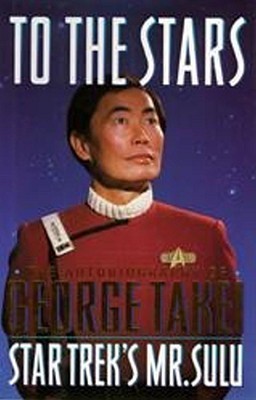
To the Stars by George Takei

★★★★★

I LOVE George Takei!

I actually first read this book back in college for a Japanese culture class. In fact, George Takei was a guest speaker! Anyway, I recently read George Takei's latest graphic novel, It Rhymes with Takei, and realized that the graphic novel borrows a lot from this book - so much so that I was inspired to re-read it (again). I wanted to piece together a fuller picture of his life, pulling together events from both books into a single timeline.

This memoir focuses first on his family growing up, then chronicles his acting career, as well as his political and civic activism. Even when I read this book 30 years ago, I remember noting that it never mentioned romantic relationships at all. Little did I know, back then, that the "journalist Brad Altman" whom he thanked in his acknowledgements, and who once visited him on location during a film shoot, was actually his significant other!

George Takei's writing is descriptive and engaging. The first part is invaluable in its telling of an American childhood spent inside the barbed-wire fences of Japanese American concentration camps. The strength and comfort George Takei drew from his parents - from Daddy and Mama - made my heart swell. Throughout the book, he periodically returned to his Japanese American roots as he recounted events from his life as an actor or as an activist. Sometimes, the two identities overlapped, as when he tirelessly advocated for Sulu's promotion, a fictional development that not only benefited his character, but also illustrated the "virile meritocracy" (p. 398) that was missing in real life as Asian Americans ran into "glass ceilings" that halted their professional advancement (now specifically termed "bamboo ceilings"). Inspired in part by his father's example, George Takei came to be extensively involved with progressive politics and civil rights activism. He has a life-long commitment to the ideals of "an American culture, strengthened by its diversity instead of balkanized by it" (p. 210), perfectly represented in Gene Roddenberry's vision for Star Trek: "infinite diversity in infinite combinations." (p. 405-406)

I wasn't even a fan of Star Trek when I read this book in college, but I'm a big fan now, and it was great fun reading all his behind-the-scenes stories about the TV series, the films, his friendships with his co-stars, and even his thoughts on the "new" The Next Generation series.

Friday, September 5, 2025

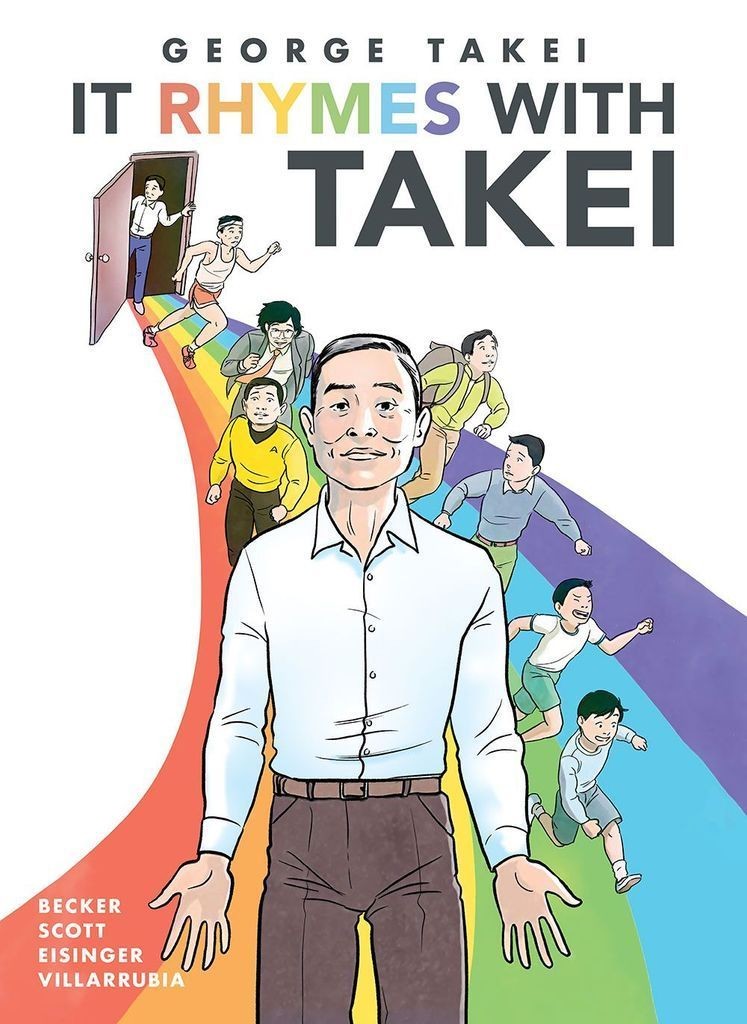
It Rhymes with Takei by George Takei

★★★★

Another great graphic memoir by George Takei. While I am a huge fan of George Takei, I'm not accustomed to reading graphic novels, so I admit this style of storytelling always takes some getting used to for me.

There are certainly LGBTQIA+ books for kids, but I would categorize this one as YA. There's nothing explicit, but the graphic novel medium was pretty effective at suggesting more extensive meaning behind a few chosen words, particularly when sexual activity was involved. Also, gay slurs do appear in the dialog.

George Takei didn't publicly come out as gay until he was 68 years old, and this graphic memoir explains why. Being gay was a constant source of fear and anxiety for him. He lived a tortured life, always in dread of being exposed, afraid that his sexuality becoming public would destroy his acting career. It may even have held him back from political aspirations. Sadly, some of his concerns were validated when a private coming out caused a distressing rift in his family.

It was comforting to read how George Takei's Buddhist upbringing helped him to accept himself and avoid the common pitfall of self-hatred. (p. 30-31) And I absolutely loved reading about how he met his husband Brad and how their relationship grew. 

In addition to chronicling George Takei's personal relationship with his own sexuality and his activism for the LGBTQIA+ community, the book also touched upon other issues such as immigration, politics, racial equity, and police brutality. In one poignant observation illustrating a common thread throughout history and current events, George Takei realized that "even my fellow Japanese Americans who had been exploited themselves, were nonetheless capable of exploiting others." (p. 37)

Bits and pieces reminded me of his 1994 autobiography To the Stars, which I read decades ago and can't remember too well anymore. I pulled out the book for a quick comparison and had fun discovering that some lines in the graphic memoir were taken from the autobiography almost verbatim! But even when telling of the same event, the perspectives presented sometimes differed between the books. For example, when recounting a college production called Portraits in Greasepaint, both books described it as a stepping stone on his career path because a casting director saw him in that performance and ended up casting him in a film; however, the graphic memoir also mentioned a romantic relationship with a fellow male cast member (p. 96), additional context that was not included in the 1994 book, which did not discuss his sexuality at all. I just might re-read To the Stars, to piece together the narratives from both books and mentally integrate them into a more complete picture. 

While overall a very inspiring book, I was a little conflicted about the ending. Much was made of how Biden defeated Trump in 2020, how the "worst policies of Trump's grievance government" were "repudiated", and how we, as a nation, "regained our deepest sense of [decency]." (p. 325) But then, the following pages acknowledged that now, in 2025, "once again, it is a heady time and a fraught time." (p. 328) The book is a timely reminder that progress is possible, and that "the strength of our nation is in its abundant diversity" (p. 333), yet there was no reckoning of what Trump's 2024 re-election says about America. 

Apropos nothing, it was surprisingly jarring to see some of the illustrations depicting the norms of an earlier time, e.g. George Takei riding a motorcycle without a helmet in 1964 (p. 128) and George Takei holding his infant nephew in his arms in the back seat of a car - no car seat! - in 1966. (p. 166)

Thursday, August 14, 2025

Wildland: The Making of America's Fury by Evan Osnos

★★★★½

If you're someone who looks around in utter disbelief at everything broken in America today - mass shootings, income inequality, inaction regarding the climate crisis, rising white nationalism and fascism, eroding democracy, etc., etc., etc. - and the fact that a lying, racist, xenophobic accused rapist and con man actually got elected - then re-elected despite felony convictions - and ask, "How did we get here?!?!!" then this book is for you. It tries to answer that question. More than anything else I've read, this book helped me to better understand Trump voters, even if I will never agree with them.

Evan Osnos provided a clear accounting of American politics spanning the terrorist attacks on September 11, 2001 - when people across the nation reaffirmed American ideals of diversity and the free exchange of ideas (p. 8) - to the insurrection at the Capitol 20 years later on January 6, 2021 - by which time "the country had spun so far out of balance that it had lost its center of gravity." (p. 13)

The author delved deep into the culture and mindset of 3 communities:

  • The money-centered elites with stratospheric wealth in Greenwich, CT who made money from money thanks to a lack of government regulations. (p. 30) Any discussion of the uber-wealthy naturally encompasses the seismic level of undue influence campaign mega-donors have on U.S. politics, and, by extension, the author detailed the damage done by the well-funded Mitch McConnell, "who operated on the plain belief that power mattered more than policy or principle." (p. 50)

  • Clarksburg, WV, where thriving local newspapers were once the cornerstone of democracy and community - until they were decimated by the growth of the internet, where news was scattered among entertainment and disinformation. (p. 67) Once the "Jewel of the Hills" (p. 56), Clarksburg fell victim to outside investors who bought political influence, allowing them to strip the land of valuable minerals, taking profits with them and leaving West Virginians to suffer the environmental harms. (p. 64-65)

  • The all-American city of Chicago, IL, which saw its African-American population grow to 33% after the Great Migration yet still endured racial segregation because of powerful discriminatory practices like redlining. (p. 78-79) Schools in Black neighborhoods were stunningly underfunded (p. 124), racial inequality was vast (p. 87), gang violence escalated (p. 118), and "nearly one third of Black men... entered the criminal justice system." (p. 131) Against this backdrop, we saw the beginning, and then the meteoric rise, of Barack Obama's political career.

  • Through intimate portraits of individuals in each community, Osnos illustrated how starkly different one's life can be depending on where you grow up, the color of your skin, and how much money you have. He drew a straight line from the Wall Street subprime mortgage schemes concocted by wealthy white Greenwich financiers to the dire economic plights of poor Black homeowners in Chicago (p. 134), and he compellingly weaved together the threads of a Clarksburg Marine with PTSD, the local community newspaper, and the opioid epidemic.

    On a national level, angry conservative commentators (p. 139) and changing demographics that predicted minorities eventually becoming the majority (p. 230-231) fueled racism and the right-wing, white nationalist politics of the Tea Party that gained traction during Obama's administration. (p. 142) White people began to fear for their privilege due to their perception that "white Americans faced imminent demise" (p. 235), which was unsubstantiated by actual statistics. (p. 237) (That these people settled on fighting to maintain social inequity to benefit themselves rather than fighting for social equity so that no one group was privileged over others is, IMHO, disgusting.)

    Osnos also discussed the uniquely American cult of "hyperindividualism" at the expense of community, evident in politics through declining influence of labor unions and increasingly regressive taxes. (p. 145) He wrote of how the U.S. was able to engage in 18 years of "the War on Terror" largely without accountability as there was no sense of collective sacrifice, the burden of casualties having fallen on less than 1% of the population (p. 147), and news reaching the others "too muddled by the peek-a-boo distractions of our time." (p. 148)

    In a book of eye-opening revelations, most shocking to me was "elite survivalism". The book described Silicon Valley billionaires who have private planes and underground bunkers for the specific purpose of having a safe haven not just for the impending doom of climate change, but also in case angry, unemployed masses break out the pitchforks for the people who brought forth the technological innovations (mostly fears around AI) that took away their jobs. (p. 285-287) (Again, that so many of the tech elite look to protect themselves instead of using their billions to address climate change or social safety nets or ethical use and the consequences of AI is, again, IMHO, obscene.)

    Osnos occasionally takes a step back and outlines how some of the factors stirring the pot of unrest began long before September 11, 2001. Capitalism amplified inequality (p. 99), and corporate PACs and lobbyists in the 1980s brought forth a wild swing towards pro-business, anti-consumer policies. (p. 170) Osnos connected the dots between libertarian Reagan Republicans and modern-day Trumpism, both built on "a coalition of conservative elites and the white working class." (p. 172) He further described how pure capitalism led to the growth of the gun industry: as hunting became less popular in the 1970s, among other marketing schemes, gun industry trade publications began targeting elementary school children in efforts to expand their customer base. (p. 263-266)

    By the time Osnos addressed the first Trump presidency directly, it was clear the administration's actions were not the result of incompetence but rather, the goal was to actively undermine and dismantle federal agencies that stood in the way of capitalism. (p. 292-293) Steve Bannon, Trump's campaign chief, called it the "deconstruction of the administrative state" (p. 287), but more than that, the Trump administration believed in "empowering it [the federal government] in the name of private interests." (p. 294)

    As depressing as the facts are, it was encouraging that Osnos was able to instill a sense of hope by highlighting progressive activists in all 3 locations of Greenwich, Clarksburg, and Chicago.

    To close, here are some poignant, insightful quotes that struck me:

  • Regarding the connection between income inequality and being disenfranchised: "Poverty can be as much about power as it is about possessions; they hadn't felt poor until someone came along and showed them how little power they really had." (p. 189)

  • A quote by Samuel Popkin, a political scientist, that succinctly explains the appeal of Trump: "The more complicated the problem, the simpler the demands become. When people get frustrated and irritated, they want to cut the Gordian knot." (p. 282)

  • A warning issued in 1992 by Francis Fukuyama, another political scientist: After the Cold War, people might "struggle for the sake of struggle... out of a certain boredom... And if the greater part of the world in which they live is characterized by peaceful and prosperous liberal democracy, then they will struggle against that peace and prosperity, and against democracy." (p. 316)

  • Chicago community organizer Jahmal Cole in the midst of George Floyd protests in 2020: "We wore a hoodie for Trayvon, we took a knee for Philando, we held our breath for Eric, we walked for Laquan, but we're done. Enough is enough... We're rightly pissed off." (p. 368)

  • Abraham Lincoln's secretary of state, William Seward, describing the Civil War: "There was always just enough virtue in this republic to save it; sometimes none to spare." (p. 406)

  • Oh, one last thing. My rating is just short of 5 stars because of a misleading line. Early in the book, there’s a passing reference to "a minor [constitutional] amendment in 1992, to raise congressional salaries." (p. 51) The wording made it sound like the purpose of the amendment was to raise congressional salaries, but what it actually did was require an election before any change in congressional salaries could take effect. It just made me wonder if maybe there might be other ambiguous wording - intentional or not - that I didn't catch.

    Wednesday, August 13, 2025

    Jane Austen Roundup

    I have now read every Jane Austen novel and watched every Jane Austen screen adaptation I could find!

    Here's a list of her books in order of my preference, and under each book, a list of all the screen adaptations I watched, in order of my preference. The links take you to my "reviews" - and I put that in quotes because I know I didn't actually review each movie/mini-series entirely on its own merits; how well it represented the book was a large factor in how much I liked it.

    1. Pride and Prejudice ★★★★★
      1. 1995 BBC Mini-Series with Colin Firth ★★★★★
      2. 1980 BBC Mini-Series ★★★★½
      3. 1940 Film with Laurence Olivier ★★★★
      4. 2005 Film with Keira Knightley ★★★

    2. Emma ★★★★★
      1. 1996 TV Movie with Kate Beckinsale ★★★★★
      2. 2020 Film ★★★★
      3. 1996 Film with Gwenyth Paltrow ★★★★
      4. 2009 BBC Mini-Series ★★★½
      5. 1972 BBC Mini-Series ★★★½

    3. Mansfield Park ★★★★½
      1. 1983 BBC Mini-Series ★★★★
      2. 2007 TV Movie ★★★
      3. 1999 Film ★★★

    4. Sense & Sensibility ★★★★
      1. 1995 Film with Emma Thompson and Kate Winslet ★★★★★
      2. 1981 BBC Mini-Series ★★★★
      3. 2008 BBC Mini-Series ★★★
      4. 1971 BBC Mini-Series ★★★

    5. Northanger Abbey ★★★★
      1. 2007 TV Movie ★★★★
      2. 1987 TV Movie ★★½

    6. Persuasion ★★★★
      1. 1971 BBC Mini-Series ★★★★★
      2. 1995 TV Movie ★★★★
      3. 2007 TV Movie ★★★
      4. 2022 Netflix Movie with Dakota Johnson ★★★

    7. Lady Susan, The Watsons, Sanditon ★★★

      The book Emma was a very close second behind Pride and Prejudice. I found Emma overall more entertaining, but Pride and Prejudice did have more wit, though less humor. And the fact that Emma was a bit of a snob - a charming and endearing snob, but a snob nonetheless - was a little off-putting sometimes.

      I also really enjoyed Mansfield Park, and I don't know if it's really fair to dock it half a star just because it wasn't quite as entertaining. I thought its characters were the most complex of all Jane Austen novels.

      And even though Persuasion is listed last, and given the place of "least favored Jane Austen novel", that's not to say that I didn't enjoy it. It is, after all, still rated four stars!

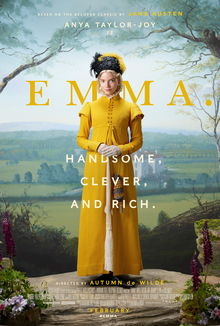
      Emma. (2020)

      ★★★★

      I happened to stumble upon this adaptation and now I wonder how many others I may have missed in the years since my Jane Austen fixation!

      At this point, I'm afraid I can't remember many details from the book anymore, so I can't do my usual book-to-screen comparison.

      I'll just say, I very much enjoyed this movie's humor and light-heartedness, as well as the elaborate costuming and gorgeous, beautifully-colored sets - and pastries! It was a lot of fun to watch. The servants especially were surprisingly comical.

      Emma was well-cast, but Mr. Knightley being light-haired threw me off, I just always imagine him to be dark-haired. I really liked the casting of Harriet; she was simpler and lower class than Emma but not made out to be frumpy. Meanwhile, Frank Churchill came across kind of sleazy, I wasn't too fond of him, and the Jane Fairfax character was not fleshed out enough (which I know is harder to do in movie adaptations than in mini-series).

      Wednesday, March 12, 2025

      Still Just a Geek: An Annotated Memoir by Wil Wheaton

      ★★★★★

      I'm late to the party as a Wil Wheaton fan, but I'm here now! I loved him on The Big Bang Theory, and I'm also a late-in-life fan of Star Trek, mostly TNG, DS9, Voyager, and Picard. Now, he's one of only a handful of celebrities who helps to normalize masking by posting masked selfies on social media, and as a covid-aware person, I love him for that.

      You have to go into this book with the appropriate expectations: It's not a typical memoir; it's a collection of blog posts first published in book form in 2004, with a lot of footnotes written in 2021. Reading this book means constantly jumping back and forth between different time periods. I found myself inadvertently applying 2021 Wil's perspective to the entire text by default, which was confusing, and had to consciously remind myself to use 2004 Wil's mindset when reading content from the original book, and to switch again to Even Younger Wil's frame of mind when reading blog posts written even earlier. Some of the annotations were just injections of humor, but others provided a lot more context and were really interesting, particularly when he noted that something that was supremely consequential for Younger Wil turned out to be just a blip in the trajectory of his life.

      Wil Wheaton tells of how he grew into his own skin in his 20s, and then continued to grow personally and professionally in his 30s and 40s. He tells his story well, even when presented in this sort of choppy manner of blog posts and annotations. I like his sense of humor, and as a fellow Gen X-er, I enjoyed his references to 80s and 90s pop culture. He is thoughtful and relatable (at least he was to me, a fellow geek), and I appreciated all he shared about Star Trek, from his personal relationship with his character Wesley Crusher (whom he came to embrace, after a bit of a rocky road) to his interactions with other people from the series. In case it matters to you in a knowing-what-to-expect kind of way, he swears liberally.

      Wil Wheaton makes abundantly clear, multiple times in the book, that some of what was published in 2004 was "gross" and "hateful". (p. xix) That he was willing to revisit and examine his previous writings that are now considered shameful (due to misogyny, ableism, etc.), and engage in a public exercise of self-reflection and accountability, shows just how much he (and society in general) has grown and learned in the intervening years. I was truly impressed by his honesty and vulnerability. And it's just good to see a cishet white male put into practice Maya Angelou's quote, "Do the best you can until you know better. Then when you know better, do better."

      I also give Wil Wheaton a lot of credit for the way he openly talked about his depression and anxiety, and the abuse he suffered at the hands of his parents. He modeled self-respect and acceptance, and in doing so, he helps to lessen some of the stigma surrounding mental illness, as well as give strength to others who may be victims of abuse.

      I'll admit that my 5-star rating may seem generous in light of the somewhat fragmented reading experience, but mostly I just really enjoyed the content. It was fun!

      Monday, January 27, 2025

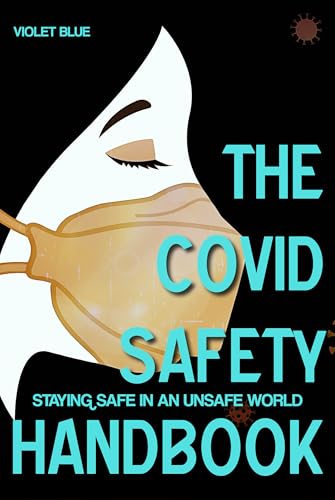
      The Covid Safety Handbook: Staying Safe In An Unsafe World by Violet Blue

      ★★★½

      All quotes refer to page numbers in the digital PDF version that I read.

      The writing is very casual. At times, the word choice sounded like conversational banter. 

      This book was written by and for the covid-cautious community; if you're a member of this group, you will absolutely feel validated and reassured.

      If you're not already sympathetic to the concerns of this group, then much of the content will seem over-the-top. Before reading this book, I had hoped it could serve as a tool for helping to convince non-covid-cautious readers to take covid more seriously. The tone, however, is not one of detached science, nor of persuasive argument; rather, the need to take covid precautions is treated as a given. The book opens with a brief rundown of the many known covid-related health risks (there's a more in-depth discussion of long covid later in the book), but ultimately, The Covid Safety Handbook is geared towards people who are already covid-aware, who want to learn more about ways to better mitigate covid risks, and who welcome suggestions on how to maintain personal boundaries and navigate situations in which their covid-cautiousness conflicts with a society that minimizes or ignores covid.

      The Covid Safety Handbook is chock-full of solid information about mitigation measures and ideas for how to manage risk assessment and implement precautions in various scenarios. I consider myself well-informed on covid-related matters, and still I learned new things. I appreciate that the book conveys a sense of gradation; covid-caution is not "all or nothing", and some protection is better than none. I'll also mention that, despite being the most covid-cautious person among my own social circles, I have applied only a portion of the strategies described in this book.

      The text is peppered with footnotes; if inclined, readers can jump to the extensive References and Resources section and go directly to a respected source and learn more. (My digital copy even included hyperlinks for one-click access to articles.) That said, occasionally I wished for even more references; for example, there was no footnote when covid was referred to as a "neurotropic vasculitis with a minimum 10% chance of making you bed-bound potentially for life" (p. 41), which sounds exaggerated. Similarly, quotes from everyday covid-cautious people were encouraging to read, yet when attributed only to "A" or "LD" and "LC" (p. 27, 70, respectively, etc.), it made me wonder, Who are these people? If these quotes came from an online forum or social media post, a reference to the forum, or a screen shot of the comment, perhaps with a date stamp, would have added credibility.

      Though thorough in its scope, the book often felt "mile wide, inch deep", which is understandably consistent with its "handbook" designation; I suspect the author made a conscious decision to not delve too deeply into explanations of why or how things work in order to keep the content more high-level and accessible for the average reader. (Plus, as mentioned, further details are available by following reference links.) At times, though, I wished at least for more accurate wording, for example, I would have liked to see the words "rapid antigen test" to differentiate at-home tests from PCR lab tests in the bullet point, "You’re contagious if your test is still positive." (p. 29) I also noticed a number of editing mistakes.

      My rating of 3.5 stars is mainly due to the grievances mentioned; I felt I had to lower my otherwise 4-star rating, as reading this book was overall a positive, helpful experience for me. I especially appreciated the many valuable, up-to-date resources, and the latter chapters that addressed the emotional and psychological toll of being covid-cautious in a covid-minimizing world.

      Saturday, December 14, 2024

      The Message by Ta-Nehisi Coates

      ★★★★★

      For me, Ta-Nehisi Coates is not easy to read. I'm generally a slow reader to begin with, and the less conversational the writing, the longer it takes me to read it. Ta-Nehisi Coates writes with a kind of lyricism; he is succinct, but not exactly straightforward.

      This book is a reflection on writing. Coates believes that "this tradition of writing, of drawing out a common humanity, is indispensable to our future, if only because what must be cultivated and cared for must first be seen." (p. 16) Through writing, "we are charged with examining the stories we have been told, and how they undergird the politics we have accepted, and then telling new stories ourselves." (p. 19) He addresses the book to his students, tasking young writers with "nothing less than doing their part to save the world." (p. 20)

      The Message is a must-read for its ability to open a reader's eyes to the ways in which our beliefs, our perspectives, our very understanding of the world around us, are shaped not only by our own thoughts and the facts at our disposal, but also by the carefully curated narratives we see and hear in the news and other cultural mediums all around us. The job of a writer is to tell people's stories, and it's up to us as readers to seek out what is not automatically presented to us - and to question why some accounts are readily available and others are not.

      Much of the book reads like a memoir, with Coates sharing personal experiences and meditations, and other parts like a travelogue, as Coates recounts his visits to Senegal, South Carolina, and Palestine.

      Describing his time in Dakar, Senegal, Coates writes about the deep poignancy of traveling to Africa for the first time, how he had "come back" (p. 44) to the home of his enslaved ancestors. He thinks of his "exponential grandmothers taken from this side of the world and... their frustrated dreams of getting back home... [and] the home they tried to make on the other side, despite it all." (p. 44) He reflects that only by traveling and experiencing "the unique interaction between that world and your consciousness" (p. 44) are one's own fears and doubts revealed.

      In Chapin, South Carolina, Coates visits a high school English teacher forced to defend her curriculum and job against students and parents who want to ban his book, Between the World and Me. In getting to know Mary Wood, and while attending a local school board meeting in her support, he twice "heard of a reading group... as the epicenter of political disruption." (p. 98) To affect change, one must first be able to "imagine that new policies are possible. And now... some people... had, through the work of Black writers, begun that work of imagining." (p. 99)

      While touring Palestine, Coates witnesses the "separate and unequal nature of Israeli rule [that] is both intense and omnipresent" (p. 127), "where rule by the ballot for some and the bullet for others was policy." (p. 135) At first he drew connections to Jim Crow segregation, then felt compelled "to describe... [Palestine], not as a satellite of [his] old world but as a world in and of itself." (p. 146) He calls out the journalists who claim to disinterestedly present "both sides" but who "are playing god - it is the journalists who decide which sides are legitimate and which are not... And this power is an extension of the power of other curators of the culture - network execs, producers, publishers - whose core job is deciding which stories get told and which do not." (p. 148) He calls for Palestinian voices, insisting that "[i]f Palestinians are to be truly seen, it will be through stories woven by their own hands." (p. 232)

      This book offers many profound and thought-provoking ideas, but one quote sticks with me. At the school board meeting in South Carolina, a man speaking against the book ban called attention to the optics a ban would create, feeding into negative stereotypes of Southern whiteness. Coates notes, "This may seem self-interested, a stance taken more to avoid a stigma than to break an arrangement of power. Given the kind of loud virtue signaling that followed 2020, I understand the question. But virtues should be signaled, and the signalers should act to make their virtues manifest." (p. 102)