Showing posts with label multicultural. Show all posts

Wednesday, August 26, 2026

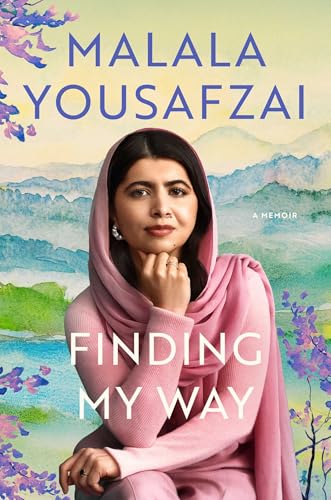
Finding My Way: A Memoir by Malala Yousafzai

★★★★

I'm a fan of Malala, which certainly made me partial to liking this book.

As far as I can tell, Malala has shown incredible grace and poise growing up in the spotlight, particularly considering she had a narrative imposed upon her when the Taliban shot her. Already a Nobel Peace Prize laureate, she was not your typical college freshman. But of course, in many ways, she was just another student, starting college like all other regular people, eager to make new friends and have new experiences - only she had to do it all in front of British Secret Sevice officers while dodging tabloid photographers.

Still, regular person or not, she was going through college - and life - under extraordinary circumstances. Even when falling behind in her studies, she was compelled to continue working (by giving speeches all over the world) during the school term not just to help her causes, but because she was actually the sole breadwinner for her entire family!! And when she finally extricated herself from work obligations during the school year and brought up her grades, PTSD from her shooting set her back again. (As an aside, I did wonder, where was her security team when she had her first alarming PTSD episode?)

We follow Malala's personal growth as she came to terms with her own identity as a native Pakistani who had grown comfortable with the English ways of her adopted country while continuing to feel a deep, longing connection with her home in Swat Valley. I teared up when she told of her first time returning to Pakistan since being forced to leave when she was shot.

Considering her role as a world-renowned activist, her personal life had been surprisingly sheltered - she had never eaten at a McDonald's before college! (p. 34) - and some of her friends teased her for being gullible. She was a good sport and rather matter-of-fact about her naivete; in fact, she seemed all the more self-confident in the way she showed no embarrassment or self-consciousness about lacking the common knowledge and experiences of her peers. She exhibited the same straightforward directness when she described her mental health issues; though cultural stigma against mental health care likely delayed her access to treatment, there was no shame in her account, only a clear, steady desire to find some answers and figure out how to help herself.

Though most of the book centered on Malala's college experiences, her mental health, and her relationship with her future husband, there is a remarkable section towards the end when she recounted events during the Taliban takeover of Afghanistan when the U.S. military withdrew. Many Malala Fund partners were in Afghanistan, and in her efforts to help them evacuate, she reached out to all the world leaders who had been happy to stand beside her for photo ops. Notably, none of the men stepped up. "Women, on the other hand, responded immediately, answering my calls and jumping into action." (p. 264)

An uplifting read, and I put down this book an even bigger fan than when I started it.

Wednesday, May 6, 2026

Water Mirror Echo: Bruce Lee and the Making of Asian America by Jeff Chang

★★★★★

I find it amusing that this is the second book in a row that I've read with a title following the format "[List of Words]: [Famous Chinese Person] and the Making of [Asian Thing]", but that is neither here nor there. (The previous book being Chop Fry Watch Learn: Fu Pei-Mei and the Making of Modern Chinese Food.)

At times, the writing in Water Mirror Echo felt lofty, but then, Bruce Lee is a lofty subject. From our modern-day perspective, Bruce Lee is first and foremost a legend, and so it makes sense to start there, using his stardom as the foundation upon which we can start to get to know him in a way that "returns him to a human scale." (p. 6)

This is my first biography of Bruce Lee, and even without having read any others, it's clear Water Mirror Echo is a definitive source. This book is not just an accounting of Bruce Lee's life or Bruce Lee's teachings; it additionally places Bruce Lee into the context of Asian America, examining how he "navigated fascination and revulsion with 'the Oriental,' a corpus of distorted images that limited Asian American opportunity and mobility." (p. 5) The greater context provided for Bruce Lee's fight with Wong Jack Man was especially interesting (Ch. 22-23), as was the background on the racism of Hollywood and the common use of yellowface at the time when Bruce Lee came onto the scene. (Ch. 24-26) Bruce Lee had to fight for his own visibility and for the respectful representation of gung fu on screen, and in doing so helped bring visibility and validation to Asian America, a community just beginning to define itself towards the end of his life and around the time of his death. (p. 6)

All that said, of course the book starts at the beginning, and the early chapters quickly drew me in with a full, fascinating account of Bruce Lee's childhood growing up in Hong Kong, including important political and cultural context. Bruce Lee lived a life of opposing yet complementary existences - like the yin-yang symbol he adopted for the logo of his Jun Fan Gung Fu Institute - and we follow his evolution from child movie star and teen cha-cha heartthrob / street thug in Hong Kong to philosophical college student / local gung fu teacher in Seattle and Oakland to martial arts star / struggling Hollywood actor in Los Angeles. Even when his path came full circle and he achieved kung fu movie star fame in Hong Kong, his constant travels back and forth across the Pacific meant he had "to remember which side of the ocean I'm on, and whether I'm the superstar or the exotic Oriental support player." (p. 353)

When Bruce Lee finally landed a starring role in a film co-produced by a Hollywood studio - Enter the Dragon - he agonized over the script and the way Asians were portrayed; the American studio executives and writers offered up Orientalism and cared only about western audiences, but Bruce was acutely sensitive to how scenes would play out for Asian audiences. A representative from the co-production company in Hong Kong observed that Bruce "had to deal with the audiences who would be criticizing him and scrutinizing him. And so the weight was on him." (p. 405-408) Even on set, he was a bridge; while the American director and producers "yelled and cursed" (p. 409) at the Chinese crew, Bruce embodied gentle authority: "He took time to recognize the carpenters and plasterers. He ate with the crew members, stuntmen, and extras. He made sure that they received the same kind of box meal as him." (p. 410)

I especially appreciated that Jeff Chang rounded out Bruce's story by also giving us complex, fleshed-out portraits of those who profoundly influenced him and those he profoundly influenced, e.g., his father, Ruby Chow -- his primary guardian after he arrived in the U.S., who, I learned, was also writer Frank Chin's godmother! (p. 86) -- Amy Sanbo (his college girlfriend), and many, many fellow martial artists and students, including Kareem Abdul-Jabbar.

I enjoyed this book immensely, but towards the end, when the narrative reached the 1970s, just as Bruce Lee was beginning his ascent to international stardom, I found myself picking up the book with a heavy heart, and reading slowly with apprehension. I knew what was coming, and the anticipation of tragedy and grief gave poignancy to everything.

Random note: I read this book so carefully that a singular discrepancy stood out to me. On page 101, Takauki "Taky" Kimura is "sixteen years Bruce's senior", a detail repeated on page 102 where it clearly says "Takauki Kimura was born in 1924." But then later, on page 144, James Yimm Lee is reported to have been born in 1920, "the same year as Ruby Chow and Taky Kimura."

A comment on formatting: The book has many short chapters with many section breaks, making it super readable for someone like me who tends to read in short intervals. Also, I appreciated the photos printed in-line with the text. (Having to flip back and forth to a collection of photos in the middle of a book is a pet peeve of mine.)

Finally, a note to self: On pages 167-168, in a letter to Linda, there's an excerpt of a writing by 19th century Unitarian minister William Henry Channing called "My Symphony" which I love and will strive to adopt as my own life philosophy: "To live content with small means; to seek elegance rather than luxury, and refinement rather than fashion, to be worthy, not respectable, and wealthy, not rich; to study hard, think quietly, talk gently, act frankly; to bear all cheerfully, do all bravely, await occasions, hurry never."

Thursday, February 19, 2026

Chop Fry Watch Learn: Fu Pei-Mei and the Making of Modern Chinese Food by Michelle T. King

★★★★★

The back flap of the book's dust jacket says Fu Pei-mei's cookbooks "have become beloved emblems of cultural memory, passed from parent to child, wherever diasporic Chinese have landed." Indeed, like the author, I am of that particular slice of Asian America that can characterize myself as "Chinese American by way of Taiwan" (p. xxii), and I remember my immigrant mom having all 3 cookbooks, though only the first in the series was heavily used, with stains and handwritten notes. Consequently, I went into this book - a book that shines a light on the food-centered nostalgia of my childhood - feeling pre-disposed to adore it. (Thanks to my niece for recognizing my potential interest and gifting me this book!)

Michelle T. King offers up Chop Fry Watch Learn as a "history of Chinese food as seen through Fu Pei-mei's life and career... in all its global, gendered, political, and technological dimensions... [reflecting] multiple generations of families, connected across oceans by an abiding love of Chinese food." (p. xxi)

I especially appreciated the thread of discourse describing and explaining the use of the label "Taiwanese", which has evolved over the decades and has noticeably shifted in my own lifetime and experiences. (p. 15-16, 191) Equally fascinating to me was Fu Pe-mei's influence in worldwide gastrodiplomacy on behalf of the Republic of China, distinct from the People's Republic of China, a delicate, complex, and nuanced effort that continues today with those wishing to promote Taiwan and Taiwanese food as distinct from China and Chinese food. (p. 150-153, 186-187, 193) (Indeed, I was reminded of a recent trip to Taiwan when we had a delicious banquet-style dinner of what I would have called "Chinese" dishes but what the restaurant advertised as "Mandarin".) The author doesn't shy away from exploring current, less flattering, even scornful public perception of Fu Pei-mei, as seen in her examination of a TV series based on Fu's life that was not well received by those who thought it "only reinforced the hierarchical legacy of mainlander-Taiwanese relations." (p. 182)

I enjoyed the "East vs. West" contrast between Fu Pei-mei's general philosophy of cooking as "an act of energetic devotion to the family" (p. 28) and that of her contemporary Julia Child, who wrote that her book Mastering the Art of French Cooking was for those "who can be unconcerned on occasion with... children's meals, the parent-chauffeur-den mother syndrome or anything else which might interfere with the enjoyment of producing something wonderful to eat." (p. 29)

I loved this book for its presentation of modern Taiwanese history as seen through the lens of cooking - including Fu Pei-mei's TV shows, cookbooks, cooking classes, and their relevance to overseas Chinese home cooks and immigrant communities - and especially for its personal connection to my own family history, allowing me to see familiar dishes and even my own mother in a larger context. I'm inspired to break out those cookbooks and learn a new dish or two.

Wednesday, September 24, 2025

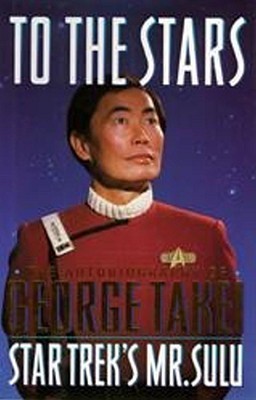
To the Stars by George Takei

★★★★★

I LOVE George Takei!

I actually first read this book back in college for a Japanese culture class. In fact, George Takei was a guest speaker! Anyway, I recently read George Takei's latest graphic novel, It Rhymes with Takei, and realized that the graphic novel borrows a lot from this book - so much so that I was inspired to re-read it (again). I wanted to piece together a fuller picture of his life, pulling together events from both books into a single timeline.

This memoir focuses first on his family growing up, then chronicles his acting career, as well as his political and civic activism. Even when I read this book 30 years ago, I remember noting that it never mentioned romantic relationships at all. Little did I know, back then, that the "journalist Brad Altman" whom he thanked in his acknowledgements, and who once visited him on location during a film shoot, was actually his significant other!

George Takei's writing is descriptive and engaging. The first part is invaluable in its telling of an American childhood spent inside the barbed-wire fences of Japanese American concentration camps. The strength and comfort George Takei drew from his parents - from Daddy and Mama - made my heart swell. Throughout the book, he periodically returned to his Japanese American roots as he recounted events from his life as an actor or as an activist. Sometimes, the two identities overlapped, as when he tirelessly advocated for Sulu's promotion, a fictional development that not only benefited his character, but also illustrated the "virile meritocracy" (p. 398) that was missing in real life as Asian Americans ran into "glass ceilings" that halted their professional advancement (now specifically termed "bamboo ceilings"). Inspired in part by his father's example, George Takei came to be extensively involved with progressive politics and civil rights activism. He has a life-long commitment to the ideals of "an American culture, strengthened by its diversity instead of balkanized by it" (p. 210), perfectly represented in Gene Roddenberry's vision for Star Trek: "infinite diversity in infinite combinations." (p. 405-406)

I wasn't even a fan of Star Trek when I read this book in college, but I'm a big fan now, and it was great fun reading all his behind-the-scenes stories about the TV series, the films, his friendships with his co-stars, and even his thoughts on the "new" The Next Generation series.

Friday, September 5, 2025

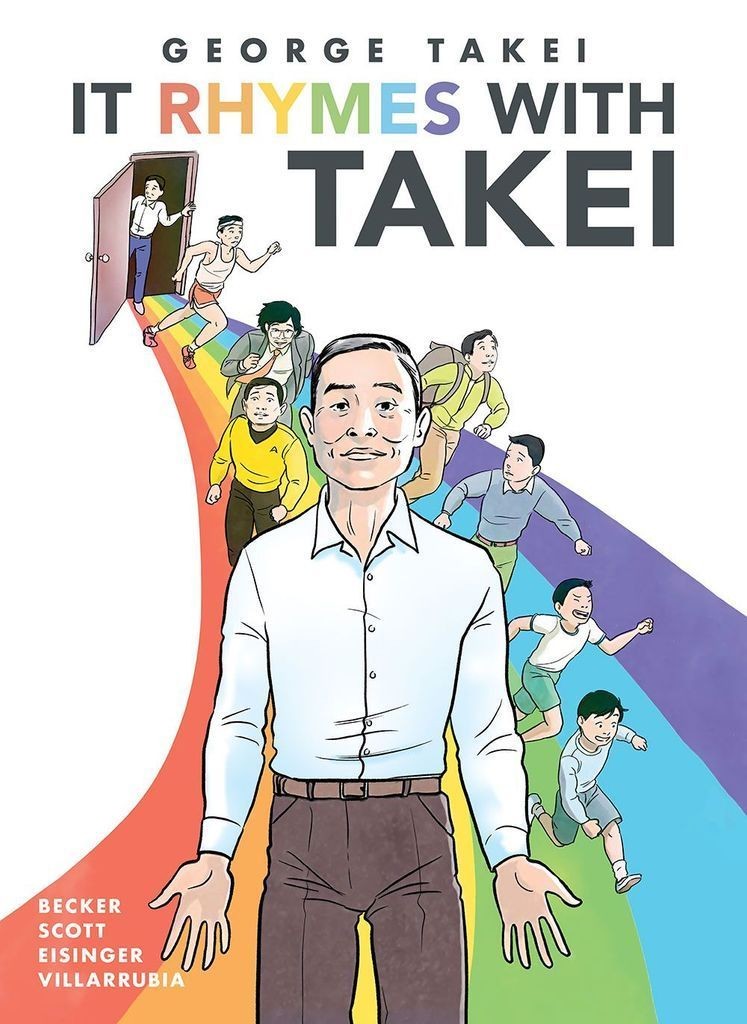
It Rhymes with Takei by George Takei

★★★★

Another great graphic memoir by George Takei. While I am a huge fan of George Takei, I'm not accustomed to reading graphic novels, so I admit this style of storytelling always takes some getting used to for me.

There are certainly LGBTQIA+ books for kids, but I would categorize this one as YA. There's nothing explicit, but the graphic novel medium was pretty effective at suggesting more extensive meaning behind a few chosen words, particularly when sexual activity was involved. Also, gay slurs do appear in the dialog.

George Takei didn't publicly come out as gay until he was 68 years old, and this graphic memoir explains why. Being gay was a constant source of fear and anxiety for him. He lived a tortured life, always in dread of being exposed, afraid that his sexuality becoming public would destroy his acting career. It may even have held him back from political aspirations. Sadly, some of his concerns were validated when a private coming out caused a distressing rift in his family.

It was comforting to read how George Takei's Buddhist upbringing helped him to accept himself and avoid the common pitfall of self-hatred. (p. 30-31) And I absolutely loved reading about how he met his husband Brad and how their relationship grew. 

In addition to chronicling George Takei's personal relationship with his own sexuality and his activism for the LGBTQIA+ community, the book also touched upon other issues such as immigration, politics, racial equity, and police brutality. In one poignant observation illustrating a common thread throughout history and current events, George Takei realized that "even my fellow Japanese Americans who had been exploited themselves, were nonetheless capable of exploiting others." (p. 37)

Bits and pieces reminded me of his 1994 autobiography To the Stars, which I read decades ago and can't remember too well anymore. I pulled out the book for a quick comparison and had fun discovering that some lines in the graphic memoir were taken from the autobiography almost verbatim! But even when telling of the same event, the perspectives presented sometimes differed between the books. For example, when recounting a college production called Portraits in Greasepaint, both books described it as a stepping stone on his career path because a casting director saw him in that performance and ended up casting him in a film; however, the graphic memoir also mentioned a romantic relationship with a fellow male cast member (p. 96), additional context that was not included in the 1994 book, which did not discuss his sexuality at all. I just might re-read To the Stars, to piece together the narratives from both books and mentally integrate them into a more complete picture. 

While overall a very inspiring book, I was a little conflicted about the ending. Much was made of how Biden defeated Trump in 2020, how the "worst policies of Trump's grievance government" were "repudiated", and how we, as a nation, "regained our deepest sense of [decency]." (p. 325) But then, the following pages acknowledged that now, in 2025, "once again, it is a heady time and a fraught time." (p. 328) The book is a timely reminder that progress is possible, and that "the strength of our nation is in its abundant diversity" (p. 333), yet there was no reckoning of what Trump's 2024 re-election says about America. 

Apropos nothing, it was surprisingly jarring to see some of the illustrations depicting the norms of an earlier time, e.g. George Takei riding a motorcycle without a helmet in 1964 (p. 128) and George Takei holding his infant nephew in his arms in the back seat of a car - no car seat! - in 1966. (p. 166)

Saturday, December 14, 2024

The Message by Ta-Nehisi Coates

★★★★★

For me, Ta-Nehisi Coates is not easy to read. I'm generally a slow reader to begin with, and the less conversational the writing, the longer it takes me to read it. Ta-Nehisi Coates writes with a kind of lyricism; he is succinct, but not exactly straightforward.

This book is a reflection on writing. Coates believes that "this tradition of writing, of drawing out a common humanity, is indispensable to our future, if only because what must be cultivated and cared for must first be seen." (p. 16) Through writing, "we are charged with examining the stories we have been told, and how they undergird the politics we have accepted, and then telling new stories ourselves." (p. 19) He addresses the book to his students, tasking young writers with "nothing less than doing their part to save the world." (p. 20)

The Message is a must-read for its ability to open a reader's eyes to the ways in which our beliefs, our perspectives, our very understanding of the world around us, are shaped not only by our own thoughts and the facts at our disposal, but also by the carefully curated narratives we see and hear in the news and other cultural mediums all around us. The job of a writer is to tell people's stories, and it's up to us as readers to seek out what is not automatically presented to us - and to question why some accounts are readily available and others are not.

Much of the book reads like a memoir, with Coates sharing personal experiences and meditations, and other parts like a travelogue, as Coates recounts his visits to Senegal, South Carolina, and Palestine.

Describing his time in Dakar, Senegal, Coates writes about the deep poignancy of traveling to Africa for the first time, how he had "come back" (p. 44) to the home of his enslaved ancestors. He thinks of his "exponential grandmothers taken from this side of the world and... their frustrated dreams of getting back home... [and] the home they tried to make on the other side, despite it all." (p. 44) He reflects that only by traveling and experiencing "the unique interaction between that world and your consciousness" (p. 44) are one's own fears and doubts revealed.

In Chapin, South Carolina, Coates visits a high school English teacher forced to defend her curriculum and job against students and parents who want to ban his book, Between the World and Me. In getting to know Mary Wood, and while attending a local school board meeting in her support, he twice "heard of a reading group... as the epicenter of political disruption." (p. 98) To affect change, one must first be able to "imagine that new policies are possible. And now... some people... had, through the work of Black writers, begun that work of imagining." (p. 99)

While touring Palestine, Coates witnesses the "separate and unequal nature of Israeli rule [that] is both intense and omnipresent" (p. 127), "where rule by the ballot for some and the bullet for others was policy." (p. 135) At first he drew connections to Jim Crow segregation, then felt compelled "to describe... [Palestine], not as a satellite of [his] old world but as a world in and of itself." (p. 146) He calls out the journalists who claim to disinterestedly present "both sides" but who "are playing god - it is the journalists who decide which sides are legitimate and which are not... And this power is an extension of the power of other curators of the culture - network execs, producers, publishers - whose core job is deciding which stories get told and which do not." (p. 148) He calls for Palestinian voices, insisting that "[i]f Palestinians are to be truly seen, it will be through stories woven by their own hands." (p. 232)

This book offers many profound and thought-provoking ideas, but one quote sticks with me. At the school board meeting in South Carolina, a man speaking against the book ban called attention to the optics a ban would create, feeding into negative stereotypes of Southern whiteness. Coates notes, "This may seem self-interested, a stance taken more to avoid a stigma than to break an arrangement of power. Given the kind of loud virtue signaling that followed 2020, I understand the question. But virtues should be signaled, and the signalers should act to make their virtues manifest." (p. 102)

Monday, October 28, 2024

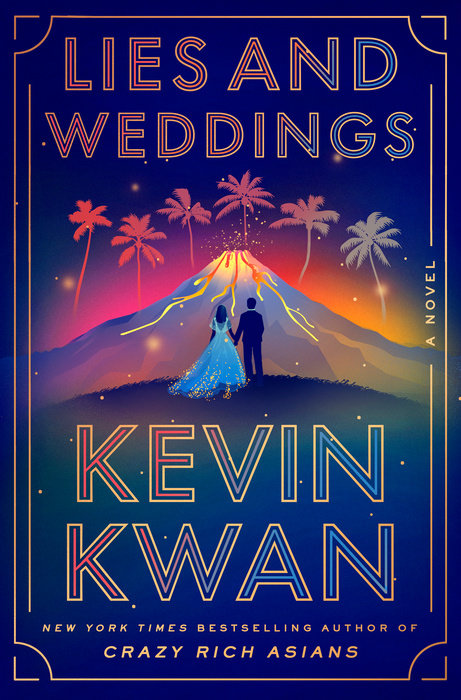
Lies and Weddings by Kevin Kwan

★★★★

*** WARNING!! This review contains spoilers!! ***

An entertaining read with short episodic chapters. Very easy to imagine this book as a hit streaming TV series! I think being a fan of the British TV show Midsomer Murders, with all their episodes featuring English country estates, helped me to enjoy this book even more, allowing me to easily imagine Greshamsbury Hall and the surrounding village.

Once again, Kwan brings us into the world of the uber rich, only this time, it's not just Asians in Asia, but also half-Asians as well as English landed aristocracy, international investors, and Persian-Iranian-Americans drowning in opulence in Hawaii, Morocco, Los Angeles, and Venice. I kept my phone handy to search up words and references I didn't recognize, from fashion and architecture terminology to famous people and places. This time, part of the fun of all the astonishing over-the-top luxury was the disapproval of the more social justice minded characters.

The narrator including each character's educational pedigree since nursery school with their first appearance was downright hilarious (I was disappointed when this feature dropped away in the LA part of the book), and frequent cheeky footnotes added an additional layer of humor. I actually laughed out loud a couple times.

I had every intention of giving this book 5 stars, until the festivities got to Venice. Everything suddenly got to be a bit much. Not that the characters had been very deep to begin with, but now their actions just felt like plot devices. By this point, the inevitable conclusion was obvious, and I was surprised to find myself losing interest, as the ending was not what I had hoped it would be.

*** Warning: Stop reading here to avoid spoilers!! ***

Even Arabella, as willfully oblivious as she was, should have been able to see that Eden didn't care enough about what other people think to be blackmail-able. And I had high hopes for Martha Dung, but she turned out to be not much more than yet another billionaire with an over-the-top lifestyle, willing to throw money at acquaintances she just met. Mostly, I didn't like how ultimately, it was okay for characters to choose love as long as everyone turned out to be secretly wealthy, thereby making them acceptable. I would have liked to have seen how Bea and Rufus - and all the Greshams, really - would have adjusted to life as "regular people", having to get jobs and live within their means. And in the end, I wanted more for Freddy Farman-Farmihian, who I found to be the most interesting character; I was impressed with how Kwan wrote him to elicit a specific first impression, and then developed him so that my opinion of him took an almost 180-degree turn.

Finally, I think there's a fun reference to a character from Crazy Rich Asians, making this book feel like a spin-off, or at least like it exists in the same universe.

Tuesday, July 2, 2024

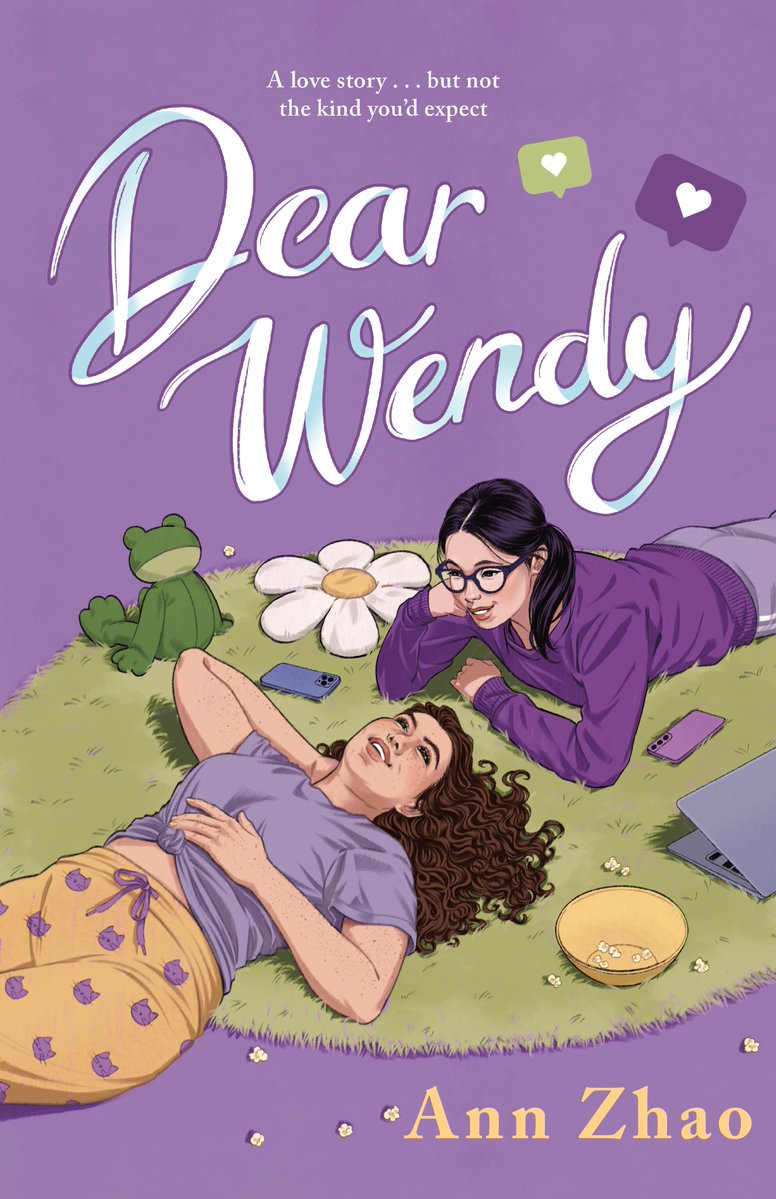
Dear Wendy by Ann Zhao

★★★★★

I love everything about this book, including the dust jacket art that features an Asian main character on the front and the iconic Wellesley bell tower on the back.

I'm not an alum of Wellesley College, but I have a soft spot for it due to a number of personal connections. I wonder if Wellesley students and alum think the portrayal of Wellesley life is authentic? I hope so. I once read a YA book set at my alma mater and was disappointed because the setting was almost irrelevant to the storyline, unlike this book, in which the Wellesley culture and campus were integral.

Representation and intersectionality are the cornerstones of this book. The "Dear Wendy" Instagram account is actually Sophie, who, in addition to being aromantic and asexual, is Chinese with immigrant parents. Her roommate is gay and Indian, with an immigrant dad and a mom who died (not actually a topic in the book). Jo, who is behind the "Sincerely, Wanda" account, is also aromantic and asexual, uses she/they pronouns, and has 2 lesbian moms. One of her roommates is white and bisexual and the other is Black and gay. Introductions with pronouns are modeled as being the norm.

It's perhaps stating the obvious, but one of the best things about this book is its mere existence, its ability to serve as a mirror for aro-ace readers and a window for those who may know nothing about it.

Chapters are written from the first-person perspective of either Sophie or Jo, which is always a fun format to read. Interspersed are Dear Wendy and Sincerely, Wanda relationship questions and responses, which actually amount to pretty good relationship advice for young readers. The fact that texting and social media are fundamental modes of communication for this generation is also reflected in even more fun formatting.

I really enjoyed the portrayal of how a budding friendship can be uncertain in the same ways as a potential romance, e.g., Does the other person even like me? Should I ask them to hang out? What kind of activity should I suggest? What if they say no? There's also a great message that aro-ace or not, a person isn't defined by a romantic relationship, and a close platonic friendship can be just as fulfilling and supportive.

As a Chinese person myself, I appreciated the Chinese dialogue from Sophie's parents, written in accented pinyin. But even though there were plenty of context clues, each line was not directly translated, which is kind of a pet peeve of mine when foreign languages pop up because if I didn't know Chinese, I'd still want to know exactly what was being said in the other language. And maybe that makes me a total Wendy, which I admit and fully accept!

Thursday, October 13, 2022

The Only One Club by Jane Naliboff

★★

I saw this book recommended as a way to help support covid-cautious kids who continue to wear masks in mask-optional settings, like school. Peer pressure is real, and being the only person in a classroom wearing a mask can be isolating and intimidating.

I really, really wanted to like this book. Growing up in the 1980s, I remember the discomfort and embarrassment of being the only Asian person in my class, the only kid who wore glasses, even the only student in my class who was a member of the Brownies! Young me absolutely would have benefited from the way this book takes being "the only one" of something and turns it on its head as something to be PROUD of. When the main character, Jennifer, realized she was the only Jewish kid in her class, she immediately delighted in being "the only one" and wanted to celebrate it. That premise is fantastic! I just wish the implementation could have been better.

Right off the bat, the book felt dated. Mrs. Matthews, the teacher, had the whole class making Christmas decorations. Back in the '80s, this type of classroom activity was commonplace. Maybe it was still happening here and there in 2004, when this book was first published. But definitely in 2022, when I read this book, a teacher presumably in a public school centering a Christian holiday in the classroom just didn't feel right.

I do love how Jennifer did not for a second feel embarrassed about being the only Jewish kid in her class. Being Jewish was something that could potentially put Jennifer on the receiving end of hateful words and deeds, and being the only one made her particularly vulnerable because she had no obvious or automatic allies. For her to take pride in something that could be used as fodder for taunts or other inappropriate behavior directed towards her is what made Jennifer's attitude and actions particularly brave, meaningful, and mature.

It was strange, then, when her classmates joined The Only One Club for things like: having a last name that is also the name of a bird, having a pet iguana, and being able to jump Double Dutch. These are not the type of differences that would normally cause chidren to feel like they don't belong, as being a different race or religion, or being the sole mask-wearer, would. Moreover, some of the reasons didn't even make sense! TWO twin girls joined by being "the only one(s?)" who were twins?! And then the teacher joined because she was "the only one" who wasn't already in the club, thereby negating her reason for joining as soon as she joined!

According to the illustrations, Jennifer's class was wonderfully culturally diverse. Alongside some of the superficial differences, it would have been easy to include more substantial differences, e.g., one kid could have been the only one who was Chinese, another could have been the only one who spoke Spanish, this kid could have been the only one with glasses, or a wheelchair, and that kid could have been the only one with asthma, or a food allergy.

Speaking of food allergies, the exchange between Jennifer and Jonah during lunch nearly gave me a conniption! With a "mouth full of peanut butter", "Jonah gave her a raspberry, spraying peanut butter all over the lunch table"!!!!! The illustration literally had food particles on a trajectory to land on Jennifer's food! What if Jennifer was allergic to peanuts!? What if the next kid to sit at that table was allergic!?

Anyway. This book might be a good option for its Hanukkah theme, but as a book about inclusion, I feel it doesn't quite get across the idea that inclusion needs to extend to attributes that may make individuals feel out of place because they are atypical compared to a widely accepted norm.

Friday, July 29, 2022

Loveless by Alice Oseman

★★★★

A truly important - and funny! - book that goes a long way in normalizing the exploration and discussion of sexuality. There is plenty of drama to move the story along, but really the primary plot is Georgia coming to terms with being aromantic and asexual.

In the beginning, I was put off by how Georgia, an 18-year-old student starting university, centered sex and romance, believing that everybody is supposed to have a romantic partner. She saw herself as the weird one for not having kissed anyone yet, let alone not having had sex. But as it turned out, one of the key points of the book was Georgia realizing that there are no rules about how you "should" behave or what you "ought" to do when it comes to relationships. You do what feels right to you, as long as you're not hurting anyone. You do you. A very healthy, empowering message.

Perhaps this message was best summed up by Georgia's roommate, when she said to Georgia, "I think it's pretty amazing that you haven't felt peer-pressured into doing anything [sexually] by now. You haven't made yourself do anything you didn't want to do. You haven't kissed anyone just because you're scared of missing out. I think that's one of the most mature things I've ever heard, actually." (p. 118)

There's also a meaningful point about friendships, how they can be just as valuable as romances. I really enjoyed Georgia's friendships, both the comfort and familiarity she shared with her old friends and the exciting novelty of getting to know her new friends.

This book is very modern, with lots of teenage slang, including very casual use of the f-word. I even had to Google some of the lingo, e.g., apparently "AU" means "alternative universe" in fan fiction.

More notably, though, potential readers might appreciate a heads up in knowing that this book is very frank and open about sex, sexuality, masturbation, attraction, social norms, and identity. ("Hand jobs" and "getting fingered" are explicitly mentioned.) The book lays bare a few variations of difficult and awkward conversations, which is actually great, in a way, because if you have similar questions yourself, you can just read this book and spare yourself those conversations in real life!

On a lighter note, it was fun reading a book that was set in the UK. Georgia didn't go to college, she went to "uni", which apparently is usually a 3-year endeavor, not 4 like in the U.S, and typically does not require sharing your dorm room with a roommate. Georgia and her friends drank a lot, but since the drinking age is 18 in the UK, presumably it was all legal. At times it felt like Georgia's uni experience revolved a bit too much around drinking culture, but I admit it was realistic, so it's probably a good thing for teenage readers to be exposed to that kind of party lifestyle safely in a book, giving them a chance to think about how they might handle certain situations.

The only other thing I wanted to mention is that I found the part about Georgia explaining aro-ace identity to her cousin a bit convenient plot-wise, like, just as soon as Georgia figured it out herself, she's in a position to support someone else in the exact same struggle? But I admit it was a useful scene because it showed how older people, who didn't grow up with the open-mindedness and terminology of today, might be moving through life, doing the best they can, without having the wherewithal to fully understand their own identity. 

Overall, a good read for mature teenagers - and their parents! - to better understand the range of sexual identities out there. It also provides a lot of good modeling on how to talk about such matters.

Monday, July 11, 2022

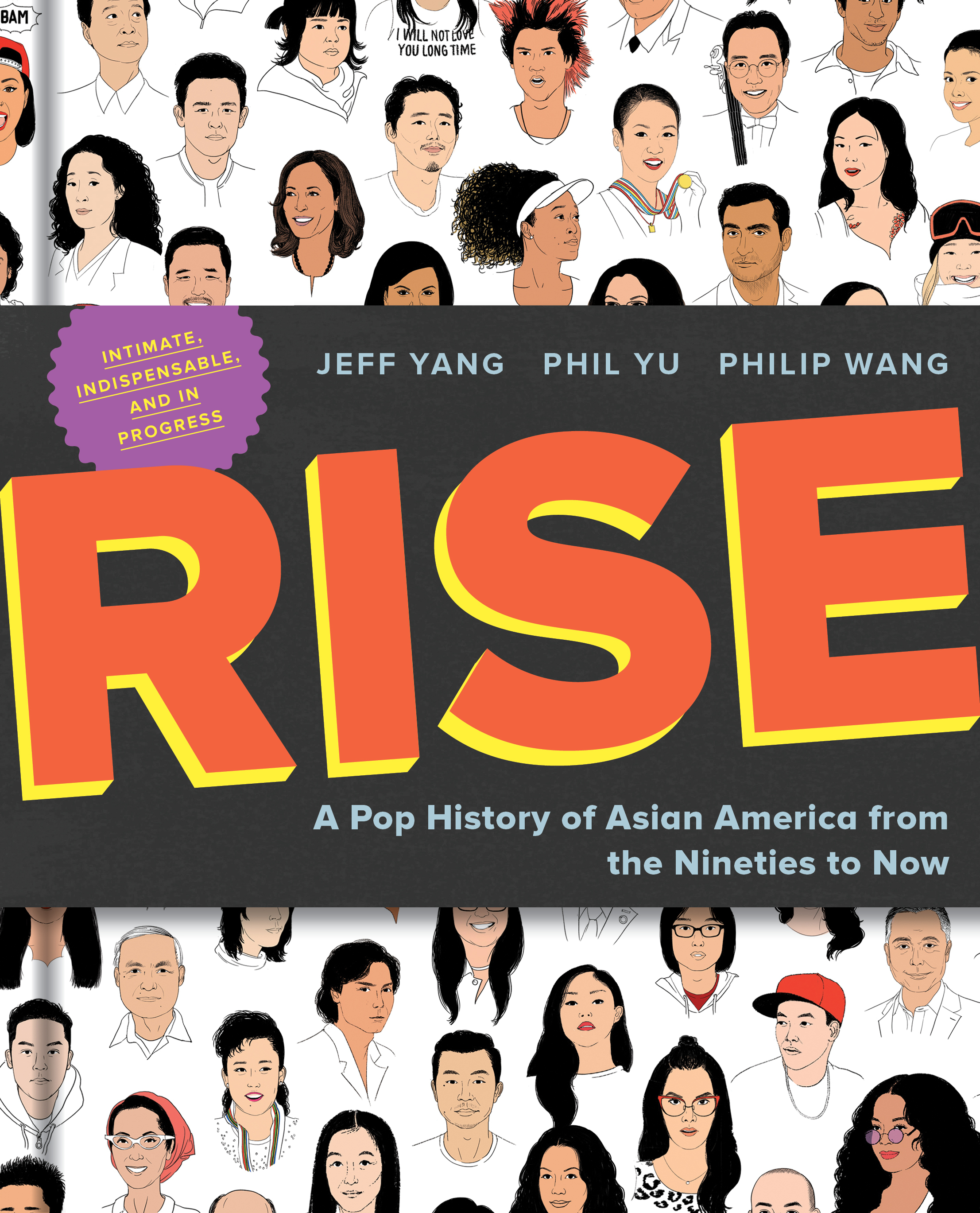
Rise: A Pop History of Asian America from the Nineties to Now by Jeff Yang, Phil Yu, and Philip Wang

★★★★★

As fun as it is informative!

This book is about the rise of Asian America, a self-defined community (separate from the idea of "Asians in America") that broke through stereotypes and bamboo ceilings. The growth of Asian America's visibility was spurred by the coming of age of kids born to a wave of Asian immigrants who first arrived in the U.S. when exclusionary immigration laws were lifted in the late 1960s. 

I am one of those kids! This book, more than any other, resonated with me in an unprecedented way. It absolutely made me feel seen. Everything, literally everything, down to the list of songs in "Original Synth: The Anthems of Young Asian America" (p. 26-27) rang true for me. In "Finding Our Religion" (p. 279), I actually burst out laughing at #27: "People singing hymns in an Asian language and English at the same time, creating cacophony" (p. 281) - a hilarious truth I witnessed in my youth and had totally forgotten.

Rise is a collection of essays, illustrations, graphic novel content, photos, timelines, lists, infographics, quotes, commentary - all of it raising up Asian American people, culture, accomplishments, and issues. The three authors - whose work I've followed online for years! - wrote most of the content, but plenty of other prominent Asian Americans have bylines or were interviewed. (If you aren't familiar with a particular contributor, there's a handy list with biographical blurbs at the back of the book.) It's very much a coffee table book - printed on heavy,  photo quality paper with content organized in colorful, eye-catching, easy-to-digest chunks - but I read it from start to finish, cover-to-cover, every word, every caption. I just could not get enough of it.

The vast majority of the book upliftingly covers "the good", e.g., Asian American representation in entertainment, sports, arts, politics, etc. Sufficient space is also given to "the bad", e.g., yellowface and cultural appropriation, and "the ugly", e.g., controversial topics like tiger parenting.

Though the book's subtitle focuses attention on the 1990s and later, there's actually a very enlightening "Before" section that presents a brief but thorough overview of Asian American history through the 1980s. I was in high school and college during the 1990s, so that section felt personally nostalgic for me. And with much of the 2010s still fresh in my mind, I really enjoyed getting a behind-the-scenes look at Fresh Off the Boat, Crazy Rich Asians, Linsanity, and #StarringJohnCho.

Sunday, July 10, 2022

Portrait of a Thief by Grace D. Li

★★★★

In a somewhat improbable premise, five college-aged Chinese Americans agree to commit a series of art heists.

For about the first third of the book, it felt like the heist was contrived to simply be the means by which these characters would come together. The pacing was slow and deliberate, each character engaging in much introspection and self-analysis as they looked to justify their decision to join the crew. As children of immigrants, each with their own unique experiences, they examined their familial relationships and self-identities, tried to understand their place in the Chinese diaspora and make sense of their uncertain futures. The weight of immigrant dreams and unresolved sense of self hung over almost every conversation, action, and interaction.

When the first heist finally started to come together, a healthy dose of suspended disbelief was necessary. Here we had a young adult crew, all somewhere on the stereotypical Asian child-of-immigrants predetermined path to success (e.g., elite school, pre-med or engineering, etc.), with little to no relevant criminal experience (except what one happened to conveniently pick up as the son of the FBI expert on Chinese art theft), planning a heist in 4 weeks while also holding down their full-time studies or job. The main characters being on the precipice of change positioned them well for so much self-reflection, but maybe the story would have been a little more believable if they were all just a bit older.

Still, seeing the first heist come together was a satisfying development. The pace picked up, though the book never quite became a page-turner for me. About halfway through, an unexpected twist finally hooked me and got me wondering how things would end.

I found it difficult to become fully immersed in the book because I was constantly distracted by the author's writing style. The prose leaned into the art theme, was excessively descriptive and poetic with careful attention being paid to the way light or darkness fell into a room, or on someone's face, or over a city, with colors of gold and red or gray. The author relied heavily on this: a set-up employing the word "this", followed by a colon, followed by some kind of revelatory statement.

Yet, I gave this book 4 stars. It resonated with me in a very personal way that does not often happen. I enjoyed the main characters and their changing relationships; each of them felt like someone I could have known in college, and in them I recognized pieces of myself and my Chinese American community growing up. And it wasn't just the complicated identity stuff that I found relatable, but also the casual references to boba and dumplings. Also, Chinese characters were dropped in-line with English text, not just the pinyin romanization but actual Chinese characters! The representation just felt amazing.

Sunday, June 19, 2022

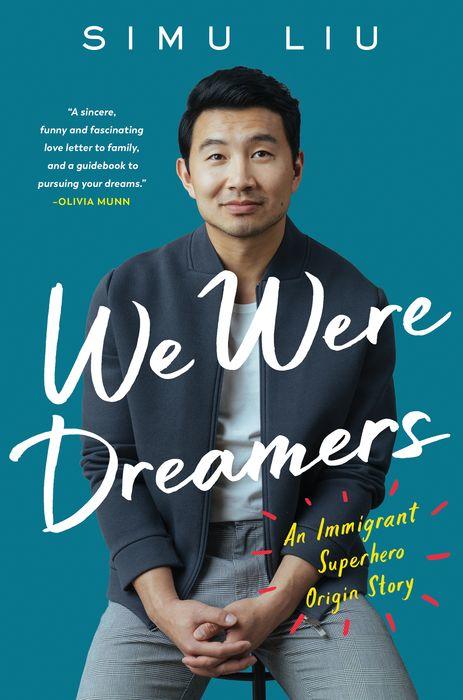
We Were Dreamers: An Immigrant Superhero Origin Story by Simu Liu

★★★★★

A beautiful memoir.

Simu Liu names his parents' treatment of him as abuse (p. 123), and he spent much of his teenage and young adult years being an attention-seeking tryhard. But, oh, he was genuine. He just so earnestly wanted to feel accepted. His path to self-discovery and reconciliation with his parents was nothing short of remarkable. He writes engagingly and comes across as embodying both a bold self-confidence that fuels his pursuit of acting dreams and a realistic sense of humility that ensures he fully appreciates his successes.

Right off the bat, in the prologue, I knew this book would not let me down. Being a superhero in a Marvel movie could not be farther from my own experiences, but Simu Liu's account of his parents' reaction to his landing the role of Shang-Chi resonated with me. I am also a child of Chinese immigrants, and while Simu's family history is vastly different from mine, the culture was familiar, his personal story reminiscent of the many stories within my own community growing up. Yes, representation really does matter, and I especially appreciated his discussion towards the end of the book about how Asian Americans in the entertainment industry rallied around him and helped him to lean into his Asianness.

I think this book would be a great read for teens who may feel lost, oppressed by their parents, or who otherwise feel a sense of not being worthy. Simu Liu is obviously an exception case in that he has a rare gift for performance - not everyone can grow up to be a superhero, after all - but still, this book shows how meaningful it is to feel seen, how important it is to be true to yourself, and that there is always hope for a better existence, for a healthier relationship with your parents.

All that said, I have to say, I found it fascinating how, early in the book, Simu Liu took pains to not make any political commentary, presumably to avoid any repercussions from the long arm of the Chinese government. He makes it clear that his family in China was "unencumbered by any political aspirations whatsoever." (p. 9) I found it jaw-dropping how he matter-of-factly wrote about the Cultural Revolution with absolutely no judgment, for example, when he described how his paternal grandfather lived in a "self-imposed house arrest" to hide from the "Red Guard, a militia of radicalized Chinese youth that harassed, beat, and sometimes killed [intellectuals] in the name of the revolution." (p. 23). I mean, what?! When his father was a child, the Chinese government "required millions of Chinese families to send their children away from home to work in mountainous areas or farming villages to learn the value of hard labor... [and his father's sister], at age fifteen, volunteered to be the one to leave." (p. 24) Seriously, WHAT?!? He even used the euphemism "cadre school" (p. 36) to describe the labor camp to which his maternal grandfather was sent. If any reader is unfamiliar with Communist China's Cultural Revolution, Red Guard, and labor camps, this book provides a shockingly inadequate introduction. I have to assume the downplayed content was an explicit decision to avoid conflict with China, since Shang-Chi and the Legend of the Ten Rings is controversial in China, and Simu Liu has already gotten into hot water for some past comments.

Sunday, May 1, 2022

Troublemaker by John Cho with Sarah Suk

★★★★★

It wasn't intentional, but my library just happened to fill my hold request so that I read this book over April 29, the 30th anniversary of the LA riots.

The 1992 riots in Los Angeles serve as the backdrop for this story, which unfolds at the intersection of immigration, child-of-immigrant identity, racial injustice, and gun violence. On top of all that, the main character Jordan is trying to navigate strained relationships with both his father and his friend. Jordan's life is complicated, as many children's lives are. In that way, it reminded me of the book Blended, which also has themes of race and gun violence, and also openly addresses the many issues children face in real life. I appreciate these books for providing a framework for kids to process complex issues in age-appropriate ways.

I'm not Korean, but I'm an American-born child of Asian immigrants, and the Park family dynamics were familiar; the portrayal of Korean American experiences felt authentic.

Some parents might like to know that though the title may allude to John Lewis's quote about getting into "good trouble", there is quite a lot of actual "troublemaking" in this book, from cheating in school to stealing from family to hitchhiking with strangers! Every such action is presented with clear disapproval, and it's obvious that the decisions to engage in these activities were poor and reckless. I think the right vs. wrong morality is evident, so kids aren't likely to want to emulate Jordan and Mike. In fact, I actually think it's solid representation to show that yes, sometimes kids make bad decisions. Sometimes those decision come from a place of weakness or curiosity, sometimes they come from a place of desperation or wanting to do good, but no matter the motivation, bad decisions do not make for a "bad kid", and I think that's an important message for all kids to understand.

While Jordan is trying to unpack a lot of big and meaningful questions, the events of the book actually take him on an exciting adventure, making for an engaging and entertaining read even if you're not particularly interested in the social justice issues.

There is no Korean glossary, but there is an Author's Note at the back of the book. I think I might even recommend reading that first, to help frame and set the context for the book.

Friday, April 8, 2022

The Turtle of Michigan by Naomi Shihab Nye

★★★★★

Having read The Turtle of Oman, I set my expectations accordingly for this book, and I think that helped me to better appreciate it. I really loved it. Some might call the writing "slow", but I'd describe it as gentle, steady, and deliberate, with poetic interludes. Occasionally, the narration transitioned between third and second person. I really enjoyed the way the writing channelled the perspective and narrative voice of a child.

Aref is 8 years old. He's inquisitive, friendly, and not shy, a good model for young readers, particularly those who may feel nervous about moving to some place new. It's very clear how Aref benefited from a very diverse neighborhood and school, both in his old home of Muscat, Oman and in his new home of Ann Arbor, Michigan. Such diversity may not be the reality in many places, which means this book could serve as a good "window" for young readers who have less personal experience with different cultures.

It's been a while since I read The Turtle of Oman, so I can't remember for sure, but I think this book picks up right where that book left off. From the very beginning, we see Aref discovering a powerful truth: oftentimes, the anticipation of something is more anxiety-producing than actually experiencing the thing itself. The Turtle of Oman was about Aref feeling sad and scared about moving to America, but once he boarded the plane, he felt relief and excitement and was open to adventure.

Aref and his family are Arabs from Oman. There are occasional references to the Arabic language and Omani culture, which set the background and help to describe the main characters, but they are not central plot points. Oman is predominantly Muslim, but it's not clear if Aref's family is Muslim. There is a chapter about learning to celebrate Christmas in America, and other cultural and religious holidays are mentioned, but Aref's family's usual holidays are never identified. It seems like the author made a very conscious decision to not mention religion at all, since it wasn't even touched upon in the Christmas chapter.

Tuesday, February 22, 2022

Go Back to Where You Came From: And Other Helpful Recommendations on How to Become American by Wajahat Ali

★★★★★

Immigrant and child-of-immigrant memoirs are quickly becoming one of my favorite genres.

I started following Wajahat Ali on Twitter based on his posts about his daughter's medical situation, Legos, and Star Wars. I didn't even know he was a politics and race commentator until later.

Right off the bat, this book opened with the author's irreverent responses to hate mail he's received. I imagine this introduction might be an eye-opener for white readers who never realized the kind of abuse commonly faced by people of color in the public eye.

In the beginning, it felt like the author was channeling a comedian. The humor in his writing struck me as similar to Dave Barry's, even when he hit on heavy topics like racism and mental health. While entertaining, the humor also felt like it was being wielded as a shield, like, "I have to make a joke now, because if I don't laugh, I might just break down and cry." As the book progressed, the author shared the lows, and even lower lows, of his life, and the writing carried more gravitas. Gradually, by the end, the writing felt sincerely earnest.

Being a memoir, this book is very approachable and easy to read, which actually makes it a good Trojan horse for its sharp discussions of race. Ali's personal narrative is interspersed with lots of social commentary and edifying tidbits about Muslims in history and culture. At times, the content felt more like a collection of essays than a straight chronological narrative. Unlike other immigrant memoirs I've read, Ali's story was atypical in that it took many unexpected turns involving near-death experiences and the criminal justice system.

I enjoyed Ali's writing style, which was full of pithy truths like, "[Accents were a] telltale sign that, despite all their successes, their investment and time spent in this country, they were still foreigners and immigrants, a punching bag and a punchline," (p. 40) and, "The playground is where you first learn your rank in the American hierarchy [of race]." (p. 42)

One thing (of many) that I found remarkable about Ali's life was just how much he was supported by the elders in his community. In America, I think much of the spotlight is on peer relationships, and not enough credit is given to how valuable our aunties and uncles and those in our grandparents' generation can be in our lives.

I appreciated the book ending on a very hopeful note, with Ali quoting the Prophet Muhammad: "If the Hour [the day of Resurrection] is about to be established and one of you was holding a palm shoot, let him take advantage of even one second before the Hour is established to plant it." (p. 221)

I also liked that non-English words were translated in-line, so there was no need to flip back and forth to a glossary at the back of the book.

Now, I've got to see if I can get my hands on a copy of Wajahat Ali's play, The Domestic Crusaders...

Monday, November 22, 2021

Displacement by Kiku Hughes

★★★★½

I don't generally read a lot of graphic novels, but I really appreciate it as a medium for making certain topics, like Japanese internment camps, accessible to young readers. 

Kiku Hughes is 16 years old, half Japanese, and lives in 2016 Seattle. She doesn't know much about her Japanese American ancestry when she's suddenly and inexplicably transported to 1942 and finds herself in a Japanese internment camp, where she learns about Japanese American history by experiencing it first-hand.

I liked that the author actually used the term "incarceration camp" instead of "internment camp", a decision explained in the back of the book. I've always thought of "internment camp" as a euphemism that doesn't sufficiently convey the inhumanity of the camps.

I also really appreciated seeing a mixed-raced protagonist, which is still pretty rare in books, I think. It's hard enough trying to understand your identity as a 4th generation Asian American, and being half white just adds a whole other layer of complexity. 

And speaking of identity. Through illustrations, we know that Kiku and a friend were members of the LGBTQ community, but it wasn't mentioned in the text explicitly. 

This book explores generational and community trauma, then shows how that legacy can be used to help advance justice for other marginalized groups. The "current time" part of the book takes place during and after the 2016 presidential election. Clear parallels are drawn between the U.S. treatment of Japanese Americans during World War II and the Trump administration's anti-Muslim and anti-Latinx immigration policies. 

My only complaint is that we never learn anything at all about Kiku's grandfather or her white father. Her grandmother was apparently a single mother, and she later re-married, but I couldn't help but wonder what happened to the father of her children. Along the same lines, we also don't know anything about Kiku's white father. I understand that there's not much reason to include him for most of the book, but at the end, it would have been a nice showing of support to see him learning about Japanese American history and going to protests alongside his wife and daughter.  

Wednesday, September 15, 2021

Anne Frank: The Diary of a Young Girl

★★★★★

It seems inappropriate to review a person's diary, so I'm treating this review more like a book report.

Eleanor Roosevelt wrote the introduction in the edition I read, saying this about the book: "Reading it is a rich and rewarding experience." (p. x) And that's just it. This book enriches the life of the person who reads it.

Early on, it was almost prescient the way Anne laid out a simple biography of herself, and wondered who would be interested in what she wrote. From her light-hearted reports of her active social life at age 13, before going into hiding, to her thoughtful introspection from inside "the Secret Annex" at age 15, the diary could not have been better written if its future relevance was known and planned.

Anne Frank was clearly an exceptional teenager. She had more insight and self-awareness than most adults. She explicitly identified her ideals and worked on self-improvement. She understood and articulated the value of hard work and the importance of strength of character. She formulated her own perspectives and philosophies on intelligence, nature, and religion.

I see Anne's diary as an example of humanity in its purest form. Even in hiding, knowing her life was in danger, her day-to-day concerns included typical mother/daughter conflict and musings on boys. She wrote about concentration camps and the Gestapo, too, but she knew that constant focus on the war and the suffering of Jews would break her spirit. She was wise beyond her years in writing, "I don't think then of all the misery, but of the beauty that still remains." (p. 154)

We see the statistic that 6 million Jewish people died during World War II, but in reading Anne's diary, we can better understand that it was 6 million individuals, 6 million persons each with potential and value - like Anne - who were lost to the world.

Too frequently I finish a book only to find that there are appendices that I would have appreciated reading sooner, so I'll mention that the edition I have has a 3-part afterword that I'm glad I read in between reading diary entries. Part I was a brief historical summary, providing relevant context for the diary. (Notably, it was truly remarkable how the description of Hitler's rise, written decades ago, was disturbingly similar to Trump's rise.) Part II explained what happened to Anne and the others after the diary ends. Part III described how the book came to be published, how Anne's story has continued to be spread, and how her life has continued to be meaningful, even after her death.

Saturday, August 21, 2021

You Should See Me in a Crown by Leah Johnson

★★★★½

Liz is a poor, Black, queer teenager in a wealthy, predominantly white Indiana suburb that is obsessed with prom. She is an unlikely candidate for prom queen, but enters the competition in hopes of winning the college scholarship that goes with the crown. Over the course of the campaign, we see Liz gain confidence as she asserts herself as worthy of the title and learns that, despite usually being on the margins of her high school's social scene, she, too, can feel like she belongs. Along the way, she has to navigate complex friendships, serious and emotional family matters, and a budding romance.

Published and set in a pandemic-free 2020, the book feels modern and relevant, with characters matter-of-factly acknowledging the importance of consent for both casual physical contact and romantic overtures. There are plenty of pop culture references, the pages sprinkled with passing mentions of celebrities like Simone Biles and Timothée Chalamet, and shows like Hamilton and Stranger Things. Entertaining and funny, the book is light and easy-to-read, though it also addresses some heavy issues like the loss of a parent and life-threatening illness.

Liz's first romantic relationship is a typical teenage romance, the object of her affection just happens to be a girl. Her sexuality is not a central focus of the book, though it does realistically come into play as a factor in her electability as prom queen. Similarly, Liz's race is not a primary focus of the book, but her being one of the few Black students in school does come up. In fact, I had a little chuckle when Liz's narrative referenced one of my favorite memes: "I try to channel the confidence of a mediocre white man in a boardroom: untouchable." (p. 255)

I'm giving this book just half a star shy of 5 stars because I didn't think it was believable that Liz wasn't disciplined after her very public use of the F-word in school. (For those who might want to know, the F-word is only explicitly written out once; after that, "eff" is used instead.) Also, I get that Rachel was supposed to be an unsympathetic character, but in a book full of well-fleshed-out characters, she just felt too one-dimensional to me.

Thursday, August 5, 2021

While Justice Sleeps by Stacey Abrams

★★★★

I don't usually read political thrillers, but I follow American politics, and the author being Stacey Abrams was enough to pique my interest.

I got the feeling that Abrams really enjoyed writing this book. There were lots of fun word choices, like when a woman is described as "an eggplant-attired matron of impeccable breeding and questionable chromatic theory." (p. 177) I could just imagine the author chuckling to herself and being really proud of that phrasing.

This book is a light read, easy and entertaining. My husband would call it "popcorn reading". There is drama from the very beginning and the action is non-stop, with quite a few unexpected developments. It was certainly a page-turner for me, with sufficient suspense to keep me wondering and occasional oblique references to things you assume will be spelled out later. Early on there was what I considered an unrealistic guessing of a password - Do people really have predictable passwords these days? - but I got over it and made sure to put myself into suspended disbelief mode for the rest of the book. It was easy to imagine the story unfolding like in a movie; if it gets adapted, I'd see it for sure!

Incidentally, I appreciated the diversity of the characters; the protagonist is mixed-race white and Black, and her best friend is Asian.