Showing posts with label book: 4-and-a-half stars. Show all posts

Thursday, August 14, 2025

Wildland: The Making of America's Fury by Evan Osnos

★★★★½

If you're someone who looks around in utter disbelief at everything broken in America today - mass shootings, income inequality, inaction regarding the climate crisis, rising white nationalism and fascism, eroding democracy, etc., etc., etc. - and the fact that a lying, racist, xenophobic accused rapist and con man actually got elected - then re-elected despite felony convictions - and ask, "How did we get here?!?!!" then this book is for you. It tries to answer that question. More than anything else I've read, this book helped me to better understand Trump voters, even if I will never agree with them.

Evan Osnos provided a clear accounting of American politics spanning the terrorist attacks on September 11, 2001 - when people across the nation reaffirmed American ideals of diversity and the free exchange of ideas (p. 8) - to the insurrection at the Capitol 20 years later on January 6, 2021 - by which time "the country had spun so far out of balance that it had lost its center of gravity." (p. 13)

The author delved deep into the culture and mindset of 3 communities:

  • The money-centered elites with stratospheric wealth in Greenwich, CT who made money from money thanks to a lack of government regulations. (p. 30) Any discussion of the uber-wealthy naturally encompasses the seismic level of undue influence campaign mega-donors have on U.S. politics, and, by extension, the author detailed the damage done by the well-funded Mitch McConnell, "who operated on the plain belief that power mattered more than policy or principle." (p. 50)

  • Clarksburg, WV, where thriving local newspapers were once the cornerstone of democracy and community - until they were decimated by the growth of the internet, where news was scattered among entertainment and disinformation. (p. 67) Once the "Jewel of the Hills" (p. 56), Clarksburg fell victim to outside investors who bought political influence, allowing them to strip the land of valuable minerals, taking profits with them and leaving West Virginians to suffer the environmental harms. (p. 64-65)

  • The all-American city of Chicago, IL, which saw its African-American population grow to 33% after the Great Migration yet still endured racial segregation because of powerful discriminatory practices like redlining. (p. 78-79) Schools in Black neighborhoods were stunningly underfunded (p. 124), racial inequality was vast (p. 87), gang violence escalated (p. 118), and "nearly one third of Black men... entered the criminal justice system." (p. 131) Against this backdrop, we saw the beginning, and then the meteoric rise, of Barack Obama's political career.

  • Through intimate portraits of individuals in each community, Osnos illustrated how starkly different one's life can be depending on where you grow up, the color of your skin, and how much money you have. He drew a straight line from the Wall Street subprime mortgage schemes concocted by wealthy white Greenwich financiers to the dire economic plights of poor Black homeowners in Chicago (p. 134), and he compellingly weaved together the threads of a Clarksburg Marine with PTSD, the local community newspaper, and the opioid epidemic.

    On a national level, angry conservative commentators (p. 139) and changing demographics that predicted minorities eventually becoming the majority (p. 230-231) fueled racism and the right-wing, white nationalist politics of the Tea Party that gained traction during Obama's administration. (p. 142) White people began to fear for their privilege due to their perception that "white Americans faced imminent demise" (p. 235), which was unsubstantiated by actual statistics. (p. 237) (That these people settled on fighting to maintain social inequity to benefit themselves rather than fighting for social equity so that no one group was privileged over others is, IMHO, disgusting.)

    Osnos also discussed the uniquely American cult of "hyperindividualism" at the expense of community, evident in politics through declining influence of labor unions and increasingly regressive taxes. (p. 145) He wrote of how the U.S. was able to engage in 18 years of "the War on Terror" largely without accountability as there was no sense of collective sacrifice, the burden of casualties having fallen on less than 1% of the population (p. 147), and news reaching the others "too muddled by the peek-a-boo distractions of our time." (p. 148)

    In a book of eye-opening revelations, most shocking to me was "elite survivalism". The book described Silicon Valley billionaires who have private planes and underground bunkers for the specific purpose of having a safe haven not just for the impending doom of climate change, but also in case angry, unemployed masses break out the pitchforks for the people who brought forth the technological innovations (mostly fears around AI) that took away their jobs. (p. 285-287) (Again, that so many of the tech elite look to protect themselves instead of using their billions to address climate change or social safety nets or ethical use and the consequences of AI is, again, IMHO, obscene.)

    Osnos occasionally takes a step back and outlines how some of the factors stirring the pot of unrest began long before September 11, 2001. Capitalism amplified inequality (p. 99), and corporate PACs and lobbyists in the 1980s brought forth a wild swing towards pro-business, anti-consumer policies. (p. 170) Osnos connected the dots between libertarian Reagan Republicans and modern-day Trumpism, both built on "a coalition of conservative elites and the white working class." (p. 172) He further described how pure capitalism led to the growth of the gun industry: as hunting became less popular in the 1970s, among other marketing schemes, gun industry trade publications began targeting elementary school children in efforts to expand their customer base. (p. 263-266)

    By the time Osnos addressed the first Trump presidency directly, it was clear the administration's actions were not the result of incompetence but rather, the goal was to actively undermine and dismantle federal agencies that stood in the way of capitalism. (p. 292-293) Steve Bannon, Trump's campaign chief, called it the "deconstruction of the administrative state" (p. 287), but more than that, the Trump administration believed in "empowering it [the federal government] in the name of private interests." (p. 294)

    As depressing as the facts are, it was encouraging that Osnos was able to instill a sense of hope by highlighting progressive activists in all 3 locations of Greenwich, Clarksburg, and Chicago.

    To close, here are some poignant, insightful quotes that struck me:

  • Regarding the connection between income inequality and being disenfranchised: "Poverty can be as much about power as it is about possessions; they hadn't felt poor until someone came along and showed them how little power they really had." (p. 189)

  • A quote by Samuel Popkin, a political scientist, that succinctly explains the appeal of Trump: "The more complicated the problem, the simpler the demands become. When people get frustrated and irritated, they want to cut the Gordian knot." (p. 282)

  • A warning issued in 1992 by Francis Fukuyama, another political scientist: After the Cold War, people might "struggle for the sake of struggle... out of a certain boredom... And if the greater part of the world in which they live is characterized by peaceful and prosperous liberal democracy, then they will struggle against that peace and prosperity, and against democracy." (p. 316)

  • Chicago community organizer Jahmal Cole in the midst of George Floyd protests in 2020: "We wore a hoodie for Trayvon, we took a knee for Philando, we held our breath for Eric, we walked for Laquan, but we're done. Enough is enough... We're rightly pissed off." (p. 368)

  • Abraham Lincoln's secretary of state, William Seward, describing the Civil War: "There was always just enough virtue in this republic to save it; sometimes none to spare." (p. 406)

  • Oh, one last thing. My rating is just short of 5 stars because of a misleading line. Early in the book, there’s a passing reference to "a minor [constitutional] amendment in 1992, to raise congressional salaries." (p. 51) The wording made it sound like the purpose of the amendment was to raise congressional salaries, but what it actually did was require an election before any change in congressional salaries could take effect. It just made me wonder if maybe there might be other ambiguous wording - intentional or not - that I didn't catch.

    Monday, November 22, 2021

    Displacement by Kiku Hughes

    ★★★★½

    I don't generally read a lot of graphic novels, but I really appreciate it as a medium for making certain topics, like Japanese internment camps, accessible to young readers. 

    Kiku Hughes is 16 years old, half Japanese, and lives in 2016 Seattle. She doesn't know much about her Japanese American ancestry when she's suddenly and inexplicably transported to 1942 and finds herself in a Japanese internment camp, where she learns about Japanese American history by experiencing it first-hand.

    I liked that the author actually used the term "incarceration camp" instead of "internment camp", a decision explained in the back of the book. I've always thought of "internment camp" as a euphemism that doesn't sufficiently convey the inhumanity of the camps.

    I also really appreciated seeing a mixed-raced protagonist, which is still pretty rare in books, I think. It's hard enough trying to understand your identity as a 4th generation Asian American, and being half white just adds a whole other layer of complexity. 

    And speaking of identity. Through illustrations, we know that Kiku and a friend were members of the LGBTQ community, but it wasn't mentioned in the text explicitly. 

    This book explores generational and community trauma, then shows how that legacy can be used to help advance justice for other marginalized groups. The "current time" part of the book takes place during and after the 2016 presidential election. Clear parallels are drawn between the U.S. treatment of Japanese Americans during World War II and the Trump administration's anti-Muslim and anti-Latinx immigration policies. 

    My only complaint is that we never learn anything at all about Kiku's grandfather or her white father. Her grandmother was apparently a single mother, and she later re-married, but I couldn't help but wonder what happened to the father of her children. Along the same lines, we also don't know anything about Kiku's white father. I understand that there's not much reason to include him for most of the book, but at the end, it would have been a nice showing of support to see him learning about Japanese American history and going to protests alongside his wife and daughter.  

    Saturday, August 21, 2021

    You Should See Me in a Crown by Leah Johnson

    ★★★★½

    Liz is a poor, Black, queer teenager in a wealthy, predominantly white Indiana suburb that is obsessed with prom. She is an unlikely candidate for prom queen, but enters the competition in hopes of winning the college scholarship that goes with the crown. Over the course of the campaign, we see Liz gain confidence as she asserts herself as worthy of the title and learns that, despite usually being on the margins of her high school's social scene, she, too, can feel like she belongs. Along the way, she has to navigate complex friendships, serious and emotional family matters, and a budding romance.

    Published and set in a pandemic-free 2020, the book feels modern and relevant, with characters matter-of-factly acknowledging the importance of consent for both casual physical contact and romantic overtures. There are plenty of pop culture references, the pages sprinkled with passing mentions of celebrities like Simone Biles and Timothée Chalamet, and shows like Hamilton and Stranger Things. Entertaining and funny, the book is light and easy-to-read, though it also addresses some heavy issues like the loss of a parent and life-threatening illness.

    Liz's first romantic relationship is a typical teenage romance, the object of her affection just happens to be a girl. Her sexuality is not a central focus of the book, though it does realistically come into play as a factor in her electability as prom queen. Similarly, Liz's race is not a primary focus of the book, but her being one of the few Black students in school does come up. In fact, I had a little chuckle when Liz's narrative referenced one of my favorite memes: "I try to channel the confidence of a mediocre white man in a boardroom: untouchable." (p. 255)

    I'm giving this book just half a star shy of 5 stars because I didn't think it was believable that Liz wasn't disciplined after her very public use of the F-word in school. (For those who might want to know, the F-word is only explicitly written out once; after that, "eff" is used instead.) Also, I get that Rachel was supposed to be an unsympathetic character, but in a book full of well-fleshed-out characters, she just felt too one-dimensional to me.

    Tuesday, April 28, 2020

    Prairie Lotus by Linda Sue Park

    ★★★★½

    *** Warning: This review contains spoilers!! ***

    This book is remarkable for its place in children's literature. I appreciate its existence so much! It's a lovely story about a pioneer girl in the vein of Little House on the Prairie, but the main character, Hanna, is half Chinese. 

    Before moving to the Dakota Territory in 1880, Hanna and her parents lived through the 1871 mass lynching of Chinese people in Los Angeles. The event is used to set the tone for society's attitude towards Chinese people in the time period of this book. Personally, I did not know about this race riot until I was an adult - I certainly never heard about it in school - and I am beyond pleased that this book provides an opportunity for young readers to learn about this piece of American history.

    I am especially thrilled that this book features a half-Chinese main character, since books featuring mixed race characters are even rarer than books featuring people of color. There is much in this book that will resonate with Asian and half-Asian readers: Hanna's anxiety and discomfort from being different from everyone around her; the physical and mental exhaustion of worrying about how she ought to behave, and how others are perceiving her, on top of all the regular expectations of being in school; the indiginities suffered when others mistreat her, and the injustice of being blamed for others' cruelty; the self-doubt in wondering how someone's behavior towards her might be different if she weren't Chinese. These are all the emotions and experiences that are familiar to Asian Americans today.

    It's worth noting that the book does not use the word "chink" as a racial slur, but does use the phrase "chinks in the boards." (p. 68) I have to assume this was a conscious choice of words. Maybe the author is saying, "Nope, I am not going to use that awful word and, in fact, I'm going to use the non-offensive definition just to show how the word itself is twisted and gets its power only from the hate and racism of the people speaking the word." Other characters do use the term "Chinaman", which is appropriate for the time period. Since only the townspeople who don't like Hanna use the word in dialog, I think the text sufficiently conveys that the word is generally not acceptable and is derogatory. 

    The author does an excellent job incorporating lessons of race that are applicable in real life. Although most often, when Hanna was mistreated, she was forced to suffer in silence, I liked that when given an opportunity, Hanna spoke up and modeled how a person could deal with a microaggression while remaining calm and non-confrontational. The book even states that Hanna had "spent a lot of time thinking what she should say" in case she was faced with a particular insult, which I appreciated because in my own experience, in the heat of an offense, I can rarely think of an effective response.

    The book also does a great job showing how Hanna herself, in a position of being at the mercy of others, was limited in what she could do; it was important that she have white allies who were willing to do the hard work of having the conversations that could truly change minds. The author even makes a point to show how standing up to others is a daunting and seemingly impossible task for a single person, but becomes doable with the support of just one other person. Again, in this example, the author is careful to show that the right approach did not come quickly and easily, but rather, took a lot of consideration and thought, planning and practice.

    I appreciate that Hanna's story includes interactions with Native Americans. I don't know how students learn about America's westward expansion now, but I clearly remember being in middle school and learning about Manifest Destiny as a fact of history. It actually feels like a relief to know that young readers today have access to narratives that re-frame the events of this period from a non-white perspective. Hanna ties her experience with Native Amerians to her overall understanding of American society, thinking, "I used to think only of how white people treated Chinese people. Now I know it's about how white people treat anybody who isn't white." (p. 157)

    Besides race, this book also addresses loss. Hanna needs to come to terms with the death of her mother, keeping her memories and love for her mother strong, even while her father moves them far away from any place that would remind them of her.   

    I am impressed, too, in the way this book handles an assault. Hanna being a victim of physical violence (written in a very age appropriate way) might seem like one too many issues being tackled, but it's a realistic possibility. The event and the aftermath are not dwelled upon; readers get a glimpse of how a physical assault can affect a person's thinking and behavior. I think it's a worthwhile inclusion, it provides a point of reference for young readers to process abuse.

    A couple minor things made me rate this book 4 1/2 stars instead of 5 stars. At one point, a character declares that "it was Koreans who had invented chopsticks". (p. 51) I am no scholar of Asian history, but I turned to Google, and every resource I could find on the history of chopsticks credits China with their invention. The assertion was made to show the character's pride in being Korean, but since it appears to be inaccurate, I'm concerned that young readers may accept it as fact, and I wonder why it was included, instead of some other undisputed Korean achievement. 

    Also, a great deal is made in the book about how Mr. Harris had to write to the federal government to ask whether or not Hanna is legally allowed to attend the same school as everyone else. A lot of events hang on this question, yet we don't get an answer. (In San Francisco in the 1880s, Chinese children attended Chinese-only schools, and during segregation in the South, Chinese children were considered colored and barred from white schools.)

    Tuesday, November 26, 2019

    Neverseen (Keeper of the Lost Cities #4) by Shannon Messenger

    ★★★★½

    *** Warning: This review contains spoilers!! ***

    I really enjoyed this installment! Sophie and the gang are now working with the Black Swan, so it's a pretty satisfying beginning. The first half of the book focused on Prentice, then the spotlight turned to Exillium, but there was a flow to the events, and there was a clear story arc involving the gnomes that tied it all together for the conclusion. There were lots of surprising revelations, plus a couple major events at the very end, one very poignant, the other a twist to set up the next book.

    Ultimately, my rating is short of 5 stars because of some developments that seemed just too easy, or too simplistic. For example, Exillium's harsh practices were long-standing, yet Sophie was able to effect a full 180-degree change simply by telling two Councillors the truth? Did the Councillors really not know? Was there literally no oversight at Exillium?! Also, the whole idea that the Black Swan, and Della, would let 7 kids walk into Ravagog with only Alvar as a guide was a bit much, too. The Black Swan went out of their way to be secretive, but suddenly they needed Alvar's ogre knowledge, and they brought him on board, welcomed him to their hideout, assigned him a very important task without asking him to swear fealty first, and completely disregarded how Alvar used to argue with Alden against the Black Swan! Tam and Linh were equally unvetted, but at least they had nothing to lose, and good reason to help the gnomes.

    Monday, September 30, 2019

    Keeper of the Lost Cities (Keeper of the Lost Cities #1) by Shannon Messenger

    ★★★★½

    Super derivative and frequently reminded me of Harry Potter. Sophie, like Harry, was a pre-teen who had only ever known a human existence when suddenly she finds out she is something else. They were both whisked away to a special school in a secret world hidden from humans. They feel inadequate for not understanding the ways of "their people", yet they are both uniquely more advanced than their peers in special ways. Light leaping is analogous to apparating and disapparating, and Keefe's dad reminded me a lot of Lucius Malfoy.

    All that said, even if this work is derivative, my son says it gets more original in future books, and my daughter points out that at least it's well-executed. I'll have to keep reading to see if I agree with my son, but I can say I do agree with my daughter. Characters are engaging, the plot is intriguing. What exactly is the big secret of Sophie's existence?! Sophie's crush is a little eye-rolling, but it's all age-appropriate. I also really like that Sophie seems to have a good head on her shoulders. Most of the time, she properly turns to adults in times of crisis, and when she doesn't, the repurcusions are swift.

    I'm giving the book short of 5 stars because it kind of irks me the way Marella and Jensi were just dropped. They were the first to reach out to Sophie in school, not knowing anything about her, and I think they deserved more consideration than they got! At one point, Sophie has a falling out with some people and laments that she "had no friends". But what about Marella and Jensi!? Apparently they are chopped liver.

    Sunday, September 22, 2019

    Dr. Susan Love's Breast Book (6th Edition) by Susan M. Love

    ★★★★½

    The first thing that struck me was the very first line of the Acknowledgments, in which Dr. Susan Love says that she revises this book every 5 years. From my own limited research, it's clear that the treatment of breast cancer has had major developments over the last few decades, and it's good to know this book stays abreast (haha) of new advancements. 

    The second thing that struck me was the very first line of the Introduction, in which Dr. Love notes that this sixth edition, published in 2015, will probably be the last revision. I hope this is not really the case, because this book is such a thorough, accessible, go-to reference for breast cancer. It would be a shame if future women don't have an up-to-date resource like this one! I hope that maybe someone else from the Dr. Susan Love Research Foundation will take over the book and ensure it's continued relevancy. (Maybe they figure everything should just be online these days...)

    Dr. Love's writing style is colloquial, her descriptions and explanations are clear and easy to understand. A quote on the front cover touts this book as "the bible for women with breast cancer," and it really is. I think any woman who has been diagnosed with breast cancer should get their hands on this book as soon as possible and keep it close by for reference. 

    This isn't a book that needs to be read cover to cover; chapter titles are self-explanatory, and there is a complete index, so you can look up terms and topics and questions as they come up. (In fact, there are sections towards the end titled "How Long Do I Have?" and "End-of-Life Planning: Making Your Wishes Known" that I really hope I don't ever have to read.)  

    That said, this book isn't just for women who have already been diagnosed with breast cancer. Any woman who has started getting mammograms, or who has found a lump and is facing a possible diagnosis, should have this book, too. There are entire chapters on screening and diagnosis that I imagine would be very helpful if they are read even before being diagnosed, or while going through it.

    In my personal experience, I wish I had this book for reference as soon as I felt a lump. My cousin gave me the book in the time between diagnosis and double mastectomy, but I admit I didn't read it right away, and that's on me. I should have read the sections on mastectomy and sentinel lymph node biopsy before my surgery. All the information is so straightforward and thorough; the book included everything that I had otherwise gathered from multiple web sites and online support groups, plus some. Moreover, my online research involved having to filter out random pieces of information that didn't apply to me, and it took a lot longer than if I had just read a few pages of this book instead.

    I finally picked this book up about 3 weeks after my surgery, just before meeting with my medical oncologist. Once I saw how accessible the information was, I jumped ahead, searched the index, and read the pages about types of cancers and different kinds of treatment. Reading just these select pages helped me feel more prepared for my appointment. And as soon as my oncologist confirmed my treatment plan, including chemotherapy and hormone therapy, I went straight to relevant sections of the book.

    I did notice that the book does not use some common terms, even when it does address the particular issue. For example, it mentions that after a mastectomy, "surrounding tissue under the arm may seem baggy and excessive and hang over your bra," (p. 475) but it doesn't use the term "dog ears", which is how the condition is referred to in online forums. It also describes "axillary web syndrome" (p. 348) as a side effect of lymph node surgery, but does not use the word "cording", and neither term is included in the index. As someone who happened to develop cording after surgery, an index reference to this topic would have been nice.

    Additionally, not every drug is specifically mentioned. For example, in the section on gonadotropin-releasing hormone agonists, Zoladex (name brand for goserelin) is discussed, but not Lupron (name brand for leuprolide). Taxol (name brand for paclitaxel) is also not in the index. I understand that not every single drug can be covered, but as someone being prescribed these medicines, the omissions were noteworthy for me.

    I do wonder if the book being published in 2015 has anything to do with the above two observations. Like maybe the terms "dog ears" and "cording" have only recently become more widely used? Or maybe Lupron and Taxol are less common these days? I don't know.

    Because this book is more like a reference book, I have not read it in its entirety. I certainly plan to use it as needed moving forward.

    Wednesday, December 5, 2018

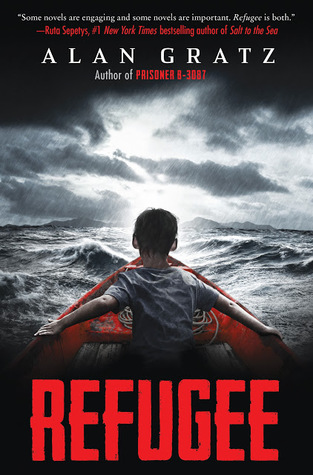
    Refugee by Alan Gratz

    ★★★★½

    An important book and something of an introduction to readers of all ages who want to learn more about refugees.

    Mahmoud is a 12-year-old boy in Aleppo, Syria in 2015. His family is fleeing civil war and heads for Germany.

    Josef is a 13-year-old boy in Berlin, Germany in 1938. His family is fleeing Nazi persecution and heads for Cuba.

    Isabel is an 11-year-old girl in Havana, Cuba in 1994. Her family is fleeing starvation and civil rights abuses and heads for America.

    Some people think trigger warnings are getting overused, but I can see how it might be helpful in a case like this. The book very quickly delves into matter-of-fact descriptions of the Nazi's inhumane treatment of Jews, the horror of having your home destroyed by a missile, and the hopelessness of living in fear of your own government and not having enough food. As you might expect in refugee stories, a number of difficult topics arise, for example, death, suicide, mental illness (PTSD), children taking on adult roles, and loss in many forms. I think the book's content might be better suited for middle schoolers, but if your upper elementary student wants to read it, at least be sure to discuss the book with them before, during, and/or after their reading.

    I gave the book just shy of 5 stars because I wasn't sure what to make of it at first. In the beginning, there seemed to be a lot more "telling" rather than "showing", and everything felt melodramatic, like the book was written with the express purpose of manipulating your emotions. Of course, the subject matter is emotional, and the book eventually gave way to more natural storytelling, even if plenty of chapters ended in cliffhangers. Some reviewers seem to dislike the way the three stories are broken up and interspersed with each other, but I wonder if that strategy actually helps young readers to break up the intensity, so they can process each event individually and not get too overwhelmed by each main character's plight.

    I was impressed by the wide range of ideas this book managed to incorporate. It provides an overall picture of how political conflicts can turn ordinary people into refugees, and how these tragedies happen all over the world and throughout human history. It's thought-provoking to consider how Germany was the place from which refugees fled in 1938, but then became the place that welcomed and assisted refugees in 2015; similarly, how Cuba was in a position to receive refugees in 1938, but then became a country of origin for refugees in 1994. We see incidences in which refugees take on an "each man for himself" mindset in order to ensure their own survival, and other scenarios when refugees support and assist each other as people sharing a common struggle. We see people in positions of power who separate themselves from the humanity of the situation by reminding themselves and others that they are "just doing their job." We encounter onlookers who turn their noses up at the "dirty refugees", locals who take advantage of the refugees' desperation to make their own money, and also people who go out of their way to provide water and food and assistance.

    I found especially interesting the section at the end of the book that describes the historical facts related to each of the stories and explains how some characters were based on real people.

    Sunday, September 16, 2018

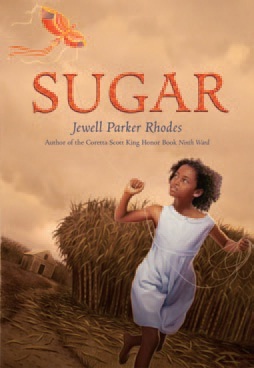
    Sugar by Jewell Parker Rhodes

    ★★★★½

    In 1870, slavery had already been abolished in the U.S. But many people who were formerly enslaved didn't have the means or the motivation to go north in search of other opportunities, and so they continued on in the only life they had ever known, living in the same shacks they lived in as slaves, and working for the same man who owned them as slaves. Sugar is a 10-year-old girl who lives and works with other formerly enslaved people on the River Road sugar cane plantation in Louisiana.

    With a good number of formerly enslaved workers leaving the plantation, Mister Wills, the owner, decides to hire Chinese workers to address the labor shortage. The original River Road folks are anxious, afraid they will lose their jobs to the Chinese workers.

    Sugar has the open-hearted, open-minded wisdom of a child, and she doesn't understand why she isn't allowed to play with Billy Wills, the owner's son with whom she gets along splendidly. She also doesn't understand why she isn't supposed to befriend the new Chinese workers, who fascinate her.

    Admittedly, I felt a bit wary going into this book. On the one hand, the Chinese people were referred to as "Chinamen" - a derogatory term - and their queue-styled hair and Eastern-styled clothing marked them as "different". Would this book reinforce the "perpetual other" stereotype of Asians? Yet, back then, Chinese people really were completely unknown to many Americans, and the use of "Chinamen" is historically accurate. In the end, I think the author did a good job portraying the Chinese workers as different, but not "exotic"; just people, like everyone else, working hard for a living. About half-way through the book, Sugar learns to say "Chinese" instead of "Chinamen", but I'm not sure it was effectively made known that "Chinamen" is actually offensive, and using "Chinese" is not just a matter of preference.

    Sugar and Billy, together with "Beau" - the youngest Chinese worker - eventually bring together the River Road community so that everyone understands everyone else just a little better.

    I really enjoyed this story, and its peek into a little-known part of U.S. history. I gave this book just shy of 5 stars because the short, matter-of-fact sentences eventually became tiresome and choppy, though they started out as a simple way to convey Sugar's childlike thinking.

    Friday, February 23, 2018

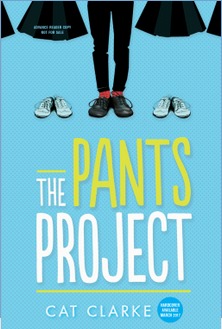
    The Pants Project by Cat Clarke

    ★★★★½

    *** Warning: This review contains spoilers!! ***

    First off, it's worth saying that The Pants Project is just a well-written, funny book! It was really enjoyable to read.

    Reading this book on the heels of George, I can't help but compare the two. This write-up is going to be less of a "review", and more of just "my impressions".

    While George was written for an upper elementary audience, and features a transgender girl in the 4th grade, The Pants Project was written for a middle school audience, and features a transgender boy in the 6th grade. Both books were well-written for their relative age groups.

    In both books, the main character had already realized they were transgender, but it was a secret they kept to themselves. Both George and Liv unfortunately attended schools that had gender-specific policies that exacerbated their discomfort, and in both cases, it was something school-related that helped to precipitate their coming out - first to a trusted friend, and then to their family.

    George was written in the third person, and female pronouns were used throughout. In The Pants Project, Liv narrates in the first person, so we don't know what pronouns he/she would prefer... I honestly wasn't sure what pronoun to use in this write-up, and I guess I settled on "they".

    Anyway. Both George and Liv had that one awesome friend who didn't bat an eye about their being transgender. I kind of wonder how realistic that is, but it seems like a good thing for kids to read books that portray that kind of compassionate friendship.

    Both George and Liv also happened to have "non-standard" families - George had a single mother, and Liv had two moms. While single motherhood was not at all an issue in George, Liv did have to face some cruel bullying directed at their moms. In that way, The Pants Project was about more than just being transgender; Liv faced other typical middle school problems, like friend drama and family struggles.

    George's mom had a bit of a harder time coming to terms with George's transgender identity, while Liv's moms were immediately 100% accepting. I do suspect that in real life, most parents are not nearly as readily supportive as George and Liv's parents, but again, it seems like a good thing for readers to see that kind of acceptance modeled in books.

    Both books had happy endings that stopped short of exploring what a transgender student might go through to come out in school. I'm sure that's a huge, difficult-to-tackle topic that maybe is best addressed separately from these brave stories about children coming out to close friends and family. Still, it's the logical next step, and I'd be interested in seeing Liv continue to challenge her classmates, teachers, and school administrators.

    I also wish The Pants Project could have revealed what Mom said to Jade, to make Jade stop bullying Liv. It just seems like it would be really useful to have a model of a speech that people could emulate if they ever have to tell off a bully - which I'm sure is quite common.

    Wednesday, November 8, 2017

    Save Me a Seat by Sarah Weeks and Gita Varadarajan

    ★★★★½

    This book uses the format in which each chapter is told from a particular character's first-person perspective. The chapters alternate between Ravi and Joe. Ravi is - in his words - "fresh off the boat" from India. Joe is one of Ravi's white American classmates. This book spans just one week, the first week of 5th grade.

    I loved so many things about this book. I'll just try to lay them out.

    I love that we hear the internal voice of a child immigrant. Off the top of my head, I can't think of any other children's book that I've read that includes such a character - and I find that shocking. Why aren't there more children's books like this?! I'm going to try to seek out some more... Anyway, I love that the reader is put into a position of better understanding how big the divide is between an immigrant's home country and America. American children - like Joe - are sure to look upon new immigrant classmates like Ravi as odd and different. But Ravi's narration lets us know that Ravi is not only a typical kid in India, but the very things that make him a target for ridicule in America are what helped make him popular and successful in India!

    Meanwhile, I love that Joe isn't just a "regular" kid in America - he's a good kid, but he feels different, too, because he has Auditory Processing Disorder (APD). He's thoughtful, but frequently misjudged. In this way, I love that this book includes a positive representation not only of cultural diversity, but also of special education diversity.

    On the one hand, I love that this book takes place in just one week. The kids are not bottling up their feelings for weeks and weeks, hiding them from their parents, letting things get worse. Though there is some hesitancy, both kids eventually open up to their parents, and things get resolved. I love that. These kids have parents and grandparents who care about them, and they really can help.

    On the other hand, I was somewhat disappointed that the book only spans one week, because at the end, I wasn't ready to leave Ravi and Joe. I wanted to read more, and see how their friendship developed!

    I love that this book had the ethnic-food-for-lunch quandary that is like a rite of passage for all immigrant children. I also love that the author gave it a bit of a different spin - Ravi did not have to feel ashamed of his lunch to realize that his lunch made him different. He recognized the difference, but was also proud and happy to eat the Indian food in his Indian-style lunch box.

    When I got to the end, I loved that this book has two glossaries - one for Indian words, and one for American words! It really helps to drive home the point that different cultures are tied to the language they use to describe every-day things. Just as an American reader would need a little context to understand words like kho kho (an Indian children's game), Shakti Kapoor (a Bollywood actor), and uppuma (an Indian food), a non-American reader would need a little context to understand words like Hacky Sack, Kohl's, and salsa! Not to mention American slang like "puke" and "crud".

    Finally, I loved realizing that the Ravi and Joe portions were written by different authors; presumably the Indian author wrote the Ravi chapters, and the non-Indian author wrote the Joe chapters. Their voices are distinct, you can hear their characters' personalities through their narration, and it may or may not have been relevant, but I just like the idea that both authors had two boys of their own, from whom maybe they drew some inspiration.

    So with all that being said, I gave this book just shy of 5 stars because of something that seems to bother me in a lot of children's books - the bully. I don't know why, but when it comes to realistic children's fiction, I always sympathize with the child bully just a little bit - I want the bully to be fleshed out enough so that we all realize that bullies aren't just evil, mean-spirited people, especially when they're kids. Usually, they have some issues they need to work out themselves, probably involving their home life, or how they're treated by their parents. In this case, the bully is a rich, probably spoiled Indian-American boy. He gets his comeuppance, but does he learn anything? Also, I wonder if Indian-American readers might resent how poorly American-born Indians are portrayed in this book, especially in the way they are depicted as being wholly different in every way from immigrant Indians. I would have liked to have seen some kind of resolution that might have brought Ravi and Dillon together in some way, even if only briefly.

    Monday, October 30, 2017

    Stanford Wong Flunks Big-Time (Millicent Min #2) by Lisa Yee

    ★★★★½

    This book is a clever companion book to Millicent Min, Girl Genius. It covers the same time period as Millicent Min, and sometimes the exact same events, only the story is told from Stanford Wong's perspective.

    I was impressed that this book is more than just the same story from a different angle. While I pegged Millicent Min for audiences as young as "upper elementary grades", this book I would put solidly in the middle school grades. Stanford's life is somewhat more complex than Millicent's. Not only is he struggling to pass summer school English, but he's hiding his summer school from his closest friends, he has a strained relationship with his parents, he has an aging grandparent who is slowly losing her mental faculties, and he likes a girl. (The book mentions "hickeys" and "second base", both in a vague manner showing that Stanford himself doesn't quite understand what those words mean.)

    From a multicultural point of view, I liked that this book was about a Chinese-American boy, but while his Chinese-American-ness was central to his character, it was also clear that Stanford was just another American kid trying to make his way through adolescence. On the one hand, this book is about a kid who just happens to be Chinese-American; the main plot is that Stanford loves basketball, but has failed English, so he needs to go to summer school. I imagine he's relatable to many young readers, and he's non-stereotypical because he doesn't fit the model minority mold. On the other hand, Stanford does have a tiger dad, and his family's dynamics were a pretty realistic portrayal of a Chinese-American family. Plus, Chinese culture makes regular appearances, mostly in the way Stanford's grandmother likes to make dim sum.

    A couple things led me to rate this book just shy of 5 stars. First, for much of the book, it really bothered me that Stanford lied so easily. While he eventually comes clean with all the big lies, I'm not sure he ever had any kind of realization that all the little lies along the way were detrimental, too, like in the way they hindered his ability to communicate meaningfully with his parents.

    Also, I didn't feel like I got enough closure with Digger. He's only a supporting character, but he was fleshed out enough that we know he acts out partly - or mostly - because he does not have a supportive home life. He is not a one-dimensional bully - we see his vulnerability a couple times - and yet there is no indication that he might change for the better after we leave the characters to their imagined futures. Too bad there isn't a book from HIS perspective!

    Friday, June 23, 2017

    The Siege of Macindaw (Ranger's Apprentice #6) by John Flanagan

    ★★★★½

    *** Warning: This review contains spoilers! ***

    A very satisfying conclusion - all loose ends tied up! - to the events that began in Book 5.

    I think the author is really good at character development. He keeps Will, Horace, and Alyss interesting while also introducing all sorts of new and different characters. He even had me feeling sorry for Keren at one point!

    The book was probably on track for a 5-star rating, but then I reined it in because I felt like there were some major holes in the action. When Will and Horace are hiding for hours under the upside-down cart, it just made no sense to me that the castle defenders wouldn't just walk out and physically inspect the cart after it's abandoned. Why wouldn't Keren order some men to investigate the cart, to see if there might be any hint of what kind of siege they might be planning? And when he orders the cart burned, the flaming arrows fail, so they just give up!? How lazy can you be! Why not walk down to investigate why the cart isn't burning, and then break it apart for firewood or something!?

    Then there was the climactic scene when Alyss was on the verge of killing Will. Of course Will wouldn't harm Alyss, but surely Alyss isn't so skilled with a sword that Will wouldn't be able to evade or restrain Alyss, right? He's one of the best-trained Ranger's after all, and managed to avoid being killed by the Scotti general in hand-to-hand combat! I think the implication is that Keren could easily have picked up the sword and finished the job, or held Will down while Alyss struck the fatal blow. But in a book where nothing goes unsaid, and battle scenes are described in great detail, it seemed like the logistics of this scene could have been fleshed out some more.

    Anyway, I loved the ending, and left the book with lots of positive feelings.

    As usual, a few mild swears ("damn" and "hell") thrown around. My third-grader who is reading the series is always especially entertained when he comes across a swear word!

    Monday, March 6, 2017

    March Trilogy by John Lewis, Andrew Aydin, and Nate Powell

    ★★★★½

    Every American should read this series in order to understand the full history and current state of racism in our country. Black Lives Matter is not new. In 1964, Ella Baker gave a speech saying, "Until the killing of black mothers' sons is as important as the killing of white mothers' sons - we must keep on." (Book 3, p. 99)

    March is a trilogy of graphic novels. This series is first and foremost a history of the Civil Rights Movement. Though written in the first person by John Lewis, it is not an autobiography, and we are given very little insight into John Lewis's personal relationships.

    Book 1: This book sets up the model for storytelling. It is the morning of President Barack Obama's inauguration. Brief scenes of John Lewis in Washington, DC are interspersed with flashbacks as he tells stories of his childhood to constituents visiting his office early that morning. Eventually the constituents and John Lewis need to go separate ways, and the reader remains the only audience for the flashbacks. I felt this book was the most accessible in terms of being a narrative, and setting the stage of what's to come. While I knew about the main events of the Civil Rights Movement - like the lunch counter sit-ins - I really did not know, before reading this book, just how much training, preparation, and planning went into them.

    Book 2: After the success of the lunch counter sit-ins, civil rights groups initiated a campaign of stand-ins to de-segregate movie theaters. But mostly this book focuses on the Freedom Rides. Again, I was familiar with the general idea, but I had much to learn. By putting themselves into life-threatening danger, participants had to apply and were extensively trained. The horrible treatment they endured is almost unthinkable, and yet, there it was, illustrated on the page. Very powerful. This book ends with the March on Washington for Jobs and Freedom, with Dr. Martin Luther King, Jr.'s "I Have a Dream" speech.

    Book 3: This book is the most intense of the three, explicitly detailing the horrific events surrounding the bombing of the Sixteenth Street Baptist Church in Birmingham, AL (in which four young girls died), and also of Selma, AL, which I was somewhat more familiar with because of the 2014 movie. The accounts in this book make it clear that the Civil Rights Movement was an agonizing series of demonstrations, arrests, marches, beatings, and funerals. So many funerals. This book also touched upon the internal controversies within the Civil Rights Movement, including disagreements between organizations in regards to methods of protests, and disagreements within organizations in regards to the role of white people in the movement.

    It's worth noting that this series is targeted for a teenage audience. Besides the physical violence depicted in the drawings, the first book uses the n-word, the second book uses the s-word, and the third book uses the f-word and makes a passing mention of sex.

    While supremely important for everyone to read, I gave the book just shy of 5 stars because the delivery of names and dates at times felt text-book-like, even despite the graphic novel context. I think the graphic novel medium was a genius method for illustrating - especially to younger audiences - just how violent the Civil Rights Movement was. But even as an adult reading this trilogy, I got lost in the names, particularly in the way every person was introduced solely within their role in the Civil Rights Movement. We did not get to know the private, surely complex people behind the names, and I sometimes felt I would have gotten even more out of the books if I had actually known more about some of the other players already.

    Also, the series seemed to end on a cliffhanger. As Book 3 progressed, SNCC (Student Nonviolent Coordinating Committee) became increasingly fractured, and one of the last lines of the story is, "It was the last day of the movement as I knew it." The trilogy ends with the passage of the Voting Rights Act of 1965, three years before Dr. Martin Luther King, Jr. was assassinated. But what happened to SNCC? What happened to John Lewis, as he adapted to the changing needs of the movement? An epilogue would have been nice. Guess I'll just have to pick up an actual biography of John Lewis to find out more about the man himself!

    Thursday, September 8, 2016

    Auggie & Me by R.J. Palacio

    ★★★★½

    Auggie & Me consists of three separate stories, each previously published as an ebook. Wonder left me downright yearning to read Julian and Charlotte's stories, so I was eager to read this collection that includes both Julian and Charlotte's perspectives.

    The Julian Chapter ★★★★

    I started out not really liking this story, with Julian's actions basically being explained away with excuses. Still, it made sense from Julian's perspective, and I could understand Julian's parents being blinded by love for their son; it's hard for any parent to believe that their child could actually be the bully.

    The school administrators, however, were another story. Mr. Tushman and Dr. Jansen were in a position to do more for both Julian and Auggie. Why didn't they arrange some kind of mediation between Julian and Auggie to address the issues between them? In this book more so than in Wonder, it was clear that the administrators all knew there were problems, but instead of stepping in to help with the root cause, they just took disciplinary action after events unfolded. Yes, Julian was responsible for his own behavior, but I felt the school should have done more to help diffuse the situation.

    It wasn't until Julian went to visit his grandmother in Paris that things started to fall into place. Grandmere and Mr. Browne were finally able to identify the root problem - which, again, should have happened much earlier - and Julian finally received some empathy and understanding as Grandmere told him a rather incredible story of her own with a similar theme, and a worthy lesson.

    Pluto ★★★★★

    This story surprised me! I wasn't at all curious to know more about Christopher when reading Wonder, but I really enjoyed his story. His perspective was honest and sweet, yet still believably realistic. Suddenly, Christopher is one of my favorite characters from Wonder!

    Shingaling ★★★★★

    One of the things I liked about Pluto and Shingaling is that both stories felt down-to-earth, more realistic. Nothing too over-the-top.

    My one complaint about Shingaling is that, like Wonder, it had a lot of relationship dynamics that I think are more typical of 7th graders than 5th graders.

    Putting that aside, I think Charlotte's story was more representative of how most kids would deal with someone like Auggie. Charlotte put it well at the end of her story - she was "nice", but Summer was "kind", a more genuine and meaningful sort of friendliness. Could Charlotte have been kinder to Auggie? Sure. But Auggie just wasn't a high priority for her. She had her own troubles, mostly worrying about changing friendships - which she cleverly outlined in Venn diagrams. When she wasn't trying to figure out middle school relationships, she had a dance performance to rehearse, regular school work to attend to, not to mention the mystery of the accordian-man to solve.

    This book includes a little recap of the different-books-for-different-perspectives style of writing that is used in these Auggie books: On page 280 of my edition, Charlotte says, "Funny how all our stories kind of intertwine. Every person's story weaves in and out of someone else's story." And that's just it. Every single person has a rich and complex life that can't be understood solely through their interactions with just one other person. Through Charlotte's story, we see how Ximena - just a marginal character in Wonder - was much more fleshed out in this book. We can imagine that even Charlotte's friend Maya must have a pretty compelling story of her own, if we just took the time to get to know her, too.

    Wednesday, June 29, 2016

    Alvin Ho: Allergic to Babies, Burglars, and Other Bumps in the Night (#5) by Lenore Look

    ★★★★½

    It's been about 5 years since Isabelle and I last read Alvin Ho. Now that Sebastien just finished 2nd grade - and has suddenly become more open-minded in regards to reading material! - I had a feeling he might enjoy reading about a Chinese boy in 2nd grade. I was pleasantly surprised to discover that since we last left Alvin, two more books have been published in the series! Hooray!

    I picked up this book, and it was like those 5 years hadn't passed at all. Alvin is still in 2nd grade, and he's still scared of pretty much everything. Through humor and empathy, we see how sensitive, lovable Alvin comes to terms with his mother's pregnancy.

    Alvin is such a sweet boy, my heart just about melted when he and his siblings built the birthing nest for their mom.

    The only reason I didn't give this book 5 stars is because I felt it left one loose thread hanging. A little closure on that bit about the burglar would have been nice.

    Wednesday, June 22, 2016

    Smile by Raina Telgemeier

    ★★★★½

    This book has a lot of the same themes as Roller Girl, which I know was published after Smile, but which I happened to read first.

    Raina is a middle schooler who struggles with all the expected challenges of puberty - frenemies, boys, acne, etc. Unfortunately, she also has a freak accident in which her top two front teeth are knocked out!! Aagh!! The poor girl has to endure frequent and painful orthodontist visits and a series of uncomfortable dental procedures and equipment.

    There are so many things that I like about this book! Raina is, understandably, unhappy about her dental situation, but she is not distraught and does not wallow in self-pity. She kind of just keeps picking herself up and going back to school. She is as insecure as any other middle schooler, yet she makes good decisions; if she's uncomfortable in a situation, she'll do what's best for her, and won't just follow the crowd.

    I often feel that there is too much emphasis these days on people having BFFs, so I really liked the fact that Raina does not seem to have one "best friend". She has a group of friends with whom she feels comfortable hanging out.

    One of the great life lessons of this book is finding out who your friends really are, and what it means to be a friend to somebody. For much of this book, I was a little underwhelmed with Raina's friendships, and I worried that these relationships were being portrayed as "typical friendships" for middle schoolers. Thankfully, by the end of the book, Raina made some pretty keen realizations, and I LOVED that she entered high school with an attitude of excitement and optimism about meeting new people and making new friends. I liked especially that the transition happened without any ill-will towards her old friends.

    One small note about the cast of characters. Even though the main character and her family are Caucasian, I appreciate that other races made appearances in the book, including an African-American boy on whom Raina develops a crush. The book's diversity factor appears mainly as details in the illustrations, but it's still meaningful to see multiculturalism depicted in a normalized way.

    This book would be a great selection for any upper elementary or middle school reader who is in the midst of or on the cusp of hitting puberty. There's a sense of, "Well, if Raina can get through that, then I can get through whatever is going on in my own life, too!"

    Wednesday, June 3, 2015

    Palace of Dreams (The Familiars #4) by Adam Jay Epstein & Andrew Jacobson

    ★★★★½

    I gave this book just shy of 5 stars because of a few things that didn't sit right with me for a book that is supposed to be geared towards readers in upper elementary grades. Early on, there was a grim depiction of suicide, though the word "suicide" was not used. Also, it appears this volume has a different illustrator than the other volumes, and though I wasn't crazy about the illustrations in the first three books, I'm not crazy about these, either. I think they are better in quality, but more often than not, the pictures are scary. I don't know how it's decided which scenes get illustrated, but I would have preferred a few less frightening scenes!

    Otherwise, I really enjoyed this book. Once again, the Prophesized Three are on a quest, and this time, there is more urgency than ever. I liked that in this installment, there seemed to be more cases in which Aldwyn, Gilbert, and Skylar had to use their wits to solve problems, rather than just relying on their magic.

    The book ends on a cliffhanger, so clearly a fifth book should be in the works. Can't wait!

    Thursday, March 26, 2015

    Bobby vs. Girls (Accidentally) by Lisa Yee

    ★★★★½

    I came across this book while volunteering in my kids' elementary school library. In the cover illustration, Bobby looked like maybe he could be Asian, and with the author's name being Lisa Yee, I decided to check it out for myself. I'm always interested in multicultural books for kids!

    It took a while for Bobby's character to be fleshed out. His age (9) was not revealed until page 16, and even though we learn right away that his last name is Ellis-Chan, we don't find out for sure until page 49 that he is half Chinese. Even from the illustrations, it wasn't clear to me which parent was Chinese (I suppose it doesn't really matter!), but I finally decided it was the mom, based on the illustration on page 164.

    It's worth noting that there is zero reference to Chinese language or culture in this book, and I think that's fine. While books like those by Grace Lin, Lenore Look, and Andrea Cheng really embrace Chinese-American-ness, I think there's also a valid and important place for books in which characters just happen to be Chinese-American, and their Chinese-American-ness doesn't need to be front and center.

    Besides Bobby's ethnicity, this book also embraces diversity in other ways. Mr. Ellis-Chan is a stay-at-home dad (whose former career as an NFL player is a bit over the top), and one of Bobby's friends is Indian. Also, Bobby has environmental allergies and asthma.

    I really liked Bobby. He has heart and compassion. He's thoughtful and well-intentioned. He's just a real good kid.

    Mostly, I like this book because it is a growing-up book about a boy suitable for lower to middle elementary grades. Children's literature is awash with growing-up stories featuring girls (e.g., Ramona Quimby, Betsy-Tacy, Little House, etc.), but there are fewer similarly themed chapter books with pictures that feature boys. So far, I've really only found Henry Huggins and Alvin Ho to be comparable. There is a sequel to this book, and I'm hoping I will like it just as much as this one.

    Still, I'm giving this book 4 1/2 stars, just shy of 5, for a couple reasons. First, the book is clearly set in modern times, yet, even while trying to buck old-fashioned narrow-mindedness, it seems to reinforce it. For example, it's great that Bobby's classroom features photos of famous Americans, both male and female, but why does Sally Ride - the only female listed - require a descriptor? Even if she really is lesser known than Barack Obama and Albert Einstein, by explaining who she is and not the others, it gives the impression that she, the only female, should be less familiar to readers. Also, it's great that Bobby's dad is an active member of the PTA, but would modern-day PTA members really even use the term "PTA Lady"?

    Also, I love the way Bobby and Holly worked out their friendship, but I wish the book had further addressed Holly's friendship with Jillian Zarr. It's understandable that Holly would want some female friends with shared interests, but Jillian Zarr was downright mean and snooty. I sort of hoped she would get some sort of comeuppance.

    Incidentally, I read this book aloud to Isabelle and Sebastien, and they both liked it, too!

    Monday, February 2, 2015

    The Hobbit by J.R.R. Tolkien

    ★★★★½

    This is my third time reading this book, and I had forgotten how approachable it is. The storytelling is casual and reads more like young adult fiction. I love the adventures and the world of Middle Earth. I only wish I could have read this book in a more continuous fashion; I only had time to read it in short spurts, usually maybe half an hour straight at most. I felt like my momentum kept getting interrupted, and that detracted from my reading experience. In fact, as soon as I finished the book, I felt like I wanted to go back and read it again! But I don't know, I guess I'll move on to The Lord of the Rings, as originally planned...

    So the reason I didn't give the book 5 stars is that it did leave me with a couple questions. I never quite felt like I understood why Gandalf chose Bilbo to go with the dwarves on this adventure. How did Gandalf know that Bilbo would be up for it? Partly, perhaps, because he had some Took blood in him, but then, why Bilbo and not another hobbit in the Took family? I was also a little surprised by how silly the elves were portrayed, always singing and laughing. They didn't have the kind of dignity that I associate with them from having read LOTR.

    UPDATE 2/2/15: After watching the final installment of the Hobbit movies, I was inspired to re-read the book again. The first thing that struck me was just how many liberties Peter Jackson took with the movies. But that's beside the point. As always, a good read! This time I read it with an eye towards children, as I wondered if the book would be suitable as a read-aloud with the kids. In fact, I found the book to be pretty kid-friendly! The narrator assumes the air of a friendly storyteller, and all the potentially scary encounters are told so matter-of-factly that they aren't nearly as scary as the movie makes them out to be. Isabelle and Sebastien haven't shown much interest in this world of hobbits and dwarves, but if I can convince them to sit and listen, I think they would enjoy it!