Showing posts sorted by relevance for query jason reynolds. Sort by date Show all posts

Tuesday, March 16, 2021

Stamped: Racism, Antiracism, and You by Jason Reynolds and Ibram X. Kendi

★★★★

I picked up this book because I am already a fan of Ibram X. Kendi and Jason Reynolds. I was probably biased to like it even before I read it.

It's clear that this book was written for middle and high schoolers. The tone was casual and conversational, and the text at times flowed better if I imagined Jason Reynolds was speaking the words in front of me. The fact that I think of this book as using "hip lingo" just shows how I am old and not the target audience. 

Though the back cover loudly proclaims, "This is NOT a history book," actually, it is, just not in the traditional sense. The history presented in this book makes clear how anti-Black racism has always been and continues to be used to oppress and divide those without power so that those with power can stay in power or achieve even more political or financial gain. Much of the analysis is presented in terms of segregationism, assimilationism, and antiracism, big ideas that Reynolds makes easily accessible. This book provides the foundation one needs to better understand how racism is not just a problem with people individually, but a systemic problem rooted in policies, and how those policies have come about.

This book calls itself a "remix" of Ibram X. Kendi's book Stamped from the Beginning, which I am now inspired to read. There is so much information, mostly presented in broad strokes, that I am interested in reading the original book, which I assume fleshes out more of the details.  

This book would be a valuable read for any student because it lays bare how the typical history presented in most classrooms is whitewashed, omitting many harsh truths. I wondered, however, if some ideas weren't getting explained well enough for the intended audience of young readers. For example, the book mentioned affirmative action (p. 223, 230), but didn't define it. The reader is assumed to understand that affirmative action should be supported, but for those who haven't thought much about it, or who might not even know what it is, I think some further commentary would have helped to shed light on why affirmative action is considered controversial. 

Wednesday, April 3, 2019

Sunny (Track #3) by Jason Reynolds

★★★★★

This book is written as a series of diary entries by Sunny. I have to admit, I was a little put off by the format, because I enjoy reading dialogue. But Sunny's authentic middle school voice really won me over. I think Jason Reynolds does a fabulous job capturing Sunny's all-over-the-place kind of internal monologue.

What I liked most about this book is how Sunny really feels himself to be "weird", different from other kids. And he's not wrong. His mother died giving birth to him, so he carries around the guilt of feeling like he's his mother's murderer. He's been homeschooled his entire life, so up until he joined the track team, he had no friends his own age, and his whole life revolved around his home. I think it can be really valuable for young readers to see a character who truly feels a kind of loneliness, a person their age who doesn't fit the mold of a "typical" kid. Still, he is typical because when it comes down to it, all he wants is what everyone wants, the love of family, supportive friends, and to do what he enjoys.

Also valuable is for young readers to see how complex and full Sunny's "non-standard" life is. There're a lot of disparate ideas that all come together through Sunny. He empathizes with cancer patients at the hospital where his grandfather is a doctor. He makes connections with the groundbreaking movie Baraka. He and his father literally and figuratively piece together his mother's image, working together though their relationship is cold and strained. There's even a message about forgiveness and loyalty, relationships and new beginnings, as Sunny learns the true story behind how and why Aurelia came to be his homeschool teacher. (Heads up for parents who want to know these things: There's reference to drug addiction, but it's clear that drugs are bad, and people who suffer from drug addiction can recover and thrive.)

I love that in this book, there is no stigma in crying. Sunny cries, Aurelia cries, his father cries. Everyone cries, and it's fine, it's just what people do.

Also, as a former shot putter, I appreciate that this book brings in the "field" component of "track and field"!

Monday, October 8, 2018

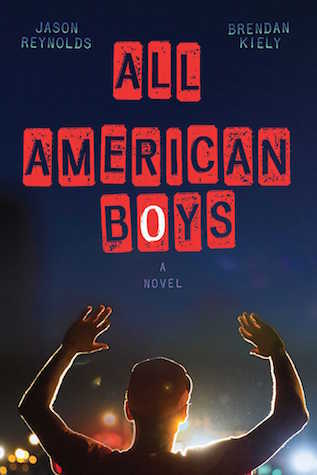
All American Boys by Jason Reynolds and Brendan Kiely

★★★★★

Quinn is a white teenaged boy who plays on the school's competitive basketball team. Rashad is a black teenaged boy who is a junior ROTC cadet, and whose best friends play on the same basketball team as Quinn. Chapters alternate between first-person narratives by Quinn and Rashad, and - unlike some other books that use this same storytelling method - the voices of the boys are distinct enough so you could probably figure out who is narrating without having to read the chapter title, thanks to Rashad's chapters being written by Jason Reynolds (a black author), and Quinn's chapters being written by Brendan Kiely (a white author).

One Friday night, as both boys have the same plans to go to a classmate's party, Rashad is racially profiled inside a corner store and becomes a victim of police brutality perpetrated by a white officer. Quinn witnesses the beating and, to his horror, recognizes the officer as his best friend's older brother Paul, a man who, in many ways, was a surrogate father figure to him after his own father died in Afghanistan. The book starts just before the incident, and spans the following week.

Having read this book on the heels of The Hate U Give, it's easy to compare the two and find similarities, though each does offer something different. The Hate U Give is written entirely from the perspective of a black girl who is the sole witness to a fatal shooting. She watches as her friend's name becomes a hashtag, and struggles as public attention turns to her as the only person who can testify about the shooting. All American Boys, on the other hand, offers the perspective of a black boy who survives a non-fatal attack and sees his own name become a hashtag. It also provides the viewpoint of a white boy who grapples with trying to make sense of what he saw, what it means about the world around him and who he is as a person. Since the incident was caught on video by other bystanders, his testimony probably isn't important to the investigation, but he still needs to make some hard choices to come to terms with what happened.

Rashad's story is compelling, and I imagine it would be especially so if you aren't already a supporter of Black Lives Matter. If you are, I expect you'll find your commitment to the movement reaffirmed, as I did.

For myself, I found Quinn's story to be more eye-opening and thought-provoking. I have to admit, as a liberal person of color who lives in a blue state, I frequently wonder, with no small amount of frustration, why more white people aren't more woke. Why can't they see the racism!? Or if they admit to seeing it, why won't they speak up and fight against it? This book doesn't make excuses for white people, but it does show how it can be difficult for individual white people to take a stand when it means losing life-long friends, challenging long-held beliefs, and actually risking opportunities for a better future (e.g., Quinn taking a stand could affect his place on the basketball team, which would affect his chances of earning a college scholarship). The stakes can be high. Given Quinn's previous relationship with Paul, we see how painful Quinn's position is; how is it that someone who he knew to be so generous and so good to him could actually be capable of such a frightening and unthinkable act? Through Quinn's struggle, we see how for many people, life would be so much easier if they just refuted the evidence and ignored the racism.

As might be expected in a book rated for teens, the boys' authentic teenaged dialogue does include swearing.

Sunday, February 9, 2020

Look Both Ways by Jason Reynolds

★★★★

This book is a collection of 10 short stories all set in the same time and place. When the closing bell rings at Latimer Middle School, students go their separate ways, sometimes alone, sometimes with friends. Every kid has a story. Taken together, we see how complex these students' lives can be, even in middle school.

I really enjoyed this book's format and storytelling. Each chapter starts with a small illustration, one part of a larger tableau (the cover art) depicting all the stories' main characters as they leave school at the end of the day. The students are all classmates, so they weave in and out of each other's stories, a tangential character in one story becoming the main character of another. I can see these crossovers being especially fun for young readers. Maybe they'll read a story and think, "Oh! This story is all about that kid from the other story!" or, "I remember these kids from their story, I know where they are going!"

Narration styles vary; stories may be told in a straightforward chronology, with flashbacks, or using some other unconventional method. At times the prose blends into poetry. Metaphors and similes abound. I have to admit, I am a very literal reader, so I am not sure I understood the "school bus falling from the sky" line that kept popping up throughout the book. The last story provides both some metaphorical context and a literal explanation for the line, which gives a nice sense of closure, though I'm still not sure I get the falling out of the sky part. Maybe it's about school buses representing the unexpected, or maybe it's just silly fun.

As usual, Jason Reynolds does not disappoint with the diversity and complexity of his characters and stories. We have kids of color, yes, but we also get glimpses of illness (sickle cell anemia, cancer, dementia), loss of a loved one, fear (of change, of dogs, of danger), bullying, homophobia, and incarceration. These hard things don't dominate, though, because the young heroes of these stories are busy with hustling schemes, video games, humor, and young love. They are supported by friends who are loyal and brave, and by familiar adults like teachers, a custodian, a crossing guard, a store owner, neighbors, and even a passer-by, people who might seem peripheral, but really are grounding.

My ratings for individual stories ranged from 3 to 5 stars, so I figured on 4 stars overall.

Saturday, January 12, 2019

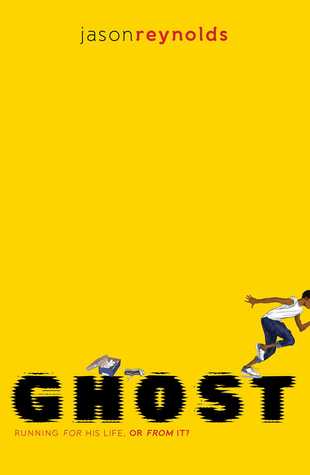
Ghost (Track #1) by Jason Reynolds

★★★★

Castle Cranshaw is a black boy, around 7th grade, who finds his way onto a competitive inner-city track team. Introducing himself to his new team, he uses his self-given nickname "Ghost" because ever since he was a victim of domestic gun violence, he's just felt like that word describes him.

Though this series is popular in the upper elementary grades at my child's school, some might consider it a better for fit the lower middle school grades. Besides the domestic gun violence, the book matter-of-factly references "junkies" and a "dope man" who sells drugs at the local basketball court. There's also a separate mention of an addict who overdoses.

The book is a first-person narrative, and the voice is authentic, poor grammar and all. The main character is a realistic portrayal of a kid trying to figure things out while carrying around a lot of angst. He understands that his single mother works hard to provide for him, and he wouldn't mind the knock-off sneakers and the free meals he gets from the cafeteria where his mom works - except that he gets bullied for those things in school. The author so effectively relates Ghost's inner monologue that I really feel for him when he has two mortifying experiences two days in a row. And while it's easy to know right from wrong, I can understand why Ghost makes the poor decisions he makes, and how he came to make those decisions, despite knowing better.

A few things kept me from giving this book a higher rating. Mostly I was disappointed in the abrupt ending, which came just as I thought I was on the cusp of a celebratory climactic ending. I'm the first person to deride an over-the-top perfect ending, but I can think of several ways the book could have ended with more closure while avoiding that trap. I can only assume that the author wants us to focus not on the finish line, but on the training and experiences that get us there.

Also, it didn't quite sit right with me that twice in the book Coach helped out Ghost in very significant ways without telling Ghost's mother. I get that Ghost and Coach were forming a relationship built on trust, but I think there are certain things that are important enough that mom really ought to know about them, especially since Ghost is still just around 12-13 years old, and many readers are even younger than that. Telling mom didn't have to be major events in the story, maybe just something that could have been tied up in a denouement.

Finally, one of my pet peeves is one-dimensional bullies, and Brandon Simmons seemed to fit that profile. I just think it's too common for children's books to have one-dimensional bullies, and I wish more books would try to show that bullies aren't just purely evil children, they are usually acting out for some reason or another. Within the very last pages, there is a hint that maybe there is more to Brandon than meets the eye, and I'm hoping that his character will be fleshed out more in the subsequent books, which I'm looking forward to reading.

Tuesday, February 5, 2019

Patina (Track #2) by Jason Reynolds

★★★

Patina picks up right where Ghost left off. We find out how the first track meet went, only now events are told from Patty's point of view.

Patty and her family have experienced more hardships than any family should have to face, particularly in so short a span of time. Patty puts on a strong front, taking it upon herself to look out for her younger sister while also doing right by her mother and keeping her own life in order. It's a lot for a kid, and I'm not sure if it was in the writing or the character, but Patty showed a lot more maturity than I would expect from a middle schooler; I kept having to remind myself that she wasn't a high schooler.

The book takes place over the course of a week, but the first few chapters spend a lot of time laying down the backstory of how Patty and her sister came to live with their aunt and uncle. It's a lot of character development as Patty goes to school and interacts with classmates while learning about Frida Kahlo, and as she goes to track practice and interacts with teammates while learning to pass the relay baton. There isn't a lot if action at first, but things start to pick up towards the end of the week.

Patty is confident and self-aware as she takes on each new day, gradually peeling back the layers of the people around her and making sense of things. She's a great character for young readers to get to know, especially if you're on the lookout for a black female protagonist in realistic children's fiction.

Tuesday, May 7, 2019

Lu (Track #4) by Jason Reynolds

★★★★★

Lu is a perfect conclusion to this series!

This book falls squarely in the "middle grade" range, as the drug addiction of tertiary characters play a central role in character and plot development. It's made clear that drug addiction is an illness that requires treatment, and that addiction causes pain and suffering not only to the person, but to their friends and family as well.

As an albino, Lu has experienced his fair share of bullying. Young readers who are teased for being different in some way can hopefully find a connection with Lu, who learns to view bullying in a new perspective that helps build his maturity and confidence.

Like Sunny, Lu cries. And other characters cry, too. Tears might not be flowing freely, but tears are wiped away, people sniffle. I think it's just so important for young readers, especially boys, to see that crying is a natural form of emotional expression, and it's not a sign of weakness.

I love the way this book handles bullies. One of my biggest pet peeves in children's books is when a bully is one-dimensional. Sure, the protagonist needs an antagonist, but more often than not, the bully is simply a thoroughly mean person used to drive the story. Realistically though, I'm guessing that not all bullies are sociopaths, maybe they are just regular people who have a whole lot going on in their own lives that they don't know how to process, and so they act out in an effort to have some semblance of control and power. Anyway, that's what we see in this book, and it's a powerful depiction of relationships and responsibilities and integrity.

As the finale of the series, the book does a great job tying in Ghost, Sunny, and Patty, so you can feel there is a kind of closure to all their stories.

Tuesday, January 29, 2019

Black Enough: Stories of Being Young & Black in America edited by Ibi Zoboi

★★★★★

As the inside jacket states, "Black is urban and rural, wealthy and poor, mixed race, immigrants, and more - because there are countless ways to be Black enough." I hope young black Americans, whatever their background, find themselves reflected in these pages. Non-black Americans should read these stories as windows into communities they might not otherwise see.

This collection of 17 short stories reflects the diversity within the black community. A number of the stories feature LGBTQ characters. Issues span the spectrum from code switching to sexual identity to death and suicide; from family dynamics and mental health to friendships and relationships; from self-identity to the power of musical influence to sexual assault.

These stories resonate. They are honest and relevant, social media use and all. The voices are compelling, the dialogue authentic. Individually, my ratings for stories varied from 3 to 5 stars, and averaged to 4.3, but the book on the whole gets 5 stars for its range and importance.

Reading these stories as a Chinese-American, the more I read, the more I wished there was such an anthology for young Asian-Americans. I can only imagine how self-affirming it might have felt to read a book called "Asian Enough: Stories of Being Young & Asian in America" as a teenager.

Below I am listing each individual story, a brief summary, and my personal rating for each (sans explanation, because that would take too long).
  1. "Half a Moon" by Renee Watson (★★★★★): A teen counselor at a camp that encourages black city girls to appreciate nature finds herself unexpectedly dealing with unresolved family issues.

  2. "Black Enough" by Varian Johnson (★★★★★): A black boy from an affluent, predominantly white community learns something about himself when he spends time with his cousin and his friends in a predominantly black community in South Carolina.

  3. "Warning: Color May Fade" by Leah Henderson (★★★★): A talented black senior in an affluent, predominantly white private boarding school struggles with speaking her truth through art in the face of parental disapproval.

  4. "Black. Nerd. Problems." by Lamar Giles (★★★★★): An entertaining glimpse into the world of mall employment through the eyes of a black teenager who self-identifies as a sci-fi nerd.

  5. "Out of the Silence" by Kekla Magoon (★★★): A girl with a secret tries to come to terms with the unexpected death of a classmate, the only other person who knew her secret.

  6. "The Ingredients" by Jason Reynolds (★★★★★): Heartwarming banter among four buddies in Brooklyn walking home from the local pool on a hot summer day.

  7. "Oreo" by Brandy Colbert (★★★★★): An upper middle class black girl in a predominantly white suburb of Chicago gets accepted to a historically black college, visits her family in a rural, predominantly black community in Missouri, and wonders if attending an HBCU is the right decision for her.

  8. "Samson and the Delilahs" by Tochi Onyebuchi (★★★): Star of the debate team, the straitlaced son of a Nigerian immigrant meets his new neighbor, a black girl who introduces him to heavy metal music, unlocking a part of himself he didn't know was missing.

  9. "Stop Playing" by Liara Tamani (★★★★★): Houston-area teens at a church youth retreat navigate the complexities of relationship drama.

  10. "Wild Horses, Wild Hearts" by Jay Coles (★★★): In the rural South, a black farm boy gets to know the white farm boy next door, though their parents are in a feud and are narrow-minded in different ways.

  11. "Whoa!" by Rita Williams-Garcia (★★★★): A part-time model and fashion student sees, in his great-grandmother's water basin, a vision of an 1840s slave, with whom he has an improbable conversation.

  12. "Gravity" by Tracey Baptiste (★★★★★): A Trinidadian immigrant in Brooklyn is sexually assaulted.

  13. "The Trouble with Drowning" by Dhonielle Clayton (★★★★): In the DC area, a girl from a wealthy family, with emotionally detached parents, struggles in the aftermath of traumatic events.

  14. "Kissing Sarah Smart" by Justina Ireland (★★★★): A mixed race girl spends the summer between high school and college visiting her white grandmother in small-town Maryland and coming to terms with her sexual identity while her mother tends to her own mental health.

  15. "Hackathon Summers" by Coe Booth (★★★★★): Every summer in high school, a boy from Rochester attends a weekend hackathon at NYU, where he falls for a Muslim girl.

  16. "Into the Starlight" by Nic Stone (★★★★★): An upper middle-class girl from a well-to-do part of Atlanta gets to know a boy with a bad reputation from a less privileged, predominantly black part of town.

  17. "The (R)evolution of Nigeria Jones" by Ibi Zoboi (★★★): A girl raised in a cult-like community dedicated to black nationalism doesn't actually believe in the movement and wants to break free.