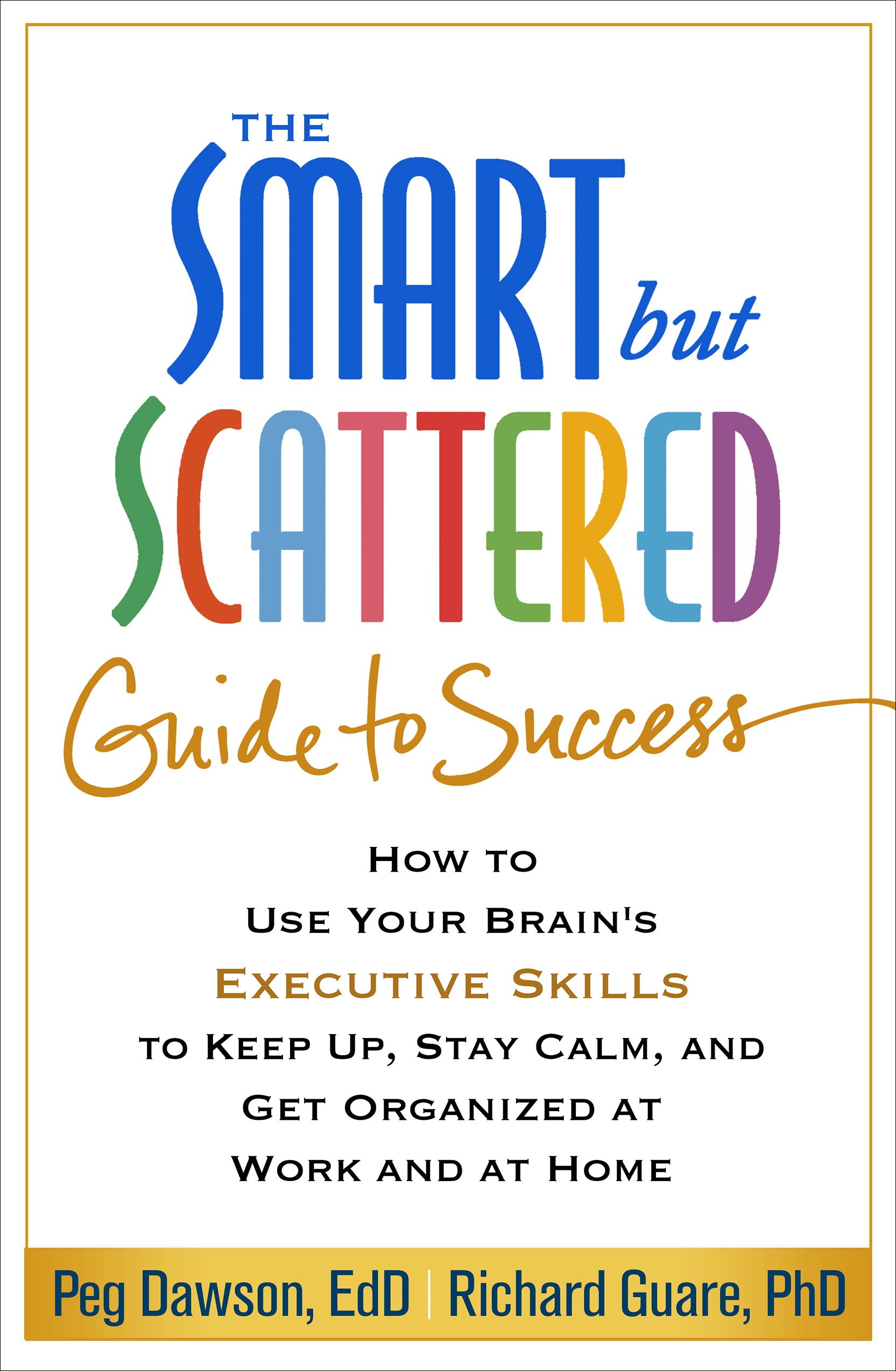
 I started this book as kind of an academic endeavor. I consider myself a highly organized person and always figured it was an innate personality trait. But lately I've been thinking about whether or not and how organizational skills can be learned.
Within the first few pages, my attitude changed from detached curiosity to personal engagement. As the whole concept of "executive skills" was introduced, I felt pretty confident in my skills in some areas, but I could immediately see room for improvement in others. Also, it was eye-opening to connect the "not able to get things done" behavior I've seen in others with specific areas of executive functioning like task initiation and sustained attention.
The authors identify 12 executive skills categories:
- Response inhibition
- Working memory
- Emotional control
- Task initiation
- Sustained attention
- Planning/prioritizing
- Organization
- Time management
- Flexibility
- Metacognition
- Goal-directed persistence
- Stress tolerance
The authors explain that typically, a person's "executive skills profile" includes both strengths and weaknesses (p. 19), and the goal is not only to improve in our weaker areas, but also to leverage known strengths to help compensate for known weaknesses. (p. 8)
I actually found the second half of the book the most informative and helpful. There is a dedicated chapter for each executive skill, and each chapter includes a discussion of the significance of the skill, what weakness in that skill might look like, recommendations for managing the weakness, recommendations for improvement, and a case study. (The case studies sometimes seemed simplistic; I wonder if they were based on real people or completely made up). Some chapters additionally provide summaries of research studies and/or scientific findings related to that executive skill. Jumping to the specific chapters that you think you need the most might be a reasonable approach, but the authors make a case for reading all the chapters (p. 114) since many skills overlap and you may pick up helpful pointers from unexpected chapters. I definitely found that to be the case for me, plus I appreciated reading all chapters because it helped me get a better sense of the "big picture" of executive skills and how they are inter-related.
Circling back to the first half of the book, a questionnaire in Chapter 2 helps you identify your strengths and weaknesses, and then lots of concrete, specific suggestions are given in Chapter 3 to help you manage any weaknesses. Personally, many of these suggestions were things I already do naturally, so this book actually taught me that these kinds of habits don't necessarily come easily to others and can be learned. Broadly, the suggestions fall under three categories:
- Change your environment, e.g. to help overcome weak task initiation, lay out needed supplies in advance for a task.
- Change the task, e.g. if weak sustained attention is an issue, instead of worrying about finishing a big task all at once, set aside a manageable amount of time each day to make incremental progress.
- Let others help you, e.g. if there's something you have to do, make a point to tell other people, since just talking about something can increase your level of commitment and help you stay accountable. At the same time, be careful not to burden others unfairly, i.e., don't intentionally give up on improving a weakness, expecting others to pick up your slack. (p. 108)
Useful suggestions include:
- Identify a very specific activity as the target for improvement, i.e., "Start small and gain confidence from experiencing successes." (p. 51) The authors go so far as to say, "We have found that setting ridiculously small goals may be the best way to achieve change." (p. 75)
- Make your immediate goal achievable, i.e., don't set yourself up for failure by setting your first goal to be something that you currently never do, e.g., if you're always at least 15 minutes late to work every day, don't aim for being on time right away, start by saying, "I will improve my punctuality for work by 5 minutes." The authors insist that if "people can consistently get to the low end of their baseline as a starting point, they are making progress." (p. 109)
- Set up visual and auditory reminders of the desired behavior, e.g., strategically place Post-It notes in relevant areas and/or schedule notifications on your smart phone.
- Stay motivated with positive self-talk and rewards.
- Consider it a success if you can regularly meet your goal 80% of the time. Don't expect perfection, and if you're not meeting the goal even with sustained effort, re-adjust the goal, e.g., make it smaller. (p. 72)
There are chapters that focus on the realms of work, home, and relationships, with worksheets and suggestions for various scenarios. These chapters are broken into titled sections, so if you're short on time or interest you could just read the parts most relevant to your personal situation.


No comments:
Post a Comment