- The Three Musketeers (#1) ★★★★
- Twenty Years After (#2) ★★★★
- The Vicomte de Bragelonne (#3) ★★★★
- Ten Years Later (#4) ★★★★
Showing posts with label Alexandre Dumas. Show all posts
Showing posts with label Alexandre Dumas. Show all posts
Friday, March 28, 2014
The d'Artagnan Romances Roundup
I seem to have taken a long break in the middle of this series, but I hope to get back to it someday!


Friday, May 10, 2013
Ten Years Later (The d'Artagnan Romances #4) by Alexandre Dumas
★★★
 First, a recap. I am reading the D'Artagnan Romances via the FREE Kindle ebooks available on Amazon:
Book 1: The Three Musketeers
Book 2: Twenty Years After
Book 3a: The Vicomte de Bragelonne
Book 3b: Ten Years Later
Book 3c: Louise de la Vallière
Book 3d: The Man in the Iron Mask
Ten Years Later actually refers to the ten years in between Twenty Years After and The Vicomte de Bragelonne, so really, I think the titles of Books 3a and 3b should have been swapped. While the Vicomte still is not consistently a central character throughout this book, he certainly plays a much bigger role here than in the book that was named after him.
About three-quarters of the way through this book, I lost all my notes, so my review is going to be shorter than I had originally intended... That's probably for the better, actually, since sometimes I think my reviews are too long anyway.
D'Artagnan and Athos make a couple brief appearances in this book, but mostly they are absent. Porthos is practically non-existent. Aramis is the key musketeer in this book, and chapters about him appear intermittently. Mostly they are setting the stage for The Man in the Iron Mask - which I only know from watching the Leonardo DiCaprio movie years ago. Surprisingly, the movie seems to have sufficiently equipped me to understand Aramis's secrets, and honestly, I think if I did not already know where the Aramis storyline is leading, I would be awfully confused about his doings in this book.
So, if this book isn't really about the musketeers, then what's it all about? Like a Jane Austen novel, this book is mostly about the love interests of "the young people". Our beloved musketeers, along with Anne of Austria, play supporting roles for the next generation - the Vicomte de Bragelonne and King Louis XIV, among others. Relationships are complicated by multiple love triangles, and there's a whole lot of drama going on at the court.
I found this book entertaining enough to keep up with it, but not especially compelling. It was easy to put it down and not pick it up again for days at a time.
First, a recap. I am reading the D'Artagnan Romances via the FREE Kindle ebooks available on Amazon:
Book 1: The Three Musketeers
Book 2: Twenty Years After
Book 3a: The Vicomte de Bragelonne
Book 3b: Ten Years Later
Book 3c: Louise de la Vallière
Book 3d: The Man in the Iron Mask
Ten Years Later actually refers to the ten years in between Twenty Years After and The Vicomte de Bragelonne, so really, I think the titles of Books 3a and 3b should have been swapped. While the Vicomte still is not consistently a central character throughout this book, he certainly plays a much bigger role here than in the book that was named after him.
About three-quarters of the way through this book, I lost all my notes, so my review is going to be shorter than I had originally intended... That's probably for the better, actually, since sometimes I think my reviews are too long anyway.
D'Artagnan and Athos make a couple brief appearances in this book, but mostly they are absent. Porthos is practically non-existent. Aramis is the key musketeer in this book, and chapters about him appear intermittently. Mostly they are setting the stage for The Man in the Iron Mask - which I only know from watching the Leonardo DiCaprio movie years ago. Surprisingly, the movie seems to have sufficiently equipped me to understand Aramis's secrets, and honestly, I think if I did not already know where the Aramis storyline is leading, I would be awfully confused about his doings in this book.
So, if this book isn't really about the musketeers, then what's it all about? Like a Jane Austen novel, this book is mostly about the love interests of "the young people". Our beloved musketeers, along with Anne of Austria, play supporting roles for the next generation - the Vicomte de Bragelonne and King Louis XIV, among others. Relationships are complicated by multiple love triangles, and there's a whole lot of drama going on at the court.
I found this book entertaining enough to keep up with it, but not especially compelling. It was easy to put it down and not pick it up again for days at a time.
Wednesday, January 23, 2013
The Vicomte de Bragelonne (The d'Artagnan Romances #3) by Alexandre Dumas
★★★
 Okay, at this point, I think I need to be clear about what series I am reading and commenting on. The D'Artagnan Romances were all originally published as serials, and they were later published in book form as a trilogy:
Book 1: The Three Musketeers
Book 2: Twenty Years After
Book 3: Ten Years Later
Apparently, Ten Years Later is such a tome that it has been further split into 3, 4, or 5 volumes, depending on the publisher. I am reading a set of FREE ebooks available on Amazon.com, and this series consists of a 4-volume version of Ten Years Later. This means I have read / will be reading these ebooks:
Book 1: The Three Musketeers
Book 2: Twenty Years After
Book 3a: The Vicomte de Bragelonne
Book 3b: Ten Years Later
Book 3c: Louise de la Vallière
Book 3d: The Man in the Iron Mask
So, on to my thoughts of The Vicomte de Bragelonne...
Even more than the first two books, The Vicomte de Bragelonne is slow to start. This book seems to be named about as appropriately as The Three Musketeers, which is to say, not very appropriately at all. (The Three Musketeers, of course, follows FOUR close friends in the King's service - D'Artagnan especially - not just Athos, Porthos, and Aramis.) In The Vicomte de Bragelonne, we get a brief glimpse of the Vicomte de Bragelonne at the very beginning, but then he goes his own way, and we don't see him again until about two-thirds of the way through the book. At best he is a supporting character, so why name the book after him?!
We trudge through some preliminary scenes that set the stage, and D'Artagnan - our protagonist - doesn't even enter until about 11% into the Kindle version I am reading. We are immediately faced with a major question about D'Artagnan, but rest assured, Dumas will explain everything in due time. Athos comes in around 22% into the Kindle version, and that's when the story really picks up.
This installment has even more politics than the first two books, which - despite the fact that I am quite interested in real-life politics - made for less interesting reading for me. At times, when the story focused on Monk or Mazarin, it seemed like nothing was really happening, and I was just waiting for the next adventure or intrigue to start. The adventures, of course, were nothing less than what you would expect from D'Artagnan!
Unlike the first two books, there was no central antagonist in this one - no Milady or Mordaunt to tie all the adventures into one cohesive story. Sure, I do wonder how King Louis IV will reign (because I have no knowledge of French history, remember), but that's not exactly a pressing plot. Ultimately, I suppose I should cut this ebook some slack, since it was never meant to be one self-contained novel, and instead is just one excerpt of a seriously long serial.
Porthos doesn't make his entrance until 90% into the Kindle edition, but what an entrance it is! I love that guy. Aramis comes in even later.
As usual, I appreciate the sense of honor portrayed in the series, particularly from Athos. At one point, he tells Charles II, "I am never happy when I have a duty to accomplish." Another favorite quote comes from D'Artagnan: "We are not truly generous and good save from the moment when the eye has become hardened, and the heart remains tender." This statement kind of sums up the passing of time for the four friends - together they have seen war and death and betrayal, yet each holds the others in a special place in his heart, and they remain loyal to each other.
Just as in Twenty Years After, it really kills me that the four friends aren't forever on the same side. In Twenty Years After, there were divisions, but at least no real harm was done, in the end. This book takes it one step farther, and though I don't know how it will all end, right now, sadly, it seems the four friends no longer follow their "one for all" motto, and instead, at least one of them seems to be thinking only of himself.
As this is only the first part of the original book, the ending is pretty abrupt. I've already got the next book queued up on my Kindle.
Okay, at this point, I think I need to be clear about what series I am reading and commenting on. The D'Artagnan Romances were all originally published as serials, and they were later published in book form as a trilogy:
Book 1: The Three Musketeers
Book 2: Twenty Years After
Book 3: Ten Years Later
Apparently, Ten Years Later is such a tome that it has been further split into 3, 4, or 5 volumes, depending on the publisher. I am reading a set of FREE ebooks available on Amazon.com, and this series consists of a 4-volume version of Ten Years Later. This means I have read / will be reading these ebooks:
Book 1: The Three Musketeers
Book 2: Twenty Years After
Book 3a: The Vicomte de Bragelonne
Book 3b: Ten Years Later
Book 3c: Louise de la Vallière
Book 3d: The Man in the Iron Mask
So, on to my thoughts of The Vicomte de Bragelonne...
Even more than the first two books, The Vicomte de Bragelonne is slow to start. This book seems to be named about as appropriately as The Three Musketeers, which is to say, not very appropriately at all. (The Three Musketeers, of course, follows FOUR close friends in the King's service - D'Artagnan especially - not just Athos, Porthos, and Aramis.) In The Vicomte de Bragelonne, we get a brief glimpse of the Vicomte de Bragelonne at the very beginning, but then he goes his own way, and we don't see him again until about two-thirds of the way through the book. At best he is a supporting character, so why name the book after him?!
We trudge through some preliminary scenes that set the stage, and D'Artagnan - our protagonist - doesn't even enter until about 11% into the Kindle version I am reading. We are immediately faced with a major question about D'Artagnan, but rest assured, Dumas will explain everything in due time. Athos comes in around 22% into the Kindle version, and that's when the story really picks up.
This installment has even more politics than the first two books, which - despite the fact that I am quite interested in real-life politics - made for less interesting reading for me. At times, when the story focused on Monk or Mazarin, it seemed like nothing was really happening, and I was just waiting for the next adventure or intrigue to start. The adventures, of course, were nothing less than what you would expect from D'Artagnan!
Unlike the first two books, there was no central antagonist in this one - no Milady or Mordaunt to tie all the adventures into one cohesive story. Sure, I do wonder how King Louis IV will reign (because I have no knowledge of French history, remember), but that's not exactly a pressing plot. Ultimately, I suppose I should cut this ebook some slack, since it was never meant to be one self-contained novel, and instead is just one excerpt of a seriously long serial.
Porthos doesn't make his entrance until 90% into the Kindle edition, but what an entrance it is! I love that guy. Aramis comes in even later.
As usual, I appreciate the sense of honor portrayed in the series, particularly from Athos. At one point, he tells Charles II, "I am never happy when I have a duty to accomplish." Another favorite quote comes from D'Artagnan: "We are not truly generous and good save from the moment when the eye has become hardened, and the heart remains tender." This statement kind of sums up the passing of time for the four friends - together they have seen war and death and betrayal, yet each holds the others in a special place in his heart, and they remain loyal to each other.
Just as in Twenty Years After, it really kills me that the four friends aren't forever on the same side. In Twenty Years After, there were divisions, but at least no real harm was done, in the end. This book takes it one step farther, and though I don't know how it will all end, right now, sadly, it seems the four friends no longer follow their "one for all" motto, and instead, at least one of them seems to be thinking only of himself.
As this is only the first part of the original book, the ending is pretty abrupt. I've already got the next book queued up on my Kindle.
Sunday, December 16, 2012
The Three Musketeers (1973)
★★
 I really wanted to like this movie, but it was so campy and dated that I found myself multi-tasking, and then forgetting to actually watch the movie.
To its credit, the movie did have good sets and good costumes, and it included unexpected details from the book - like d'Artagnan's mother's healing ointment, the Cardinal's guards paying the townspeople to cheer for the Cardinal, and the Duke of Buckingham's shrine to Anne of Austria.
But then, other important details from the book were inexplicably changed, seemingly for no reason. d'Artagnan did not lose his letter of introduction when he first encountered Rochefort, and d'Artagnan did not save Constance when she was first kidnapped by the Cardinal's guards - she got away merely by being clumsy! Obviously, Constance was made into a klutz for comic purposes, but why cut out a good swashbuckling scene? Frequently, opportunities to showcase swashbuckling were enhanced by bringing in the three musketeers to aid d'Artagnan, though they were not all four so frequently brought together in the book. At one point, it's made clear that d'Artagnan is illiterate - What!? Why!? Weird.
Overall, the movie was just too corny, and the actors never drew me in. I wanted so much to like it, I even tried to watch the sequel, The Four Musketeers, which presumably finishes the story from where the first movie left off. It's not often that I just give up on a movie and turn it off, but I really just found myself not enjoying the movie at all. Now I can't even give the sequel a rating because I didn't even finish watching it!
I really wanted to like this movie, but it was so campy and dated that I found myself multi-tasking, and then forgetting to actually watch the movie.To its credit, the movie did have good sets and good costumes, and it included unexpected details from the book - like d'Artagnan's mother's healing ointment, the Cardinal's guards paying the townspeople to cheer for the Cardinal, and the Duke of Buckingham's shrine to Anne of Austria.
But then, other important details from the book were inexplicably changed, seemingly for no reason. d'Artagnan did not lose his letter of introduction when he first encountered Rochefort, and d'Artagnan did not save Constance when she was first kidnapped by the Cardinal's guards - she got away merely by being clumsy! Obviously, Constance was made into a klutz for comic purposes, but why cut out a good swashbuckling scene? Frequently, opportunities to showcase swashbuckling were enhanced by bringing in the three musketeers to aid d'Artagnan, though they were not all four so frequently brought together in the book. At one point, it's made clear that d'Artagnan is illiterate - What!? Why!? Weird.
Overall, the movie was just too corny, and the actors never drew me in. I wanted so much to like it, I even tried to watch the sequel, The Four Musketeers, which presumably finishes the story from where the first movie left off. It's not often that I just give up on a movie and turn it off, but I really just found myself not enjoying the movie at all. Now I can't even give the sequel a rating because I didn't even finish watching it!
Sunday, December 9, 2012
Twenty Years After (The d'Artagnan Romances #2) by Alexandre Dumas
★★★★
*** Warning: This review contains spoilers! ***
 Before reading this book, if you had asked me whether or not I enjoy reading historical fiction, I would have quickly answered, "No." In my opinion, most prominent historical figures actually led interesting lives, so why bother making stuff up about them? I was once turned off by a historical fiction book about John F. Kennedy - it just seemed a bit ridiculous. Here's a man whose place in American history is larger than life, and dozens of biographies have been written about various aspects of his personal and political life - why make up a story when there are fascinating true stories to be told?
It wasn't until I started reading Twenty Years After that I had a sudden epiphany: the "d'Artagnan Romances" are all historical fiction! While reading The Three Musketeers, of course I knew that the King of France, Anne of Austria, and Richelieu were real people, and along the way I found out that d'Artagnan himself was an actual person, too! But I didn't put the "historical fiction" label on the series until I started reading Twenty Years After and found myself Googling "Mazarin" and "Frondist". I gradually realized that the reason I so much enjoy Alexandre Dumas's historical fiction, while shunning other historical fiction I have encountered in the past, is because - perhaps to the chagrin of my high school world history teacher - I literally had absolutely zero knowledge of the English and French historical figures in his books. I might as well have been reading about fictional characters. For a while, when the four friends were perpetually on the verge of saving England's King Charles I, I was in such suspense! Not having any clue about the life and death of King Charles I, I really didn't know - would they save him or not?! Haha. (The same thing happened to me in reading The Three Musketeers. For the well-educated student of history, wondering whether or not John Felton would succeed in assassinating the Duke of Buckingham is perhaps like wondering whether or not Lee Harvey Oswald would succeed in assassinating John F. Kennedy.) On the other hand, I am so well acquainted - simply by being an American - with John F. Kennedy's life story that I just couldn't take the jump to fictionalizing him.
Anyway, the actual historical context of this book was even more confusing than it was in The Three Musketeers. So you had Mazarinists and Frondists, but then what of the many dukes and princes!? I couldn't really figure out or keep track of who was on which side, or whether or not that information was really important to the story anyway. All I knew is that the four friends found themselves in opposing political parties, and that really bummed me out.
It really was kind of sad to see middle-aged versions of the musketeers, though I guess d'Artagnan was the only one who I really sort of pitied. Athos was in a good place, and even if Aramis was perpetually conflicted about whether he was truly an abbe or a musketeer, at least he managed to keep himself involved. Porthos, of course, wished for a barony, but since Mousqueton was so happy with their life, I found Porthos's wistfulness more comical than anything else. (Indeed, Porthos was frequently much more the comic relief in this book than in the previous one.) d'Artagnan, though, was still, after twenty years, only a lieutenant! Dumas poignantly described him in this way: "So long as he was surrounded by his friends he retained his youth and the poetry of his character... Athos imparted to him his greatness of soul, Porthos his enthusiasm, Aramis his elegance. Had D'Artagnan continued his intimacy with these three men he would have become a superior character." Alas, they had separated.
It was satisfying to see that the original three musketeers still had their original lackeys in their service. Planchet alone had gone his own way, and he had his own part to play in this story. Happily, he still had a special place in his heart for d'Artagnan.
Like The Three Musketeers, Twenty Years After wasn't really a funny book overall, but it had moments of comical genius. Honestly, I laughed out loud when d'Artagnan spoke of the biscuits as "veritable sponges", and I even related the excerpt to Ken!
In so many ways, Twenty Years After was a great continuation of The Three Musketeers. There's plenty of swashbuckling and action, and such honor! Such nobility! Even more than before, we see examples of d'Artagnan's cleverness.
Sadly, in the end, we see the four friends part once again. I can't pick up the next volume in the series fast enough.
*** Warning: This review contains spoilers! ***
Before reading this book, if you had asked me whether or not I enjoy reading historical fiction, I would have quickly answered, "No." In my opinion, most prominent historical figures actually led interesting lives, so why bother making stuff up about them? I was once turned off by a historical fiction book about John F. Kennedy - it just seemed a bit ridiculous. Here's a man whose place in American history is larger than life, and dozens of biographies have been written about various aspects of his personal and political life - why make up a story when there are fascinating true stories to be told?It wasn't until I started reading Twenty Years After that I had a sudden epiphany: the "d'Artagnan Romances" are all historical fiction! While reading The Three Musketeers, of course I knew that the King of France, Anne of Austria, and Richelieu were real people, and along the way I found out that d'Artagnan himself was an actual person, too! But I didn't put the "historical fiction" label on the series until I started reading Twenty Years After and found myself Googling "Mazarin" and "Frondist". I gradually realized that the reason I so much enjoy Alexandre Dumas's historical fiction, while shunning other historical fiction I have encountered in the past, is because - perhaps to the chagrin of my high school world history teacher - I literally had absolutely zero knowledge of the English and French historical figures in his books. I might as well have been reading about fictional characters. For a while, when the four friends were perpetually on the verge of saving England's King Charles I, I was in such suspense! Not having any clue about the life and death of King Charles I, I really didn't know - would they save him or not?! Haha. (The same thing happened to me in reading The Three Musketeers. For the well-educated student of history, wondering whether or not John Felton would succeed in assassinating the Duke of Buckingham is perhaps like wondering whether or not Lee Harvey Oswald would succeed in assassinating John F. Kennedy.) On the other hand, I am so well acquainted - simply by being an American - with John F. Kennedy's life story that I just couldn't take the jump to fictionalizing him.
Anyway, the actual historical context of this book was even more confusing than it was in The Three Musketeers. So you had Mazarinists and Frondists, but then what of the many dukes and princes!? I couldn't really figure out or keep track of who was on which side, or whether or not that information was really important to the story anyway. All I knew is that the four friends found themselves in opposing political parties, and that really bummed me out.
It really was kind of sad to see middle-aged versions of the musketeers, though I guess d'Artagnan was the only one who I really sort of pitied. Athos was in a good place, and even if Aramis was perpetually conflicted about whether he was truly an abbe or a musketeer, at least he managed to keep himself involved. Porthos, of course, wished for a barony, but since Mousqueton was so happy with their life, I found Porthos's wistfulness more comical than anything else. (Indeed, Porthos was frequently much more the comic relief in this book than in the previous one.) d'Artagnan, though, was still, after twenty years, only a lieutenant! Dumas poignantly described him in this way: "So long as he was surrounded by his friends he retained his youth and the poetry of his character... Athos imparted to him his greatness of soul, Porthos his enthusiasm, Aramis his elegance. Had D'Artagnan continued his intimacy with these three men he would have become a superior character." Alas, they had separated.
It was satisfying to see that the original three musketeers still had their original lackeys in their service. Planchet alone had gone his own way, and he had his own part to play in this story. Happily, he still had a special place in his heart for d'Artagnan.
Like The Three Musketeers, Twenty Years After wasn't really a funny book overall, but it had moments of comical genius. Honestly, I laughed out loud when d'Artagnan spoke of the biscuits as "veritable sponges", and I even related the excerpt to Ken!
In so many ways, Twenty Years After was a great continuation of The Three Musketeers. There's plenty of swashbuckling and action, and such honor! Such nobility! Even more than before, we see examples of d'Artagnan's cleverness.
Sadly, in the end, we see the four friends part once again. I can't pick up the next volume in the series fast enough.
Saturday, December 8, 2012
The Three Musketeers (1948)
★★★★★
*** Warning: This review constains spoilers! ***
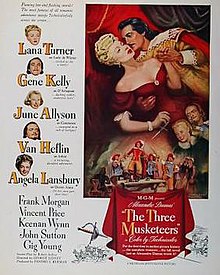 I love this movie!
Great costumes, great casting - it's a beauty to watch. Especially the swashbuckling! Even the scenes of galloping horses were exciting. I also saw, for the first time, a beautiful young Angela Lansbury. Really, just an all-around very entertaining movie!
This screen adaptation is, for the most part, delightfully true to the book. Buttercup, the Count de Warde, and Kitty are included, and we see that all four lackeys exist, though Planchet is the only one with a major role, and Grimaud is the only other one mentioned by name.
My prudish sensibilities actually appreciated some of the efforts to "purify" the story. Madame Bonacieux in the book is Mademoiselle Bonacieux in the movie, and she is d'Artagnan's landlord's niece rather than his wife. Instead of talking about "rich mistresses", the movie has "rich widows".
As the story progresses, it gradually starts to deviate from the book, mostly to simplify and condense the story. It is, after all, only a 2 hour movie. There is no siege of La Rochelle, and Lord de Winter and John Felton are omitted. In a nice twist, Constance is sent by the Queen to the Duke of Buckingham in England for her safety (rather than to a French convent), and she ends up being Milady's jailer. There is no "Hollywood ending" for Constance or Milady - there the movie is completely faithful to the book.
I liked this movie so much that I watched it again the very next day, and enjoyed just as much the second time!
*** Warning: This review constains spoilers! ***
I love this movie!Great costumes, great casting - it's a beauty to watch. Especially the swashbuckling! Even the scenes of galloping horses were exciting. I also saw, for the first time, a beautiful young Angela Lansbury. Really, just an all-around very entertaining movie!
This screen adaptation is, for the most part, delightfully true to the book. Buttercup, the Count de Warde, and Kitty are included, and we see that all four lackeys exist, though Planchet is the only one with a major role, and Grimaud is the only other one mentioned by name.
My prudish sensibilities actually appreciated some of the efforts to "purify" the story. Madame Bonacieux in the book is Mademoiselle Bonacieux in the movie, and she is d'Artagnan's landlord's niece rather than his wife. Instead of talking about "rich mistresses", the movie has "rich widows".
As the story progresses, it gradually starts to deviate from the book, mostly to simplify and condense the story. It is, after all, only a 2 hour movie. There is no siege of La Rochelle, and Lord de Winter and John Felton are omitted. In a nice twist, Constance is sent by the Queen to the Duke of Buckingham in England for her safety (rather than to a French convent), and she ends up being Milady's jailer. There is no "Hollywood ending" for Constance or Milady - there the movie is completely faithful to the book.
I liked this movie so much that I watched it again the very next day, and enjoyed just as much the second time!
Tuesday, November 20, 2012
The Three Musketeers (2011)
★★★
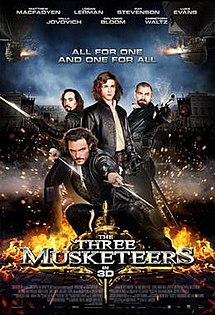 Definitely an action-adventure flick. The movie has a lot more swashbuckling and gun fighting than the book, and it's clear this is a Hollywood production. I didn't realize until afterwards that the movie was intended for 3D, and in retrospect, it probably would have been a lot more impressive as a big screen, 3D experience.
From the very beginning, this movie plays fast and loose with the original story. The movie invents a crazy back story in which Athos, Porthos, and Aramis are in cahoots with Milady, and they are involved in some kind of James Bond-like intrigue. Oddly, Buckingham is an over-stylized villain.
I thought Orlando Bloom was overly dramatic as Buckingham, and actually, I would have preferred to see him as d'Artagnan! d'Artagnan was a bit younger than I expected (15-ish instead of 19-ish), and Athos and Porthos came across as a lot older than I expected (mid-30's instead of mid-20's). Buckingham and Aramis shared an uncanny resemblance, which is actually an important point in the book, but completely irrelevant in this movie.
I did enjoy the casting of the cardinal, the king, and the queen.
Besides the glaring deviations from the book, and the altogether invented material, I also wondered why smaller deviations were made. Why make Athos, Porthos, and Aramis ex-musketeers? It would have been fun to see them in musketeer uniforms.
There were also shortcuts and LOTS of omissions - no Captain de Treville, no Grimaud or Mosqueton or Bazin, no fleur-de-lis, no Lord de Winter. But what else could be expected, the book is much too long and complex to be done justice in a two-hour movie.
The ending is completely different from the book's ending, but it's about what you would expect from a Hollywood movie. Clearly there is a sequel in the works, but I don't expect it to be in any way related to the books. Overall, the movie is comfortably light-hearted, and the song for the closing credits, "When We Were Young," really captures the spirit if the book.
Definitely an action-adventure flick. The movie has a lot more swashbuckling and gun fighting than the book, and it's clear this is a Hollywood production. I didn't realize until afterwards that the movie was intended for 3D, and in retrospect, it probably would have been a lot more impressive as a big screen, 3D experience.From the very beginning, this movie plays fast and loose with the original story. The movie invents a crazy back story in which Athos, Porthos, and Aramis are in cahoots with Milady, and they are involved in some kind of James Bond-like intrigue. Oddly, Buckingham is an over-stylized villain.
I thought Orlando Bloom was overly dramatic as Buckingham, and actually, I would have preferred to see him as d'Artagnan! d'Artagnan was a bit younger than I expected (15-ish instead of 19-ish), and Athos and Porthos came across as a lot older than I expected (mid-30's instead of mid-20's). Buckingham and Aramis shared an uncanny resemblance, which is actually an important point in the book, but completely irrelevant in this movie.
I did enjoy the casting of the cardinal, the king, and the queen.
Besides the glaring deviations from the book, and the altogether invented material, I also wondered why smaller deviations were made. Why make Athos, Porthos, and Aramis ex-musketeers? It would have been fun to see them in musketeer uniforms.
There were also shortcuts and LOTS of omissions - no Captain de Treville, no Grimaud or Mosqueton or Bazin, no fleur-de-lis, no Lord de Winter. But what else could be expected, the book is much too long and complex to be done justice in a two-hour movie.
The ending is completely different from the book's ending, but it's about what you would expect from a Hollywood movie. Clearly there is a sequel in the works, but I don't expect it to be in any way related to the books. Overall, the movie is comfortably light-hearted, and the song for the closing credits, "When We Were Young," really captures the spirit if the book.
Sunday, November 18, 2012
The Count of Monte Cristo (2002)
★★★½
*** Warning: This review contains spoilers! ***
 I remember being very excited to see this movie in the theaters, and then being very disappointed. After re-reading the book - and seeing the French mini-series - I actually ended up enjoying this re-watching more than I thought I would.
Of course, the original 1,462-page story is really too much for a standard 2-hour movie, so some condensing of the story and omissions of characters is expected. Making Fernand the son of a count actually turned out to be a smart way of making Mercedes into a countess without having to spend any time on Janina, which was completely left out. No Haydee! A significant omission, but one could easily suspect the she would not be needed in a Hollywood version of the story.
All told, I wouldn't be surprised if there were more characters omitted than included - no Caderousse, no Bertuccio (who was replaced by Jacopo, whose role was increased), no Benedetto, no alter egos for the Count of Monte Cristo, no Maximilian and Valentine love story, no Franz or DeBray or Beauchamp. The only young person was Albert, whose story was given an unexpected twist.
Danglar and Villefort were minimized, and Edmond's revenge on them was much less complex than in the book. Fernand was the primary antagonist, and he was made into a womanizing gambler with no sense of honor at all - quite a change from the character in the book.
Despite all the differences from the book, I really enjoyed the first part of the movie. I loved that the movie progressed chronologically, and we saw Edmond at sea, we saw the love between him and Mercedes, and we saw the hope of his future as he was promoted to captain. Edmond's imprisonment, and his developing relationship with the Abbé Faria, was portrayed so well that it was just all that much more disappointing when, after Edmond escaped, the story veered farther and farther from the book.
I thought the casting of Edmond was perfect - he made a believable transformation from naive young sailor to worldly count. Mercedes, though, didn't have the dignity or the beauty I expected. Guy Pearce was maybe a bit over-dramatic as Fernand.
The ending, though far from the one laid out in the book, was about what you'd expect from a Hollywood production. I really didn't mind, but being such a huge fan of the book, I just can't bring myself to give this movie more stars. Still, it was entertaining, and not bad.
*** Warning: This review contains spoilers! ***
I remember being very excited to see this movie in the theaters, and then being very disappointed. After re-reading the book - and seeing the French mini-series - I actually ended up enjoying this re-watching more than I thought I would.Of course, the original 1,462-page story is really too much for a standard 2-hour movie, so some condensing of the story and omissions of characters is expected. Making Fernand the son of a count actually turned out to be a smart way of making Mercedes into a countess without having to spend any time on Janina, which was completely left out. No Haydee! A significant omission, but one could easily suspect the she would not be needed in a Hollywood version of the story.
All told, I wouldn't be surprised if there were more characters omitted than included - no Caderousse, no Bertuccio (who was replaced by Jacopo, whose role was increased), no Benedetto, no alter egos for the Count of Monte Cristo, no Maximilian and Valentine love story, no Franz or DeBray or Beauchamp. The only young person was Albert, whose story was given an unexpected twist.
Danglar and Villefort were minimized, and Edmond's revenge on them was much less complex than in the book. Fernand was the primary antagonist, and he was made into a womanizing gambler with no sense of honor at all - quite a change from the character in the book.
Despite all the differences from the book, I really enjoyed the first part of the movie. I loved that the movie progressed chronologically, and we saw Edmond at sea, we saw the love between him and Mercedes, and we saw the hope of his future as he was promoted to captain. Edmond's imprisonment, and his developing relationship with the Abbé Faria, was portrayed so well that it was just all that much more disappointing when, after Edmond escaped, the story veered farther and farther from the book.
I thought the casting of Edmond was perfect - he made a believable transformation from naive young sailor to worldly count. Mercedes, though, didn't have the dignity or the beauty I expected. Guy Pearce was maybe a bit over-dramatic as Fernand.
The ending, though far from the one laid out in the book, was about what you'd expect from a Hollywood production. I really didn't mind, but being such a huge fan of the book, I just can't bring myself to give this movie more stars. Still, it was entertaining, and not bad.
Tuesday, November 13, 2012
The Count of Monte Cristo (1998)
★★
*** Warning: This review contains spoilers!! ***
 Ugh. So much of my time watching this mini-series was spent feeling disappointed that I really can't bring myself to give it more than 2 stars.
Where do I begin?
Ugh. So much of my time watching this mini-series was spent feeling disappointed that I really can't bring myself to give it more than 2 stars.
Where do I begin?
Of course, whenever a movie is based on a book, every way in which the movie deviates from the book is a point of criticism for me. I do understand that in order to simplify the story for the screen, the story sometimes needs to be condensed, or characters omitted. In this way, it did not really bother me at all that Eugenie Danglars and Julie Morrel were left out, or that Madame Danglar's affair with Lucien DeBray (also completely omitted) was not included.
I can't, however, so easily overlook other omissions or modifications that seemed to serve no purpose. Haydee was not introduced until much later in the story, which was detrimental to the Count's character development. Her mere presence upon their arrival in Paris is what gave the Count an air of mystery and eccentricity. Without Haydee, the Count came across as just another rich guy.
I suppose it made sense, for simplicity's sake, to separate Benedetto from Bertuccio, but was it really necessary to change Benedetto's name? His role became so minor, his entire relationship with the Count having been omitted, that the whole court scene in which he identifies Villefort as his father was omitted! This scene was pivotal in the book, filled with drama, and without it, Villefort doesn't descend into madness as he does in the book.
And speaking of Villefort - Madame Villefort's cherished son, Edward, was completely left out as well. Indeed, he had a small role to play, but it was significant in that it was only upon his death that the Count of Monte Cristo realized - by his own accord - that his vengeance had gone too far.
Instead of having that meaningful moment of self-realization, the movie gives us the Count's realization through Camille, who was not in the book at all and who was nothing but an annoying, infuriating distraction. At one point in the movie, Monte Cristo calls Valentine "too blond, too insipid" - he might as well have been talking about Camille, and yet, he supposedly fell for her! A huge part of the Count of Monte Cristo's character was his long-held belief that having had his heart broken by Mercedes, he did not think he was capable, nor did he think he was worthy, of loving again. And even though we saw a glimmer of hope in Monte Cristo, it wasn't until after everything unfolded that he allowed himself to feel love again. The one redeeming thing about Camille is that the Count did not end up with her.
But wait, there's more. Instead of progressing chronologically from the beginning, the movie relied too much on flashbacks to explain why Edmond Dantes was in prison in the first place, and it never really explained the motivation of Danglars or Fernand. We never saw a true portrait of the young, happy, life-loving, filled-with-potential Edmond, and so the viewer never got a good sense for what was really sacrified when Edmond was sent to prison.
In the book, it was clear that the only way Edmond was able to survive so many years in prison was because he and the Abbe Faria devoted their time to Edmond's all-around education - in politics, languages, alchemy, etc. Why did the movie dismiss all that, and say that the abbe taught him nothing?!
The movie also took strange liberties to introduce a sexual angle to the story. Besides the booty call with Camille (which was LAME-O!), Edmond encountered a superfluous prostitute when he first escaped from prison, and then the judge who pardoned Peppino had a weird fetish! Why bother with that stuff?
Overall, the lack of attention to details was disappointing. The "red silk purse" represented so much in the book, why change it to a dull brown sack!? The portrait of Mercedes looking out to sea let the reader know that Mercedes never stopped loving Edmond - so why leave it out of the movie?
Finally, much of the casting and character portrayals just didn't seem right. I really did not find Gerard Depardieu convincing at all. He was not the imposing figure I've always imagined the Count to be. Instead, he was stocky and fat and his shoulders were distractingly broad. Albert did not have any of the joie de vivre that he had in the book, and one of the best scenes in the book - when Albert slept peacefully while in Luigi Vampa's lair - was, of course, omitted. Fernand looked about 20 years too old.
So, was there anything I liked about this mini-series? Honestly, I didn't mind the new, Hollywood ending, because deep down I sort of wished for that ending in the book, too. I liked the way the movie gave us a glimpse of the Count's alchemy lab, so we see how he came to possess so many vials of potions and antidotes. Mostly, though, as I watched the episodes, I found myself just waiting for the series to end.
*** Warning: This review contains spoilers!! ***
Ugh. So much of my time watching this mini-series was spent feeling disappointed that I really can't bring myself to give it more than 2 stars.
Where do I begin?Of course, whenever a movie is based on a book, every way in which the movie deviates from the book is a point of criticism for me. I do understand that in order to simplify the story for the screen, the story sometimes needs to be condensed, or characters omitted. In this way, it did not really bother me at all that Eugenie Danglars and Julie Morrel were left out, or that Madame Danglar's affair with Lucien DeBray (also completely omitted) was not included.
I can't, however, so easily overlook other omissions or modifications that seemed to serve no purpose. Haydee was not introduced until much later in the story, which was detrimental to the Count's character development. Her mere presence upon their arrival in Paris is what gave the Count an air of mystery and eccentricity. Without Haydee, the Count came across as just another rich guy.
I suppose it made sense, for simplicity's sake, to separate Benedetto from Bertuccio, but was it really necessary to change Benedetto's name? His role became so minor, his entire relationship with the Count having been omitted, that the whole court scene in which he identifies Villefort as his father was omitted! This scene was pivotal in the book, filled with drama, and without it, Villefort doesn't descend into madness as he does in the book.
And speaking of Villefort - Madame Villefort's cherished son, Edward, was completely left out as well. Indeed, he had a small role to play, but it was significant in that it was only upon his death that the Count of Monte Cristo realized - by his own accord - that his vengeance had gone too far.
Instead of having that meaningful moment of self-realization, the movie gives us the Count's realization through Camille, who was not in the book at all and who was nothing but an annoying, infuriating distraction. At one point in the movie, Monte Cristo calls Valentine "too blond, too insipid" - he might as well have been talking about Camille, and yet, he supposedly fell for her! A huge part of the Count of Monte Cristo's character was his long-held belief that having had his heart broken by Mercedes, he did not think he was capable, nor did he think he was worthy, of loving again. And even though we saw a glimmer of hope in Monte Cristo, it wasn't until after everything unfolded that he allowed himself to feel love again. The one redeeming thing about Camille is that the Count did not end up with her.
But wait, there's more. Instead of progressing chronologically from the beginning, the movie relied too much on flashbacks to explain why Edmond Dantes was in prison in the first place, and it never really explained the motivation of Danglars or Fernand. We never saw a true portrait of the young, happy, life-loving, filled-with-potential Edmond, and so the viewer never got a good sense for what was really sacrified when Edmond was sent to prison.
In the book, it was clear that the only way Edmond was able to survive so many years in prison was because he and the Abbe Faria devoted their time to Edmond's all-around education - in politics, languages, alchemy, etc. Why did the movie dismiss all that, and say that the abbe taught him nothing?!
The movie also took strange liberties to introduce a sexual angle to the story. Besides the booty call with Camille (which was LAME-O!), Edmond encountered a superfluous prostitute when he first escaped from prison, and then the judge who pardoned Peppino had a weird fetish! Why bother with that stuff?
Overall, the lack of attention to details was disappointing. The "red silk purse" represented so much in the book, why change it to a dull brown sack!? The portrait of Mercedes looking out to sea let the reader know that Mercedes never stopped loving Edmond - so why leave it out of the movie?
Finally, much of the casting and character portrayals just didn't seem right. I really did not find Gerard Depardieu convincing at all. He was not the imposing figure I've always imagined the Count to be. Instead, he was stocky and fat and his shoulders were distractingly broad. Albert did not have any of the joie de vivre that he had in the book, and one of the best scenes in the book - when Albert slept peacefully while in Luigi Vampa's lair - was, of course, omitted. Fernand looked about 20 years too old.
So, was there anything I liked about this mini-series? Honestly, I didn't mind the new, Hollywood ending, because deep down I sort of wished for that ending in the book, too. I liked the way the movie gave us a glimpse of the Count's alchemy lab, so we see how he came to possess so many vials of potions and antidotes. Mostly, though, as I watched the episodes, I found myself just waiting for the series to end.
Thursday, November 1, 2012
The Three Musketeers (The d'Artagnan Romances #1) by Alexandre Dumas
★★★★
*** Warning: This review contains spoilers! ***
 A really entertaining read!
The first part of the book, in which we are introduced to d'Artagnan and the three musketeers, is downright funny. I swear I laughed out loud! As the story progresses, though, the humor is replaced by the drama of mistresses, duels, war, and intrigue.
I have to admit that all the illicit affairs with married women somewhat affected my prudish sensibilities. Maybe that sort of thing was accepted practice back then, though Dumas still seemed to go out of his way to show the reader that both Madame Bonacieux and Madame Coquenard were stuck in pitiful, loveless marriages. At first I kept thinking that poor Madame Coquenard was being quite ill-used by Porthos, but in the end it all worked out, I guess.
The ease with which the men fought duels also took some getting used to. The idea that a man would be willing to die over some off-the-cuff remark was crazy!
Characters were reliably one-dimensional, which generally speaking makes for less interesting reading, but in this case, it allowed me to confidently put my faith into certain characters without having to worry about being let down by some sort of surprise twist. There was no annoying Harry Potter-esque withholding of information - everyone dutifully told everyone else what was going on, and Monsieur de Treville - always in a position to help - was admirably informed throughout the book.
The only character whose one-dimensionalism I really didn't appreciate was Milady's. Ugh! Even as her history was gradually revealed, we never got to the root of her evil. Why was she in the convent in the first place? What was her motivation for being so evil? With her wits and feminine wiles, she could have had fame and fortune without having to be wicked to boot.
To better appreciate the book, I really could have stood to have a better understanding of French and European politics and religion at the time. Every now and then, I just muddled along, content to accept that this one person was enemies with that person and allies with that other person, but not really understanding why.
Finally, I just have to say that I really loved the ending. Not the epilogue (which was good, too, though I was sorry to see the group disbanded), but the last conversation between d'Artagnan and Athos, in which d'Artagnan says he has "nothing but bitter recollections," and Athos responds, "You are young, and your bitter recollections have time to change themselves into sweet remembrances." Ah, so poignant! Those early days, when the four friends pooled their money during times of wealth, and then equally shared the burden of hunger when the money was gone, would surely one day be looked upon as bittersweet memories.
If only we all had such devoted friends in our lives. "All for one, one for all!"
*** Warning: This review contains spoilers! ***
A really entertaining read!The first part of the book, in which we are introduced to d'Artagnan and the three musketeers, is downright funny. I swear I laughed out loud! As the story progresses, though, the humor is replaced by the drama of mistresses, duels, war, and intrigue.
I have to admit that all the illicit affairs with married women somewhat affected my prudish sensibilities. Maybe that sort of thing was accepted practice back then, though Dumas still seemed to go out of his way to show the reader that both Madame Bonacieux and Madame Coquenard were stuck in pitiful, loveless marriages. At first I kept thinking that poor Madame Coquenard was being quite ill-used by Porthos, but in the end it all worked out, I guess.
The ease with which the men fought duels also took some getting used to. The idea that a man would be willing to die over some off-the-cuff remark was crazy!
Characters were reliably one-dimensional, which generally speaking makes for less interesting reading, but in this case, it allowed me to confidently put my faith into certain characters without having to worry about being let down by some sort of surprise twist. There was no annoying Harry Potter-esque withholding of information - everyone dutifully told everyone else what was going on, and Monsieur de Treville - always in a position to help - was admirably informed throughout the book.
The only character whose one-dimensionalism I really didn't appreciate was Milady's. Ugh! Even as her history was gradually revealed, we never got to the root of her evil. Why was she in the convent in the first place? What was her motivation for being so evil? With her wits and feminine wiles, she could have had fame and fortune without having to be wicked to boot.
To better appreciate the book, I really could have stood to have a better understanding of French and European politics and religion at the time. Every now and then, I just muddled along, content to accept that this one person was enemies with that person and allies with that other person, but not really understanding why.
Finally, I just have to say that I really loved the ending. Not the epilogue (which was good, too, though I was sorry to see the group disbanded), but the last conversation between d'Artagnan and Athos, in which d'Artagnan says he has "nothing but bitter recollections," and Athos responds, "You are young, and your bitter recollections have time to change themselves into sweet remembrances." Ah, so poignant! Those early days, when the four friends pooled their money during times of wealth, and then equally shared the burden of hunger when the money was gone, would surely one day be looked upon as bittersweet memories.
If only we all had such devoted friends in our lives. "All for one, one for all!"
Tuesday, October 9, 2012
The Count of Monte Cristo by Alexandre Dumas
★★★★★
 O, Edmond! Edmond!
I love this book.
I was inspired to re-read it after spending a month in Corsica, where, on a clear day, you can see the island of Monte Cristo from the east coast beaches. When setting eyes on the outline of this large rock, it's not hard to imagine something mysterious associated with it. In fact, these days, you can take a boat near the island to fish, but if you get too close, military boats come along to shoo you off.
As a story, The Count of Monte Cristo has everything - everything! Deception! Intrigue! Romance! Ambition! Honor and vengeance, redemption and forgiveness. More than one character sinks to the depths of utter despair. All that's missing is a bit of swashbuckling, which might have appeared, except that the story took a different turn...
Towards the beginning, it would probably help to know just a little about the politics around the time of Napolean. You can get by on context, though I did find myself reading up on some Wikipedia entries.
As the story progresses, it does get a bit soap opera-y, as all the characters eventually come together, and everyone happens to know everyone else. But, all the connections do make for a great story, so I'm not complaining. If this is your first time reading the book, it might help to write down the characters in order to keep track of them.
At 1,462 pages, this book can be called a tome. But don't let that discourage you! It's just more of the story to enjoy. I usually can only get a few pages of reading in a day, and it honestly made me happy just to have this book to look forward to, for whenever I might find a spare five minutes to indulge myself.
O, Edmond! Edmond!I love this book.
I was inspired to re-read it after spending a month in Corsica, where, on a clear day, you can see the island of Monte Cristo from the east coast beaches. When setting eyes on the outline of this large rock, it's not hard to imagine something mysterious associated with it. In fact, these days, you can take a boat near the island to fish, but if you get too close, military boats come along to shoo you off.
As a story, The Count of Monte Cristo has everything - everything! Deception! Intrigue! Romance! Ambition! Honor and vengeance, redemption and forgiveness. More than one character sinks to the depths of utter despair. All that's missing is a bit of swashbuckling, which might have appeared, except that the story took a different turn...
Towards the beginning, it would probably help to know just a little about the politics around the time of Napolean. You can get by on context, though I did find myself reading up on some Wikipedia entries.
As the story progresses, it does get a bit soap opera-y, as all the characters eventually come together, and everyone happens to know everyone else. But, all the connections do make for a great story, so I'm not complaining. If this is your first time reading the book, it might help to write down the characters in order to keep track of them.
At 1,462 pages, this book can be called a tome. But don't let that discourage you! It's just more of the story to enjoy. I usually can only get a few pages of reading in a day, and it honestly made me happy just to have this book to look forward to, for whenever I might find a spare five minutes to indulge myself.
Subscribe to:
Comments (Atom)

