Showing posts with label children. Show all posts

Wednesday, October 1, 2025

The Secret Ingredient by Paul Castle

★★★

A cute follow-up to The Pengrooms, with a lot more going on than just the custom-made cakes. 

This time, Pringle and Finn are baking birthday cakes. When they deliver the cakes to birthday parties, they find they need to rely on a particular personal quality - a "secret ingredient" - in order to properly celebrate with the birthday family. For example, they must have courage to play an intimidating crocodile game with the crocodile family.

Once again, the author-illustrator challenges gender norms, this time drawing a "Birthday Boy" in a pink tutu. Another cake is delivered to the "Birthday Gull", with no gender specified. Illustrations are lovely, with many fun details to notice. 

While again featuring same-gender couples, this book goes even further and normalizes same-gender parents. The birthday sloth has 2 dads, and the birthday gull has 2 moms.

There is a happy development at the end when Pringle and Finn celebrate "a different kind of birthday" upon the arrival of their own newborn baby.

Again I wondered if there is any basis to the same-sex animal pairings that were depicted. A brief online search said female-female seagull pairings do exist, and close bonds between same-sex sloths may be possible in captivity. 

Thursday, September 25, 2025

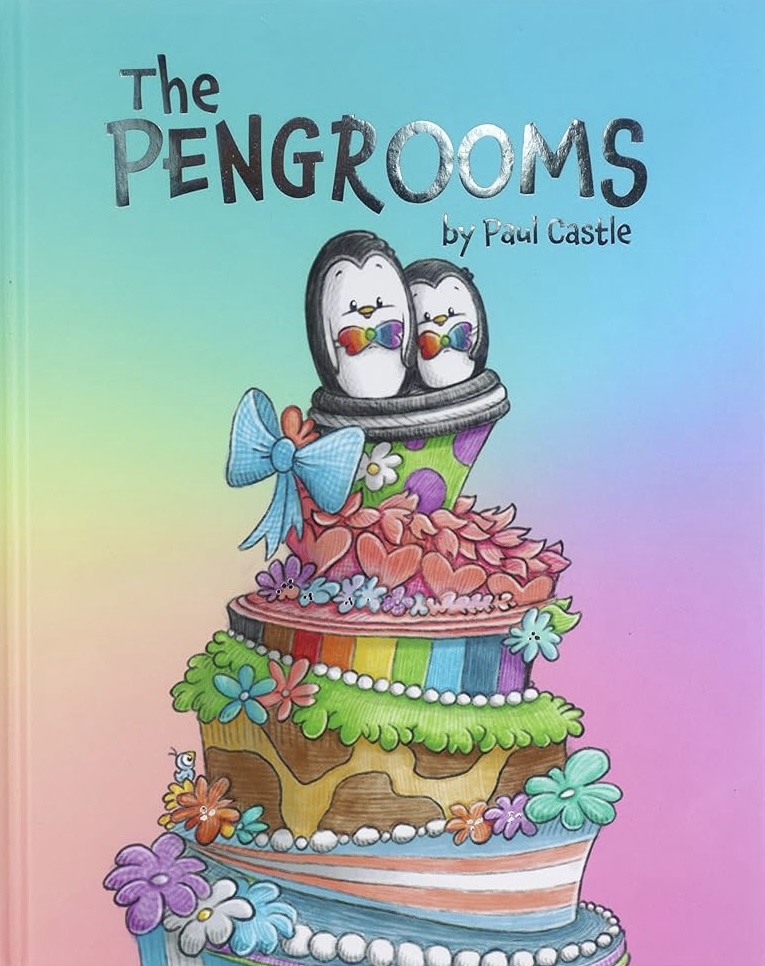
The Pengrooms by Paul Castle

★★★★★

I love the inclusivity of an LGBTQIA+ children's book, especially one that doesn't feel heavy-handed. This book is just a cute story about a pair of penguins - presumably both male based on the title - who make and deliver custom wedding cakes to other animal couples, culminating in the penguins' own wedding.

Some of the couples just happen to be same-gender: the flamingos are both grooms, the giraffes are both brides, and the genders of the mice are not specified. (I think the blue-haired mouse looks female and the pink-haired mouse looks male, which makes for a fun flipping of the "pink for girls, blue for boys" societal norm.)

The illustrations are ADORABLE. Absolutely adorable. If my kids were still little, I think I would really enjoy reading this to them and poring over the pictures, picking out my favorite details.

Just to note, I already knew about male-male penguin couples, and a bit of online research turned up references to male-male flamingo pairings and female-female giraffe pairings (though rare), so I appreciate that the animal couples are scientifically feasible.

Thursday, October 13, 2022

The Only One Club by Jane Naliboff

★★

I saw this book recommended as a way to help support covid-cautious kids who continue to wear masks in mask-optional settings, like school. Peer pressure is real, and being the only person in a classroom wearing a mask can be isolating and intimidating.

I really, really wanted to like this book. Growing up in the 1980s, I remember the discomfort and embarrassment of being the only Asian person in my class, the only kid who wore glasses, even the only student in my class who was a member of the Brownies! Young me absolutely would have benefited from the way this book takes being "the only one" of something and turns it on its head as something to be PROUD of. When the main character, Jennifer, realized she was the only Jewish kid in her class, she immediately delighted in being "the only one" and wanted to celebrate it. That premise is fantastic! I just wish the implementation could have been better.

Right off the bat, the book felt dated. Mrs. Matthews, the teacher, had the whole class making Christmas decorations. Back in the '80s, this type of classroom activity was commonplace. Maybe it was still happening here and there in 2004, when this book was first published. But definitely in 2022, when I read this book, a teacher presumably in a public school centering a Christian holiday in the classroom just didn't feel right.

I do love how Jennifer did not for a second feel embarrassed about being the only Jewish kid in her class. Being Jewish was something that could potentially put Jennifer on the receiving end of hateful words and deeds, and being the only one made her particularly vulnerable because she had no obvious or automatic allies. For her to take pride in something that could be used as fodder for taunts or other inappropriate behavior directed towards her is what made Jennifer's attitude and actions particularly brave, meaningful, and mature.

It was strange, then, when her classmates joined The Only One Club for things like: having a last name that is also the name of a bird, having a pet iguana, and being able to jump Double Dutch. These are not the type of differences that would normally cause chidren to feel like they don't belong, as being a different race or religion, or being the sole mask-wearer, would. Moreover, some of the reasons didn't even make sense! TWO twin girls joined by being "the only one(s?)" who were twins?! And then the teacher joined because she was "the only one" who wasn't already in the club, thereby negating her reason for joining as soon as she joined!

According to the illustrations, Jennifer's class was wonderfully culturally diverse. Alongside some of the superficial differences, it would have been easy to include more substantial differences, e.g., one kid could have been the only one who was Chinese, another could have been the only one who spoke Spanish, this kid could have been the only one with glasses, or a wheelchair, and that kid could have been the only one with asthma, or a food allergy.

Speaking of food allergies, the exchange between Jennifer and Jonah during lunch nearly gave me a conniption! With a "mouth full of peanut butter", "Jonah gave her a raspberry, spraying peanut butter all over the lunch table"!!!!! The illustration literally had food particles on a trajectory to land on Jennifer's food! What if Jennifer was allergic to peanuts!? What if the next kid to sit at that table was allergic!?

Anyway. This book might be a good option for its Hanukkah theme, but as a book about inclusion, I feel it doesn't quite get across the idea that inclusion needs to extend to attributes that may make individuals feel out of place because they are atypical compared to a widely accepted norm.

Tuesday, September 20, 2022

Just Ask! Be Different, Be Brave, Be You by Sonia Sotomayor

★★★½

This book is a good read-aloud to help encourage young kids to ask questions when they see differences in the people around them, which hopefully would take the place of whispers, gossip, teasing, or fear.

Each two-page spread of illustrations and text discusses a different medical condition or developmental disability. It is noteworthy that the book never uses the word "disability", and the dust jacket uses the phrase "differently abled". I suspect these word choices are somewhat controversial, since even in 2019, when this book was published, there already existed guidelines regarding language surrounding disabilities (copyright 2018 at the time of this writing) that advised against "differently abled".

Still, I applaud the book's existence. It's hard enough to talk about disabilities and identities among adults, so I appreciate that this book broaches the subject with kids, tries to normalize differences, and can serve as a springboard for further discussions.

The conditions covered are: diabetes, asthma, use of wheelchair, blindness, deafness, dyslexia, autism, stuttering, Tourette's syndrome, ADHD, food allergies, and Down syndrome.

As a parent of children with food allergies, I wish the food allergy page mentioned EpiPens as a just-in-case tool for people with life-threatening food allergies, since some kids may feel self-conscious about self-carrying their epinephrine autoinjectors.

Also, the autism page says "I have autism" and "Tiana also has autism", even though, again, in 2019 (when this book was published) the debate regarding preferred language (link to article published in 2015), e.g., "person with/has autism" vs. "autistic person", was already well under way. I think there are no easy answers, but maybe the book could have at least exposed readers to both options by using "I'm autistic" in one sentence and "Tiana also has autism" in the other.

Overall, not perfect, but serves a purpose.

Sunday, May 1, 2022

Troublemaker by John Cho with Sarah Suk

★★★★★

It wasn't intentional, but my library just happened to fill my hold request so that I read this book over April 29, the 30th anniversary of the LA riots.

The 1992 riots in Los Angeles serve as the backdrop for this story, which unfolds at the intersection of immigration, child-of-immigrant identity, racial injustice, and gun violence. On top of all that, the main character Jordan is trying to navigate strained relationships with both his father and his friend. Jordan's life is complicated, as many children's lives are. In that way, it reminded me of the book Blended, which also has themes of race and gun violence, and also openly addresses the many issues children face in real life. I appreciate these books for providing a framework for kids to process complex issues in age-appropriate ways.

I'm not Korean, but I'm an American-born child of Asian immigrants, and the Park family dynamics were familiar; the portrayal of Korean American experiences felt authentic.

Some parents might like to know that though the title may allude to John Lewis's quote about getting into "good trouble", there is quite a lot of actual "troublemaking" in this book, from cheating in school to stealing from family to hitchhiking with strangers! Every such action is presented with clear disapproval, and it's obvious that the decisions to engage in these activities were poor and reckless. I think the right vs. wrong morality is evident, so kids aren't likely to want to emulate Jordan and Mike. In fact, I actually think it's solid representation to show that yes, sometimes kids make bad decisions. Sometimes those decision come from a place of weakness or curiosity, sometimes they come from a place of desperation or wanting to do good, but no matter the motivation, bad decisions do not make for a "bad kid", and I think that's an important message for all kids to understand.

While Jordan is trying to unpack a lot of big and meaningful questions, the events of the book actually take him on an exciting adventure, making for an engaging and entertaining read even if you're not particularly interested in the social justice issues.

There is no Korean glossary, but there is an Author's Note at the back of the book. I think I might even recommend reading that first, to help frame and set the context for the book.

Friday, April 8, 2022

The Turtle of Oman Roundup

In Oman, an 8-year-old boy named Aref and his grandfather have a very close relationship. Aref is sad and anxious about having to move to a new country, but quickly adapts and thrives in his new home and school.

Saturday, January 29, 2022

The Giver Roundup

A seemingly post-apocalyptic, supernatural world with extremely different isolated communities. Main characters eventually connect with each other, but the communities remain separate.

Son (The Giver #4) by Lois Lowry

★★★★

*** Warning: This review contains spoilers!! ***

This story is divided into three sections. Book I, in which we go back to the events of The Giver and see the timeline from Claire's perspective, made for a slow start for me. Since I knew what would happen, I was anxious to move forward and get to the events after Jonas took Gabe from the community. 

I found Book II much more engaging. I appreciated the author's creativity in inventing yet another isolated community, unique in its own way. I also enjoyed the way Clair discovered mundane things and found them enchanting because she had never known them before. Still no answers were given, however, regarding how this world came to be, and I was left wondering why Claire's original home was so technologically advanced while all other communities were so primitive.

Book II as a whole made me think of how it is that our lives are made out of distinct phases that come and go. We are who we are because of the experiences we've had and the people we meet - this is where Claire witnessed how loving parents treat their children, and where she learned about romantic love - and sometimes, though there may be nothing wrong with where we are, we still need to move forward. 

The entire series came to a satisfying conclusion in Book III, and I was pleased to see some of my questions from Messenger answered. It was gratifying to finally understand Trademaster, who in this book was more clearly the Devil, at times even being described like a snake. (p. 264) I was especially happy to at last read the scene, in which Claire confides in Jonas, that I had been waiting the whole book to read. (p. 311)

In the end, there seemed to be a message of how, if you put good intentions out into the world, that good is reflected and given back to you. Just as evil feeds off of hate, goodness is made stronger by love.

This being the last book of the series, I knew the world had a supernatural component. But as with The Giver, a large chunk of the book passed without any reference to any magical powers or beings, and I was lulled into thinking of Claire's world as merely characterized by the communities in which she lived. The sudden appearance, more than halfway through the book, of something supernatural felt jarring.

As much as I enjoyed Claire's story, there were two things that irked me.

First, I wish the author had included a scene showing Claire and Alys saying goodbye. I had eagerly anticipated this scene, feeling sure it would be emotional and meaningful, and was surprised and disappointed when I realized it was omitted. Here Claire was the daughter Alys had never had, and Alys was the loving mother Claire had never had, surely their parting was significant.

Second, why wouldn't Claire - upon finding Gabe in the village and realizing that Jonas was there, too - go to Jonas, tell him her whole story, and figure out a plan for meeting Gabe earlier?! I can't understand how she waited SEVEN YEARS, until she was practically on her death bed, to make a move. It pained me to think of all those years lost and wasted.

One final note from a parental perspective. Though I categorized the first 3 books of this series as children's books, this one I think borders on young adult, mainly because of one line in which Einar described the abuses he suffered from his father and implied sexual assault. (p. 207) Still, younger readers might just gloss over the oblique reference and not even realize they've missed anything. 

Wednesday, January 19, 2022

Messenger (The Giver #3) by Lois Lowry

★★★½

*** Warning: This review contains spoilers!! ***

It's been a while since I read the first couple books, but I remember being thrown off by the supernaturalism in The Giver, because it wasn't evident at first, and I don't even remember any supernaturalism in Gathering Blue. The fantastical aspects of this world are clear early on in Messenger, with Forest actively attacking people and Matty discovering his paranormal ability. 

The story of Village presents a heartwarming, meaningful message. Village thrived on selflessness - everyone welcoming newcomers and caring for one another - and it suffered when Trademaster introduced selfishness into their community. 

Reading the book in 2022, there's an apparent parallel with contemporary issues of immigration and borders. Village is an example of how communities can benefit from diversity and compassion. Published in 2004, the book seemed to foreshadow Trump's obsession with building a wall.

I really enjoyed Matty's character, and was happy to read more about him since I liked him so much in Gathering Blue. I think the presumed post-apocalyptic world with disparate communities was intriguing, and I loved the beauty of the ending. Unfortunately, I just found myself too distracted by all the many unanswered questions. 

For example, who exactly is Trademaster? Where did he come from, and what is his story? Why does he make all these deals that are detrimental to the people making them? What does he get out of them? Is he supposed to be the Devil, making deals with people so that their truest selves are sacrificed for some temporary, worldly gain? 

At the end of the book, we learn that Forest is "an illusion...a tangled knot of fears and deceits and dark struggles for power" (p. 168), but why did it suddenly turn so evil? Was Forest somehow connected to Trademaster? And did Matty's powers work on Trademaster, too? Because if not, why wouldn't Trademaster simply resume his trading, causing the same trouble all over again, and with no Matty there to save them next time?

I tried to do the math, and Jonas, now called Leader, must be in his early 20s. I understand that he's got this special gift, but it still seems remarkable that Village would elect him as Leader at such a young age. And who was the leader before Jonas arrived? Jonas arrived with Gabriel, but we learn nothing more about him, getting only one passing mention of a boy named Gabe, who we can just assume must be Gabriel. (p. 17) Jonas tells Matty that his old community was "rebuilding themselves into something better" (p. 29), but how!? How did the Giver manage all the changes, and what became of the Committee of Elders? Later on, we see that Kira's village was also changed, but again the story of how is missing. What happened with Jamison and the Council of Guardians?

Interestingly, I found an editing error in my edition. In chapter 17, the book says that "Ramon had described poor Stocktender, who had been entangled by Forest". (p. 149) But back in chapter 2, it says Stocktender had died earlier, had not been entangled, and it was Gatherer who had been entangled to death by Forest. (p. 14)

Tuesday, October 26, 2021

Quiet Power: The Secret Strengths of Introverts by Susan Cain

★★★★

I bought this book as soon as it came out, since both my kids have introverted tendencies. But since the book is geared towards middle and high schoolers, and my kids were still in elementary school at the time, the content just didn't feel too relevant yet. Now that my kids are both teenagers, I'm glad I remembered to give this book another go; actually, I wish I had read it just a few years earlier, as I think this book can be helpful as soon as kids are in middle school and/or in their tween years.

Kids are the intended audience for this book, but I read it as a parent. I appreciated the insight into teen perspectives, and there were plenty of illustrative examples validating the experiences and feelings of introverted kids. The book also offered many concrete suggestions on how to "stretch" yourself as needed for various situations, and I came away with specific things I can do to help support my kids as they navigate school, friendships, and life at home.

The book is divided into four parts - school, socializing, hobbies, and home - each focused on how to leverage or manage your introverted nature in that particular arena. Every chapter ends with a clear, concise summary of key takeaway points, a convenient go-to section in case you have a reluctant reader or you're short on time.

Much of the content consists of stories of other introverts who achieved some level of success in some area, generally not in spite of their introversion but because of it. Sometimes a motivational story about a famous person made me think, "Great, but that person is clearly exceptional in their field, how does this help me, an ordinary person?" Stories about specific teenagers at first made me feel like, "Who is this random person?!" but in the end they did inspire a sense of, "Well, if they can do it, then so can I!"

I especially appreciated the afterword for teachers, describing how introverts can be better accommodated in schools, where the extroverted student ideal tends to be more frequently rewarded.

Thursday, July 22, 2021

The BFG by Roald Dahl

★★★★

My son read this book multiple times while in elementary school, and I finally got around to reading it myself.

The Big Friendly Giant's unusual vocabulary makes for super fun reading, especially for reading aloud. The story is a fairy tale complete with giants, an orphan with access to the Queen of England, and a happy ending.

Concerned parents may want to know that the BFG is the only giant who does not eat humans (the BFG pronounces "cannibal" as "cannybull"), and the story is about how the orphan Sophie and the BFG work together to stop the other giants from eating humans. There is an interesting bit of social commentary when the BFG questions how Sophie can judge giants for eating humans when humans themselves kill other humans and eat other animals.

Sunday, January 10, 2021

Keeper of the Lost Cities Roundup

An immersive fantasy world reminiscent of Harry Potter but with an exciting enough story arc to keep it feeling different.

Flashback (Keeper of the Lost Cities #7) by Shannon Messenger

★★½

*** Warning: This review contains spoilers!! ***

Early on in the series, when I read one book after another, I complained that there was too much recap at the beginning of each book. Now that I'm picking up book 7 after a long hiatus, I can't remember anything, and I need all the recap I can get! Still, it's not enough, there are so many references to things I don't remember at all. Oh, well.

I feel a little bad about my relatively low rating of this book, but it was just too long, with too much dialog that felt like filler, and not enough action. The book started out promising, but then fizzled, and I was halfway through before I felt like things started happening again. As in other books in the series, the storytelling that moved events forward continued to feel sloppy, with everyone mostly guessing at what the evildoers' plans were, then landing on a theory with a declaration of, "That makes sense."

I really enjoyed the creation of the multi-species bodyguard team; I liked the idea of all the species working together.

I didn't enjoy the additional focus on the Fitz-Sophie-Keefe love triangle; I'm just not a fan of romance being tangled up in action stories. Sophie still strikes me as "young", like a teenybopper compared to Fitz and Keefe being more in the "older teenager" category. I am not sure what is so desirable about Sophie to make her the target of everyone's affection, except that she's the moonlark, which makes her mysterious and special. I think both Biana and Linh having admirers would be more believable. Anyway, as eye-rolling as this sub-plot is to me, I was glad to finally see movement in the story line, and a resolution. And given how I think of Sophie as "young", I was pleased to see her put the brakes on moving too fast with Fitz. She may have been unbelievably oblivious to Fitz's feelings for her, but she was remarkably aware and mature in understanding her own feelings for Fitz, and recognizing that she wasn't really ready for a relationship yet. Wow! I super appreciated the good modeling for young readers.

Events finally picked up towards the end of the book, and the plot developments - particularly those including Alvar and "the Vacker legacy" - did not disappoint! In my mind, the ending lifted the book to 2 1/2 stars. Not sure if I will continue the series, but I'm not ruling it out. 

Thursday, May 21, 2020

Anything but Typical by Nora Raleigh Baskin

★★★★★

I know a couple people on the autism spectrum, but not well enough to know if this book is an authentic portrayal of autism. For what it is, this book touched me quite a bit. I felt like I could relate to both Jason and his mother, and I think I am leaving this book with a better understanding of people with autism. 

At first, the book felt didactic, like it was written for the express purpose of teaching readers about autism. But Jason won me over pretty quickly, and it didn't take long for me to feel invested in his story. The narrative was disjointed, which interrupted the flow of the story, but I think that approach was used intentionally to reflect Jason's non-linear way of thinking.

I appreciated that Jason was matter-of-fact about life's inequities; he understood more than people thought. He may not have shown it, but he knew when he was being treated poorly because he was different. His self-awareness, expressed through simple statements, was poignant.  

[M]om and dad couldn't make everything all right, even when they say, Don't worry. Everything is going to be all right. It's not. (p. 89)

You don't always get what you need. (p. 91)

"It's strange being in a hotel without Daddy and Jeremy, isn't it?" she says to me. Most things are strange to me, I'm thinking." (p. 154)

I loved that Jason understood his mother in meaningful ways, even though he couldn't always express himself. Like when his mom cried, he observed that it would have been better if his dad were with him, because his dad wouldn't have cried, yet he said, "[I]t's okay. That's what my mom is like. She can't help it. We all have things we can't help doing." (p. 193)

I really enjoyed the ending. I admit, I was a bit wary, afraid it would be one of those over-the-top happy endings that are so common in middle grade fiction. I don't want to put any spoilers in this review, so I'll just say it was satisfying, for me, and still realistic.

A couple nitpicky things, which I ignored when choosing my rating. First, this book threw around a lot of acronyms when describing Jason's autism. In most cases, the acronyms were explained, but I'm pretty sure SPED and IEP were never explicitly defined. I'm a stickler for clarity, so I wish the text spelled out Special Education and Individualized Education Program.

Also, I was a bit distracted by a number of typos in the edition I read. Every now and then, a word was dropped, e.g., "I don't why it is." (p. 142). Or, words were transposed, e.g., "I want to you know." (p. 192)

Tuesday, May 12, 2020

Gathering Blue (The Giver #2) by Lois Lowry

★★★

*** Warning: This review contains spoilers!! ***

Gathering Blue is just as thought-provoking as The Giver, and part of its appeal was comparing and constrasting Kira's village with Jonas's community.

Kira's village lived in poverty and fear, with an every-person-for-themselves way of life. Yet, good-hearted people like Kira and Matt still flourished. At one point, referring to plants, Kira marveled at how "blossoms continued to bloom and she was awed to see that vibrant life still struggled to thrive despite such destruction." (p. 90) That description could be a metaphor for Kira and Matt's own lives, how the cards were stacked against them, yet they flourished. Taken further, it could be a metaphor for all of humankind; though the world had faced destruction, and shocking societies had grown out of ruin, the humanity of people like Jonas and Kira could lead people towards a better existence.

Matt was my favorite character. So capable and open, with such an infectious spirit! I would love to read more about him.

This book ends on a hopeful note, but as with The Giver, I put the book down wishing for a sequel. I can imagine Kira leading Thomas, Jo, and Matt in slowly introducing more compassion and equity into their society, but how? How will they handle the Council of Guardians, and Jamison in particular? Does the other community really become known to the village, and how do the villagers react to the news? What happens when everybody finally learns that there are no beasts?

As far as I could tell, there was nothing in this book that made it clear it existed in the same universe as The Giver; we only know the two stories are related because this book is marketed as a companion book. Just one line gives a hint at a possible connection, when Matt tells Kira that there is a boy her age in the other community who has very blue eyes. From The Giver, we know that Jonas and Gabriel had "pale eyes", which could indeed mean they had blue eyes. It's a very thin connection, but it's intriguing to wonder if the boy might be Jonas in a contemporary timeline, or Gabriel many years later. 

Tuesday, May 5, 2020

The Giver (The Giver #1) by Lois Lowry

★★★

*** Warning: This review contains spoilers!! ***

I really enjoyed the writing in this book. It was straightforward and descriptive, and I think its matter-of-fact simplicity evoked a sense of calm and order, reflective of the community in the story.

I can imagine this book making a big impression on young readers, showing them the value of having choice, and how our individuality brings richness to our lives. Readers of all ages may be touched by the reminder that even if sometimes life is inconvenient, painful, or sad, it is the same range of emotions and experiences that allows us to feel joy, love, and excitement.

I was a bit thrown, however, by the uncertainty of the genre. I went into the book believing it was a kind of realistic utopian fiction, maybe futuristic or post-apocalyptic, but within the realm of possibility for humans on Earth. The totalitarian world of Sameness was intriguing; both benefits and disadvantages were clear, though its inhumanity was exposed when Jonas was introduced to the pill, even before we found out what a "release" really meant.  

Then I got to the part about the Giver transmitting ideas to the Receiver telepathically. Suddenly, I had to recalibrate my understanding of this world as one in which some people had a supernatural ability. And the fact that people couldn't see color, how could that be explained? "Memories" had odd, unexpected qualities; they could only be held by one person at a time, and they never disappeared, but needed to be held specifically by someone in the community. As these sci-fi / fantasy components emerged, the book became less of a kind of warning for us humans, and more like an interesting story of some other species, perhaps one that might be encountered on Star Trek: The Next Generation. (Incidentally, some of these details held together better in the movie version, which I watched after finishing the book. In the movie, all citizens were given an injection since birth - this could explain the color blindness - and there was advanced technology that contained memories within the community at the Boundary of Memory.)

I can see the poetry in the final scene (which Lois Lowry called "intentionally ambiguous" (p. x) in the Introduction of the edition I read), but I am personally not a fan of vague endings open to interpretation. I like closure, and I like knowing what the creator of the story intended for their characters. Though I much prefer happy endings, I admit that if I am forced to choose, I might have to say that I think Jonas and Gabriel died in the snow. (I was actually quite pleased when the movie delivered the more uplifting option of the happy ending.)

Finally, the book left me with some lingering questions. First, I understand that the Giver plays a vital role in the story, but Jonas is clearly the protagonist. Why not name the book after the Receiver? Maybe because Jonas became a Giver when he transmitted memories to Gabriel? Or, as my husband suggested, because Jonas, at the end of the book, was the Giver for the entire community?

Second, what happens to the community when they receive all of Jonas's memories? How do they manage, and how is their society changed? Will the original Giver be able to effect change, or will the Committee of Elders squash the potential as they did when Rosemary was released? I wish these questions could be answered in a sequel.

Tuesday, April 28, 2020

Prairie Lotus by Linda Sue Park

★★★★½

*** Warning: This review contains spoilers!! ***

This book is remarkable for its place in children's literature. I appreciate its existence so much! It's a lovely story about a pioneer girl in the vein of Little House on the Prairie, but the main character, Hanna, is half Chinese. 

Before moving to the Dakota Territory in 1880, Hanna and her parents lived through the 1871 mass lynching of Chinese people in Los Angeles. The event is used to set the tone for society's attitude towards Chinese people in the time period of this book. Personally, I did not know about this race riot until I was an adult - I certainly never heard about it in school - and I am beyond pleased that this book provides an opportunity for young readers to learn about this piece of American history.

I am especially thrilled that this book features a half-Chinese main character, since books featuring mixed race characters are even rarer than books featuring people of color. There is much in this book that will resonate with Asian and half-Asian readers: Hanna's anxiety and discomfort from being different from everyone around her; the physical and mental exhaustion of worrying about how she ought to behave, and how others are perceiving her, on top of all the regular expectations of being in school; the indiginities suffered when others mistreat her, and the injustice of being blamed for others' cruelty; the self-doubt in wondering how someone's behavior towards her might be different if she weren't Chinese. These are all the emotions and experiences that are familiar to Asian Americans today.

It's worth noting that the book does not use the word "chink" as a racial slur, but does use the phrase "chinks in the boards." (p. 68) I have to assume this was a conscious choice of words. Maybe the author is saying, "Nope, I am not going to use that awful word and, in fact, I'm going to use the non-offensive definition just to show how the word itself is twisted and gets its power only from the hate and racism of the people speaking the word." Other characters do use the term "Chinaman", which is appropriate for the time period. Since only the townspeople who don't like Hanna use the word in dialog, I think the text sufficiently conveys that the word is generally not acceptable and is derogatory. 

The author does an excellent job incorporating lessons of race that are applicable in real life. Although most often, when Hanna was mistreated, she was forced to suffer in silence, I liked that when given an opportunity, Hanna spoke up and modeled how a person could deal with a microaggression while remaining calm and non-confrontational. The book even states that Hanna had "spent a lot of time thinking what she should say" in case she was faced with a particular insult, which I appreciated because in my own experience, in the heat of an offense, I can rarely think of an effective response.

The book also does a great job showing how Hanna herself, in a position of being at the mercy of others, was limited in what she could do; it was important that she have white allies who were willing to do the hard work of having the conversations that could truly change minds. The author even makes a point to show how standing up to others is a daunting and seemingly impossible task for a single person, but becomes doable with the support of just one other person. Again, in this example, the author is careful to show that the right approach did not come quickly and easily, but rather, took a lot of consideration and thought, planning and practice.

I appreciate that Hanna's story includes interactions with Native Americans. I don't know how students learn about America's westward expansion now, but I clearly remember being in middle school and learning about Manifest Destiny as a fact of history. It actually feels like a relief to know that young readers today have access to narratives that re-frame the events of this period from a non-white perspective. Hanna ties her experience with Native Amerians to her overall understanding of American society, thinking, "I used to think only of how white people treated Chinese people. Now I know it's about how white people treat anybody who isn't white." (p. 157)

Besides race, this book also addresses loss. Hanna needs to come to terms with the death of her mother, keeping her memories and love for her mother strong, even while her father moves them far away from any place that would remind them of her.   

I am impressed, too, in the way this book handles an assault. Hanna being a victim of physical violence (written in a very age appropriate way) might seem like one too many issues being tackled, but it's a realistic possibility. The event and the aftermath are not dwelled upon; readers get a glimpse of how a physical assault can affect a person's thinking and behavior. I think it's a worthwhile inclusion, it provides a point of reference for young readers to process abuse.

A couple minor things made me rate this book 4 1/2 stars instead of 5 stars. At one point, a character declares that "it was Koreans who had invented chopsticks". (p. 51) I am no scholar of Asian history, but I turned to Google, and every resource I could find on the history of chopsticks credits China with their invention. The assertion was made to show the character's pride in being Korean, but since it appears to be inaccurate, I'm concerned that young readers may accept it as fact, and I wonder why it was included, instead of some other undisputed Korean achievement. 

Also, a great deal is made in the book about how Mr. Harris had to write to the federal government to ask whether or not Hanna is legally allowed to attend the same school as everyone else. A lot of events hang on this question, yet we don't get an answer. (In San Francisco in the 1880s, Chinese children attended Chinese-only schools, and during segregation in the South, Chinese children were considered colored and barred from white schools.)

Saturday, February 15, 2020

The Boy Who Harnessed the Wind: Young Readers Edition by William Kamkwamba and Bryan Mealer

★★★★★

My son in 6th grade read this book and gave it 5 stars. I agree!

The narrative voice was straightforward and matter-of-fact, but also conveyed the thoughtfulness and patience of the storyteller. The first half of the memoir described William's life in Malawi, from the days of care-free independence, hunting for birds with his faithful dog, to the months of heartwrenching hunger and fear, witnessing the horrors of famine. His account of growing up without electricity, running water, or even school is sure to make an impression on young readers.

The second half of the book centered around William's efforts to build the windmill. In this day and age, when most of us take electricity for granted, it is eye-opening to see how revolutionary a single light bulb can be, a means to achieve freedom from darkness. William's motivation and ability to self-learn from books written in English, without even a solid grasp of the English language, was remarkable. The extent to which he re-purposed the discarded junkyard scraps of an abandoned tobacco plantation was extraordinary to say the least. Without the proper tools, William even made his own tools!

I appreciated that the book also talked about William's ideas and inventions that didn't work out. It's important for young readers to see that even with William's winning combination of interest, talent, hard work, and ingenuity, he had some defeats, too. Impressively, William's goals never wavered; every innovation was designed to solve a particular problem in his home or community, and he sought to improve the lives of his neighbors and fellow Malawians.

I really enjoyed the glossy color photos. Also, the Netflix movie is a great dramatization, a worthy supplement to this book. I watched the movie as an introduction, then I read this book to get the full true story, and now I am going to read the original version (not the young readers edition), to learn even more about William and Malawi!

Sunday, February 9, 2020

Look Both Ways by Jason Reynolds

★★★★

This book is a collection of 10 short stories all set in the same time and place. When the closing bell rings at Latimer Middle School, students go their separate ways, sometimes alone, sometimes with friends. Every kid has a story. Taken together, we see how complex these students' lives can be, even in middle school.

I really enjoyed this book's format and storytelling. Each chapter starts with a small illustration, one part of a larger tableau (the cover art) depicting all the stories' main characters as they leave school at the end of the day. The students are all classmates, so they weave in and out of each other's stories, a tangential character in one story becoming the main character of another. I can see these crossovers being especially fun for young readers. Maybe they'll read a story and think, "Oh! This story is all about that kid from the other story!" or, "I remember these kids from their story, I know where they are going!"

Narration styles vary; stories may be told in a straightforward chronology, with flashbacks, or using some other unconventional method. At times the prose blends into poetry. Metaphors and similes abound. I have to admit, I am a very literal reader, so I am not sure I understood the "school bus falling from the sky" line that kept popping up throughout the book. The last story provides both some metaphorical context and a literal explanation for the line, which gives a nice sense of closure, though I'm still not sure I get the falling out of the sky part. Maybe it's about school buses representing the unexpected, or maybe it's just silly fun.

As usual, Jason Reynolds does not disappoint with the diversity and complexity of his characters and stories. We have kids of color, yes, but we also get glimpses of illness (sickle cell anemia, cancer, dementia), loss of a loved one, fear (of change, of dogs, of danger), bullying, homophobia, and incarceration. These hard things don't dominate, though, because the young heroes of these stories are busy with hustling schemes, video games, humor, and young love. They are supported by friends who are loyal and brave, and by familiar adults like teachers, a custodian, a crossing guard, a store owner, neighbors, and even a passer-by, people who might seem peripheral, but really are grounding.

My ratings for individual stories ranged from 3 to 5 stars, so I figured on 4 stars overall.

Wednesday, February 5, 2020

Logans Roundup

Realistic fiction about three generations of a Southern black family spanning the years from just after the Civil War to the Great Depression.