Showing posts with label book: 3 stars. Show all posts

Wednesday, October 1, 2025

The Secret Ingredient by Paul Castle

★★★

A cute follow-up to The Pengrooms, with a lot more going on than just the custom-made cakes. 

This time, Pringle and Finn are baking birthday cakes. When they deliver the cakes to birthday parties, they find they need to rely on a particular personal quality - a "secret ingredient" - in order to properly celebrate with the birthday family. For example, they must have courage to play an intimidating crocodile game with the crocodile family.

Once again, the author-illustrator challenges gender norms, this time drawing a "Birthday Boy" in a pink tutu. Another cake is delivered to the "Birthday Gull", with no gender specified. Illustrations are lovely, with many fun details to notice. 

While again featuring same-gender couples, this book goes even further and normalizes same-gender parents. The birthday sloth has 2 dads, and the birthday gull has 2 moms.

There is a happy development at the end when Pringle and Finn celebrate "a different kind of birthday" upon the arrival of their own newborn baby.

Again I wondered if there is any basis to the same-sex animal pairings that were depicted. A brief online search said female-female seagull pairings do exist, and close bonds between same-sex sloths may be possible in captivity. 

Tuesday, June 11, 2024

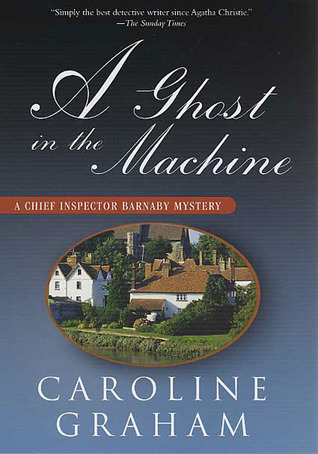
A Ghost in the Machine (Chief Inspector Barnaby #7) by Caroline Graham

★★★

*** Warning: This review contains spoilers!! I don't give away the murderer, but my thoughts could serve as hints. ***

At first I thought I'd give this book 2 stars, but towards the end I enjoyed it more like 4 stars, so I settled on a 3-star average. 

I don't generally read mysteries, but I am a huge fan of the British TV show Midsomer Murders starring John Nettles. (I haven't gotten used to Detective Chief Inspector Tom Barnaby being replaced by his cousin John Barnaby.) I picked up this book only because of its connection to the show. I would have preferred to start with the first book in the series, but this one - the last in the series - was the only one available at my library when I looked.

The author's strength is in her character-building. The first third of the book was pretty slow-going, nothing really happening and a lot of characters being fleshed out. Like the TV show, there were a couple characters who were unlikable and unpleasant right out of the gate. Surprisingly, a few characters I thought boring at first really grew on me, and eventually I rather liked them. There were even these two characters, one seemingly harmless and another who was downright loathsome, but in the end, the author had me feeling disgusted with the first and sympathetic towards the second! Notably, one of the things I enjoy most about the TV show is how the small, quaint English villages where the murders take place feel like characters in themselves, yet in this book, I never quite felt immersed in the village of Forbes Abbot.

Honestly, without the promise of DCI Barnaby and Detective Sergeant Troy, I might not have continued. In a 375-page book, the murder didn't happen until page 120, about 1/3 of the way through. Then I had to wait another 23 pages for Barnaby and Troy to finally appear. It wasn't until page 195 that something completely unexpected happened, the investigation finally started in earnest, and I actually felt drawn in.

As a fan of the TV series, I have to note that I was immediately disappointed that Troy in the book was a bit of an oaf, not just simply young and with much to learn, as he's depicted in the show. Barnaby, too, was disappointingly more gruff than his TV counterpart.

I did enjoy picking up some new British words and phrases, which is something I enjoy about the TV show, too. Also, every now and then there's a bit humor that made me chuckle.

As far as the book's mystery goes, I think I've been too influenced by TV shows in which there is always a dramatic twist. Without any expectations, I would have suspected character A to be the murderer, based on their backstory. But that would be too easy. Character B felt like a red herring. I thus suspected character C, a minor character with motive and opportunity. In the end, I was somewhat disappointed when character A turned out to be the murderer. But! There was a satisfying twist after all, when character A was revealed to be in cahoots with character D, which I hadn't guessed at all.

I enjoyed the final section labeled "Afterwards". It was nice to see what became of everyone, and all the loose ends were tied up, including some ends I didn't even think needed tying. Not sure how I feel about the developments related to the child Karen, though. I really just wanted her to have a simple, happy life with Roy and the Crudges. The supernatural bit felt out of place and decidedly un-Barnaby-like.

Tuesday, May 12, 2020

Gathering Blue (The Giver #2) by Lois Lowry

★★★

*** Warning: This review contains spoilers!! ***

Gathering Blue is just as thought-provoking as The Giver, and part of its appeal was comparing and constrasting Kira's village with Jonas's community.

Kira's village lived in poverty and fear, with an every-person-for-themselves way of life. Yet, good-hearted people like Kira and Matt still flourished. At one point, referring to plants, Kira marveled at how "blossoms continued to bloom and she was awed to see that vibrant life still struggled to thrive despite such destruction." (p. 90) That description could be a metaphor for Kira and Matt's own lives, how the cards were stacked against them, yet they flourished. Taken further, it could be a metaphor for all of humankind; though the world had faced destruction, and shocking societies had grown out of ruin, the humanity of people like Jonas and Kira could lead people towards a better existence.

Matt was my favorite character. So capable and open, with such an infectious spirit! I would love to read more about him.

This book ends on a hopeful note, but as with The Giver, I put the book down wishing for a sequel. I can imagine Kira leading Thomas, Jo, and Matt in slowly introducing more compassion and equity into their society, but how? How will they handle the Council of Guardians, and Jamison in particular? Does the other community really become known to the village, and how do the villagers react to the news? What happens when everybody finally learns that there are no beasts?

As far as I could tell, there was nothing in this book that made it clear it existed in the same universe as The Giver; we only know the two stories are related because this book is marketed as a companion book. Just one line gives a hint at a possible connection, when Matt tells Kira that there is a boy her age in the other community who has very blue eyes. From The Giver, we know that Jonas and Gabriel had "pale eyes", which could indeed mean they had blue eyes. It's a very thin connection, but it's intriguing to wonder if the boy might be Jonas in a contemporary timeline, or Gabriel many years later. 

Tuesday, May 5, 2020

The Giver (The Giver #1) by Lois Lowry

★★★

*** Warning: This review contains spoilers!! ***

I really enjoyed the writing in this book. It was straightforward and descriptive, and I think its matter-of-fact simplicity evoked a sense of calm and order, reflective of the community in the story.

I can imagine this book making a big impression on young readers, showing them the value of having choice, and how our individuality brings richness to our lives. Readers of all ages may be touched by the reminder that even if sometimes life is inconvenient, painful, or sad, it is the same range of emotions and experiences that allows us to feel joy, love, and excitement.

I was a bit thrown, however, by the uncertainty of the genre. I went into the book believing it was a kind of realistic utopian fiction, maybe futuristic or post-apocalyptic, but within the realm of possibility for humans on Earth. The totalitarian world of Sameness was intriguing; both benefits and disadvantages were clear, though its inhumanity was exposed when Jonas was introduced to the pill, even before we found out what a "release" really meant.  

Then I got to the part about the Giver transmitting ideas to the Receiver telepathically. Suddenly, I had to recalibrate my understanding of this world as one in which some people had a supernatural ability. And the fact that people couldn't see color, how could that be explained? "Memories" had odd, unexpected qualities; they could only be held by one person at a time, and they never disappeared, but needed to be held specifically by someone in the community. As these sci-fi / fantasy components emerged, the book became less of a kind of warning for us humans, and more like an interesting story of some other species, perhaps one that might be encountered on Star Trek: The Next Generation. (Incidentally, some of these details held together better in the movie version, which I watched after finishing the book. In the movie, all citizens were given an injection since birth - this could explain the color blindness - and there was advanced technology that contained memories within the community at the Boundary of Memory.)

I can see the poetry in the final scene (which Lois Lowry called "intentionally ambiguous" (p. x) in the Introduction of the edition I read), but I am personally not a fan of vague endings open to interpretation. I like closure, and I like knowing what the creator of the story intended for their characters. Though I much prefer happy endings, I admit that if I am forced to choose, I might have to say that I think Jonas and Gabriel died in the snow. (I was actually quite pleased when the movie delivered the more uplifting option of the happy ending.)

Finally, the book left me with some lingering questions. First, I understand that the Giver plays a vital role in the story, but Jonas is clearly the protagonist. Why not name the book after the Receiver? Maybe because Jonas became a Giver when he transmitted memories to Gabriel? Or, as my husband suggested, because Jonas, at the end of the book, was the Giver for the entire community?

Second, what happens to the community when they receive all of Jonas's memories? How do they manage, and how is their society changed? Will the original Giver be able to effect change, or will the Committee of Elders squash the potential as they did when Rosemary was released? I wish these questions could be answered in a sequel.

Sunday, February 2, 2020

Nightfall (Keeper of the Lost Cities #6) by Shannon Messenger

★★★

*** Warning: This review contains spoilers!! ***

There's a lot of explaining in this book. The first several chapters are basically a giant recap to the whole series, which was fine with me because at this point, all the details are getting muddled in my head.

Nightfall very satisfyingly brings in Sophie's human family. I appreciated this new development quite a bit, since I always thought it was a glaring omission of convenience for the Harry Potter series to not integrate Hermione's muggle life into the magical world. 

There were a lot of exciting developments, a couple new characters, and Sophie's enhancing ability turned out to be more interesting than I expected.

Still, the unfolding story was as convoluted as ever, with Sophie and others making tenuous connections to move the story forward. The plot seemed to be driven more by explanation than by actual events.

Until now, I had brushed off the love square as an intermittent distraction. But potential relationships were more front and center in this installment, and I just found it to be an annoyance. Probably most readers enjoy the tension, and the choosing of sides for perfect pairings, but I'm just not a fan of superfluous romance that doesn't actually move the story along.

I also found myself disappointed at the lack of storytelling detail. For example, in the sparring match between Keefe and Dimitar, I didn't get any sense of how Keefe, a teenage boy with no training in defense or weapons or fighting, was able to best the highly trained warrior king with only his levitation skill. An actual play-by-play of how he made his strikes would have been nice. Also, more than once, it was a big mystery how Lady Gisela was able to get past Sandor's goblin guard. Apparently, Keefe's ogre bodyguard Ro was able to figure it out "within about three seconds" (p. 559), but we readers were still left in the dark.

Thursday, October 10, 2019

Exile (Keeper of the Lost Cities #2) by Shannon Messenger

★★★

I still like the series, but I felt this book was lacking. I was a bit bored at the start, feeling like the story didn't pick up until chapter 8. I was annoyed at all the explicit recapping, but my daughter said if I had to wait a year in between reading books, I'd have appreciated it. The adults in this series seem to have a bigger role than I realized, because we didn't get to see any peers for Sophie until Dex appeared in chapter 15.

Similarities to Harry Potter continue, e.g., the mesmer talent is analogous to the imperius curse, and inflicting is like the cruciatus curse. Also, Silveny the flying horse-like alicorn was reminiscent of Buckbeak the flying half-horse hippogriff. But just as my son assured me, by the end of this book, the series veered quite a bit away from the wizarding world of Harry Potter. 

I was surprised at how dark and disturbing some of the scenes were, e.g., people consumed to death by flames, minds shattered to the point of insanity. I liked the encouraging message about not letting yourself get destroyed by guilt. And I thought it was weird how quickly elves turned to sedatives to calm down, instead of just trying to calm down naturally. 

Overall, the whole arc of the story just seemed kind of convoluted. The link between Sophie wanting to save Alden and her figuring some doodles in an old diary would be the answer seemed awfully tenuous. And sure, all the clues left by the Black Swan were intriguing and helped to build suspense, but why all the riddles? If they were able to contact Sophie directly via private messages in her locker, why not just give her clear instructions? 

Finally, I had to dock the rating a star because I really disliked the way the author reframed J.R.R. Tolkien. The Lord of the Rings was a seminal work of fantasy and literature, yet in Shannon Messenger's elven world, Tolkien was unoriginal and didn't understand his own writing. Maybe she was trying to pay homage to Tolkien's elves, but the execution was lacking and, at least to me, it felt derisive.

Thursday, April 25, 2019

Song of the Trees (Logans #3) by Mildred D. Taylor

★★★

After reading Roll of Thunder, Hear My Cry, book 4 in the series about the Logan family, I figured it'd be worth reading the rest of the series as well.

I have to admit, I did not realize this book is essentially a short story. I'm actually glad I read it after reading Roll of Thunder, Hear My Cry, because that meant I went into this book already knowing who the characters were. Without that pre-existing connection, I'm not sure I would have felt as invested in this story.

Song of the Trees tells of the episode, referenced in Roll of Thunder, Hear My Cry, in which a white man takes advantage of Papa not being home to strong-arm Big Ma into allowing him to cut down trees on her land. The book conveys a deep appreciation for nature while reaffirming David Logan's dignity in the face of overt racism.

Monday, March 18, 2019

Front Desk by Kelly Yang

★★★

I love that this book's first-person narrative voice is that of a child immigrant. There are very few books that I have found with this perspective, and I think it's important for immigrant children to have such books as "mirrors", and for American-born children to have them as "windows".

I also really appreciate that this book addresses racism head-on. I think race and racism should be openly discussed among children of all ages, and this book goes a long way in helping to make these topics accessible.

That said... I was troubled by just one phrase that had an outsized impact on me. Mr. Yao, the awful motel owner who exploits the Tang family, spoke "Taiwanese-accented Mandarin". The main character Mia and her family are loving, hardworking immigrants from China, while the mean, unfair boss is an immigrant from Taiwan. Most readers would probably gloss over that distinction, but Taiwanese characters in children's books are so scarce that when I, a child of Taiwanese immigrants, read the word "Taiwanese", my heart leaped with excitement! "Omg, a Taiwanese character!" Unfortunately, that feeling quickly deteriorated as I realized, "Uhh... The one Taiwanese character... is the irredeemably ignorant, cold-hearted, racist villain?" I just don't think we have enough narrative plenitude yet that would allow me to overlook such a one-sided negative portrayal of Taiwanese people, particularly because there was no Taiwanese counter-example to Mr. Yao. Maybe I would have been less bothered if, for example, Mrs. Yao had been kind and reasonable in a way that could have balanced out Mr. Yao's evilness. Also, many readers might not know that there is a kind of tension between mainland Chinese people and Taiwanese people, on account of differences in culture, history, and politics. I don't see any point in further driving in that wedge, especially with young readers.

Growing up with immigrant parents, I know that the sacrifice, discrimination, assumptions, and stereotypes faced by immigrants are real. The author deftly portrays these struggles through Mia's battle with the model minority myth, her embarrassment over her un-stylish clothing, and Mia's mother's feelings of inadequacy regarding her poor English. But the added difficulties faced by undocumented immigrants is a whole other harrowing level, and I don't think it helps to conflate the two experiences. The picture painted of immigrants in this book - Mia's parents seemingly being paid under the table, other immigrants fleeing from loan sharks, abusive employers with illegal practices, and immigration raids - point to experiences more typical of undocumented immigrants, yet they are never referred to as "undocumented". I applaud the author for tackling such an important topic, and I wish the characters were explicitly identified as undocumented. I think the distinction is important, and when made in a children's book, could really help young readers to understand that "the illegals" they hear being vilified in the news are people like their classmates and neighbors, regular people just like them. Also, identifying characters as undocumented would help explain why Mia's Mexican friend Lupe doesn't go back to Mexico to visit her family (an undocumented immigrant who leaves the country risks not being able to return), and why Mia's parents, at the end of the book, didn't even consider going to a bank for a loan. (It's not impossible for undocumented immigrants to get a loan, but being undocumented is certainly a negative factor.)

Anyway, moving beyond immigrant-related concerns... I found Mia to be easily likable. She was driven, resourceful, and well-meaning, and she had been through so much that even when she engaged in morally questionable behavior towards the end of the book, I could understand why she did it. I appreciated, too, that Jason was a complex character who developed as we got to know him.

At first I thought the cover illustration was misleading; it makes you think that the book is going to be a light-hearted account of Mia's antics as she works the front desk of the motel. It starts to feel inaccurate when you start reading about heavy ideas such as loan sharks, scary drunks, and police officers racially profiling and mistreating black people. But then, as the book progresses, there's a lot of over-the-top problem-solving that can only fly in a children's book. The ending especially was in-the-clouds level over-the-top, it actually seemed jarring and out of place when the rest of the book seemed to at least try to be realistic.

Tuesday, February 5, 2019

Patina (Track #2) by Jason Reynolds

★★★

Patina picks up right where Ghost left off. We find out how the first track meet went, only now events are told from Patty's point of view.

Patty and her family have experienced more hardships than any family should have to face, particularly in so short a span of time. Patty puts on a strong front, taking it upon herself to look out for her younger sister while also doing right by her mother and keeping her own life in order. It's a lot for a kid, and I'm not sure if it was in the writing or the character, but Patty showed a lot more maturity than I would expect from a middle schooler; I kept having to remind myself that she wasn't a high schooler.

The book takes place over the course of a week, but the first few chapters spend a lot of time laying down the backstory of how Patty and her sister came to live with their aunt and uncle. It's a lot of character development as Patty goes to school and interacts with classmates while learning about Frida Kahlo, and as she goes to track practice and interacts with teammates while learning to pass the relay baton. There isn't a lot if action at first, but things start to pick up towards the end of the week.

Patty is confident and self-aware as she takes on each new day, gradually peeling back the layers of the people around her and making sense of things. She's a great character for young readers to get to know, especially if you're on the lookout for a black female protagonist in realistic children's fiction.

Wednesday, November 21, 2018

A Wrinkle in Time (Time #1) by Madeleine L'Engle

★★★

I first read this book for school in 4th grade, and mostly I remember not understanding it. Literally the only thing I remembered about the book is the scene when the children first arrive on Camazotz, and everyone is behaving in unison. Reading this book now essentially felt like I was reading it for the first time.

I have to admit, I am not generally a reader of sci-fi, so a book about space and time travel wouldn't normally interest me. But with this book being in the media so much because of the new movie, and everyone heaping praise on the book, I figured I should give it a chance.

I was struck by how dated the writing was - the book was first published in 1962 - and I wonder if children reading the book today notice it? The way Meg calls her parents "Mother" and "Father", and Calvin using phrases like "golly day". I found it endearing in a charmingly nostalgic way.

I really liked Meg. With all her faults and emotions, she was a really authentic character to me. I liked Calvin, too, even though it seemed so random that he just showed up.

It wasn't until almost the very end of the book, when the travelers landed on the planet Ixchel, that I finally got roped in. I liked the beasts on that planet, and I wanted to see how the book would end. The actual events turned out to be anticlimactic, but it was satisfying to finally realize what the book was about: the power of love (reminiscent of Harry Potter, until I remembered that this book came first) and how the essence of people and things - what they mean to you - is more important than visible, physical characteristics. Also, I liked Meg's evolution from being completely dependent on others to being empowered to do what was required, despite being scared and unsure.

Interestingly, there were Christian references strewn throughout, and it seemed to me that the power of good in the universe was meant to come from a Lord that was constant through all the worlds and galaxies. This was somewhat surprising because while other series like The Chronicles of Narnia and The Golden Compass are known for their religious and anti-religious themes, respectively, I hadn't heard about the religious nature of this book at all! It actually made for an intriguing combination, the scientific and mathematically-oriented minds of Mr. and Mrs. Murry and Meg, and the faith and love of a Christian God powering the goodness of the universe.

Thursday, October 4, 2018

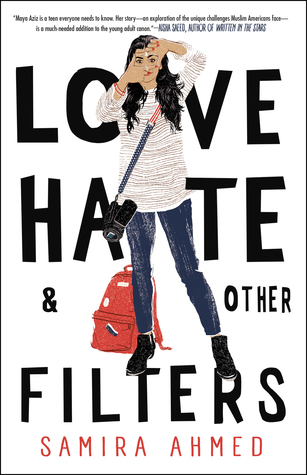
Love, Hate & Other Filters by Samira Ahmed

★★★

Maya is an Indian-Muslim-American high school senior. I think the book is well-summarized by this excerpt: "My parents' fears shrink my universe to the four walls of this house. The world outside paints us all as terrorists... And all I want is to make movies and kiss a boy." (p. 220) The book was an interesting combination of teen romance, multicultural identity searching, and spotlight on racism.

The first half of the book reads like a romantic comedy. Perpetually-blushing Maya unexpectedly finds herself in a love triangle, torn between Phil, who is white, beautiful, and captain of the football team, and Kareem, an Indian-Muslim-American student at Princeton. People who enjoy these Team Phil vs. Team Kareem type stories would probably find a lot to like in this book, but alas, I am not generally a fan. (Though that didn't stop me from picking Team Kareem.)

As an aspiring filmmaker, Maya dots her narrative and dialogue with film-related terminology and references to movies. At times, it's an effective tool for breaking the awkwardness in a scene or lightening the tension.

There were things I really loved about this book. Mostly, I enjoyed the writing, which was full of colorful metaphors. In reference to the conservatism of her immigrant community, Maya's first-person narrative observes, "some taboos cross oceans, packed tightly into the corners of immigrant baggage, tucked away with packets of masala and memories of home." (p. 9)

I was a little concerned that Maya's parents were too much of a stereotype of conservative immigrant Indian parents, but those worries were mitigated by the existence of Maya's cool aunt Hina, who served as a counter-example.

Admittedly, I felt misled by the quotes of praise from other authors (printed on the back cover) which referred to Maya as a Muslim and completely omitted her Indian identity. For pretty much the first half of the book, most of the diversity portrayed was that of her being Indian. There was a lot of Indian food, Indian clothes, and Indian culture strewn throughout. The fact that she and her family were also Muslim was mostly limited to statements of that fact and joking mentions of not eating pork. We didn't really see how being Muslim affected her day-to-day life.

It wasn't until about halfway through the book that Maya's Muslim-ness came into focus, in the wake of a terrorist attack. This is when the book finally started to get interesting, in my opinion, as Maya navigated her school with all eyes on her.

I appreciated the way the events surrounding the terrorist attack unfolded, alternating between snapshots of the perpetrator and the victims. However, I was bothered by a few passages that seemed contrived to elicit sympathy for the perpetrator. He was given a background story that some might interpret as excusing his actions; he was abused as a child, "troubled" and misunderstood as a teenager. I would have much preferred passages that instead or additionally showed how he might have fallen down a rabbit hole of hate and poor decisions.

I also was not too keen on one scene that I'm sure many readers would probably enjoy from a romance standpoint. Without giving too much away, there's a moment when Phil comes to Maya's rescue, and as romantic as that is, it just crept too much into "white savior" territory for me.

Overall, I think the book could have been better paced. The pure romance first half of the book could have been condensed, and the aftermath of the terrorist attacks could have been extended. Moreover, I felt the book ended much too abruptly after Maya took a stand for her future. There were just so many unanswered questions I had for the time that was glossed over by the epilogue, particularly in regards to Maya's relationship with her parents. So much conflict, so much tension, how did she and her parents deal with it?!

As is typical of multicultural books, foreign words are occasionally interspersed. I felt like I could understand non-English words from context, though I wasn't sure if specific words were Urdu or Hindi.

Finally, this book does include swearing and references to sex, not uncommon for a book rated for teens.

Friday, August 31, 2018

American Panda by Grace Chao

★★★

*** Warning!! This review contains spoilers!! ***

I have lots of mixed feelings about this book. I really, really, really wanted to love it. I'm a big fan of promoting diverse books, and I think narrative plenitude is super important. In that vein, I absolutely acknowledge that each individual book involving another culture can not be expected to represent the entire culture in a way that suits me, and the only way to escape that expectation is for more books, and a much wider variety of books, to be written. Maybe if we already had narrative plenitude for Asian-Americans, I wouldn't feel guilty about my rating, which I gave a little bump for its diversity factor.

From the outset, if ever there was a book that I should feel was written for me - the kind of book I would have wanted growing up - this book would be it. Like the main character Mei, I, too, am a child of immigrants whose families left China for Taiwan during the Communist Revolution. I, too, grew up in Massachusetts, went to Chinese School, danced in a traditional Chinese folk dance troupe, went to MIT, and lived in Burton Conner. In college, my mother occasionally brought me Chinese food, and I even dated a Japanese boy. So yes, I identified with Mei, and I appreciate that such a book exists that can speak to readers who are younger versions of myself.

I thought the author did a really wonderful job portraying how Mei's strict and overbearing parents were motivated by love and tradition, and how Mei's filial piety came from a place of appreciation and respect. On the whole, the book was a fantastic story about how an Asian-American teenager comes to terms with her identity while straddling two cultures. Yet, it bothered me that both Mei and her parents fit all the stereotypes, from the "tiger mom" parenting style to the model minority myth. Mei's mom was even a terrible driver, which added nothing to plot or character development. I found these characters to be believable, but I was weighed down by the propagated stereotypes.

Other characters, like Dr. Chang, were far less believable. She was a mousy, poor excuse for a doctor whose role as a plot device couldn't have been more contrived. Also, giving the mean girl Valerie an unflattering health condition seemed unnecessary.

Throughout the book, there were three things I found repeatedly distracting. The first was the frequent use of Chinese without a glossary for reference. I liked that the author used pinyin with accent marks - too frequently the crucial accents are left out of pinyin - but the Chinese was only sometimes translated. I know enough Chinese so I was able to understand all the references, but I know that when I read books with languages unknown to me, I always like to know what the non-English words mean, instead of having to guess and wonder if I guessed correctly. Sometimes, there was enough context to figure out the gist of the Chinese words' meaning, but not always.

Another distraction was the habitual references to MIT culture. The explanations about MIT lingo - most presented in a blatant "tell" rather than "show" manner - seemed more like name-dropping, giving me a sense of like, "Look, I really did go to MIT, I really am an insider, let me prove it to you." It's like the book was trying too hard to push the MIT connection.

Thirdly - and this might say more about me than the book - I was really taken aback by the occasional raunchiness. The cover art, the interior design, the personality of the main character - they all led me to believe that this would be a pretty straight arrow kind of book. But every now and then, I was thrown off by a sexually explicit joke, a sexually implicit use of a word like "horny" or "beaver", and casual use of the f-word. They all just seemed out of place for a "nice girl" character like Mei. The added vulgarity didn't add any authenticity or relevance, it was almost as if those references were thrown in to say, "Look, just so you know, Mei isn't a goody-two-shoes, and MIT students aren't all prudes." This book definitely falls in the "Young Adult" category, and I wouldn't recommend it for middle schoolers (which I might have done if I judged the book by its cover).

Finally, I was incredibly disappointed in the direction one of the conflicts took. Mei's brother Xing was disowned by their parents because he wanted to marry a woman who had a health condition that presumably prevented her from having children, thus depriving them of ever having grandchildren to carry on the family name. This was obviously a huge conflict, and any resolution would involve a major change in heart from one side or the other. Instead, the conflict was diluted when the woman got pregnant. It just seemed like a cop-out.

Overall, a good book about Asian-American identity, but not as well-executed as I would have liked.

Monday, June 18, 2018

Rich People Problems (Crazy Rich Asians #3) by Kevin Kwan

★★★

Picking up this book, I thought for sure I would end up rating it lower than the first two, thinking I'd be tired of "more of the same" in terms of the outrageous spending and constant references to fashion and food. But my curiosity about the fate of Tyersall Park drew me in, and who can resist the sprawling soap opera-y cast of inter-related characters full of drama, scandal, and crises.

In pattern with the series, this book further introduced us to new levels of luxury throughout Asia, this time in Thailand, India, and the Philippines. Also, I liked how this book finally gave us a peek into the lives of the servants at Tyersall Park.

While I wouldn't call this a thinking book, it does offer some light lessons of self-reflection and history. Mostly it's a fun, beachy read, and my only regret is not actually reading this series on a beach.

Saturday, June 2, 2018

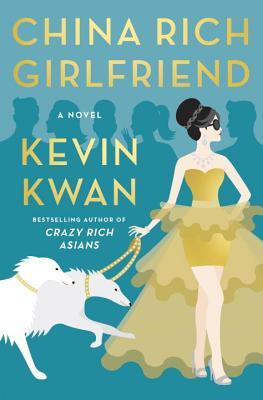
China Rich Girlfriend (Crazy Rich Asians #2) by Kevin Kwan

★★★

Another fun and entertaining read. In this installment, Rachel Chu becomes incrementally more interesting, but mostly because of the people around her and the experiences she is thrown into.

This book offers a growing cast of characters - in fact, I was disappointed not to see more of Nick's mother Eleanor - in increasingly soap opera-y storylines. It also takes us beyond Singapore to Hong Kong and China, for even more jaw-dropping examples of how the insanely wealthy "China rich" elite spend their money. To some extent, this book offered "more of the same", and I grew a bit weary of all the references to fashion and food. But there was even more drama and intrigue than in the first book, so it was still an engaging read.

Saturday, May 12, 2018

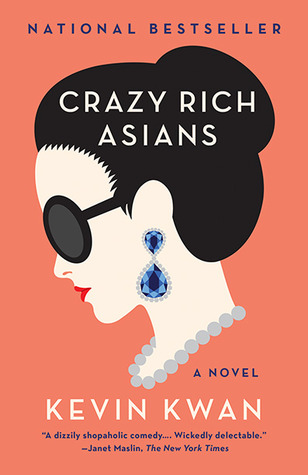
Crazy Rich Asians (Crazy Rich Asians #1) by Kevin Kwan

★★★

A fun, frolicking read among the lifestyles of the crazy rich Asians of Singapore. Frequent footnotes explained the many-faceted Singaporean culture, a mix of Chinese, Malay, Indian, and British influences, and language that drew from Mandarin, Cantonese, Malay, and Hokkien. Authentic foods, high fashion, and soaring architecture make this book one for the senses - it's easy to envision the big-screen interpretation, which I can't wait to see in August.

In fact, without the trailer for the upcoming movie - and Constance Wu firmly planted in my mind as Rachel Chu - I'm not sure what kind of an impression Rachel and Nick would have made on me; despite being main characters, they are perhaps the two least developed characters in the book. While Rachel and Nick drove the story, I found myself at least as invested in Astrid Leong's storyline, if not more. And while relationships were at the center of the drama, I wouldn't call this book a "romance" novel. It's a light-hearted romp into a fantasy of over-the-top luxury.

Sunday, November 26, 2017

Gone Crazy in Alabama (Gaither Sisters #3) by Rita Williams-Garcia

★★★

I think this book would make a good movie. It's the final installment of the series about the Gaither sisters, yet it stands well on its own.

The book takes us into the Deep South of 1969. Against the backdrop of the moon landing - which sets the context for the time period - the Gaither sisters visit their grandmother Big Ma and great-grandmother Ma Charles in Alabama. Slowly and gradually, the girls learn old family secrets - the family tree at the end of the book is helpful - with Ma Charles trying to impress upon them the importance of knowing where you came from, while Big Ma was content to let sleeping dogs lie.

This summer - perhaps with a bit of a push from the Mrs. always saying that Vonetta and Fern are capable beings, too - Vonetta and Fern started to stretch their wings. Delphine was left at a bit of a loss, as her identity, until then, had been wholly tied to being a substitute mother to her two younger sisters. I felt sad for Delphine, and happy for Fern, who was discovering herself. Regretfully, I came to dislike Vonetta. I couldn't see why Uncle Darnell and Jimmy Trotter favored her. Yes, she was entertaining and lively, but she was also selfish, stubborn, and sometimes downright mean.

The book ambled along until about 3/4 of the way through, when it took a totally unexpected and dramatic turn.

Without giving away too much of the surprise, I hope it's enough, but not too much, to say that something happens to Vonetta. It tore me apart that Delphine felt the need to defend herself against blame, that even Cecile said to Delphine, "I told you to look out for Vonetta,"(p. 232) and Jimmy Trotter said, "You're hard on Vonetta." (p. 255) As if Delphine hadn't spent most of her young life being a mother instead of a sister to Vonetta because her own mother had abandoned them and her father and grandfather expected her to be her sisters' guardian. It was hypocritical of Cecile to expect Delphine to look out for Vonetta, when she just spent an entire book - P.S. Be Eleven - trying to tell Delphine that she ought to act like the child she was, rather than trying to be her sisters' mother. That anyone could blame 12-year-old Delphine for what happened to Vonetta, and not Vonetta's own stubbornness and choice of behavior, was frustrating and infuriating. I was indignant on Delphine's behalf, and I wanted to reach through the book and hug her and tell her she was loved.

Towards the end of the book, there is an especially poignant moment between Delphine and Big Ma after Big Ma returns from the court house. In that brief interaction, we see how truly devoted and loyal and loving Delphine is to her Big Ma - and by extension, to her family as a whole.

Overall, I think the themes in this book surpass the middle grade audience it's intended for. I'm an adult, and this book gave me so much to think about.

Sunday, October 8, 2017

Fascinating: The Life of Leonard Nimoy by Richard Michelson

★★★

My to-read list is way too long, and I have yet to find time to read Leonard Nimoy's two autobiographies, I Am Not Spock and I Am Spock. When I saw this children's book in the library, I snatched it up, figuring it could serve as a quick introduction and tide me over until I get around to the autobiographies.

It's a decent book, but I'm not sure who the intended audience is. On the one hand, it's a picture book, but I'm afraid I didn't find the illustrations very compelling. They did a great job portraying the content of the book, but they just seemed sad to me. All the illustrations were colored in muted tones, and it looks like many of them were depicting night-time scenes, to fit with the "Reach for the Stars" theme. That darkness - despite the peppering of stars - conveyed a sense of loneliness to me. I do, though, have to give credit to the illustrator for very effectively rendering human likeness; before reading the text on one page, I looked at the accompanying drawing and immediately thought, "What's John F. Kennedy doing here?" - and lo and behold, Leonard Nimoy did indeed have an interaction with John F. Kennedy!

On the other hand, the reading level seemed more appropriate for middle elementary grades. I can see elementary students reading this book on their own, but then I was bothered that the book assumed a certain amount of broad knowledge. For example, the book references "jump shot" and "soda jerk" without any context whatsoever for young readers to figure out what those phrases mean. Maybe it's just meant to be read aloud by older, more knowledgable readers.

I did like the book, and was happy to learn more about how the Vulcan hand greeting was inspired by a Jewish hand gesture - something I was only vaguely aware of before. Also, it was fun to see that Leonard Nimoy's Boston in 1949 included a few places still quite familiar to modern-day Bostonians.

But then - suddenly! - the book was over. It was such an abrupt ending.

The last four pages consists of two afterwords. The first provides more information about Leonard Nimoy's work and accomplishments, and the second was an Author's Note describing the author's personal relationship with Leonard Nimoy. Clearly the story was meant to bring the reader from Leonard Nimoy's childhood to his success with Star Trek, but I think the content of those last 2 sections were just as informative and interesting as the main body of the book.

Thursday, August 24, 2017

The Emperor of Nihon-Ja (Ranger's Apprentice #10) by John Flanagan

★★★

This book started on the wrong foot for me. In Toscana, when Will and Halt watched the display of Toscan military might, they witnessed a method of training in which all soldiers lined up tightly and threw javelins simultaneously at an angle specified by a commander. Additionally, one line of soldiers was protected by a front line of soldiers with shields. They were both impressed - Will even called it "brilliant" - but did they forget that that is the EXACT same method that Will used to train his team of unskilled archers in Skandia?!? Did the author completely forget that he already used that strategy in an earlier book!?

From then on, I think I was just waiting for the book to redeem itself, and maybe I was harder on it than I might have been otherwise. I was already wary when Alyss and Evanlyn had their "incident", in which they both acted immature and petty (though I think Evanlyn was much more of a brat). Of all the many characters in this book - all of whom were, like Mary Poppins, "practically perfect in every way" - it bothered me that the only two to be burdened with significant flaws were the two women. And to make matters worse, they were fighting over a man! Ugh. We can't just have two strong women characters without having to entangle them in a love triangle? Yes, perhaps the author was setting the groundwork for the meaningful reconciliation at the end, however, I think he could have gotten the jealousy across without having the women behave so childishly. Or better yet, couldn't he have contrived some other reason for them to be at odds, rather than make it about a man?

Which brings me to another major complaint: throughout the book, both Alyss and Evanlyn were called "girls", both by the narrative author and by other characters in the book. Evanlyn led a world-wide expedition, and Alyss was a full-fledged Courier - by any measure, they should have been called "women", especially because Will and Horace, who were the same age as Alyss, were never called "boys".

Since I seem to be listing the negatives first, I might as well mention my disappointment at the end. When Alyss and Evanlyn go off on their mission, I thought it was great! Here, the two women would prove - once again - their bravery and worth. And yet, I thought the whole bit about the two of them killing the "Terror" in the forrest was just over the top. Surely if such a massive beast attacked Alyss with all its weight behind it, at the very least Alyss's shield arm would have been broken!

Specific grievances aside, on the whole, I still liked this book. Much more so than previous books in the series, this installment featured an ensemble of characters, and if anyone was a "main character", I think it was Horace! My favorite! So I enjoyed seeing him on his own in Nihon-Ja, and developing his relationship with Shigeru the Emperor. I liked reading about Nihon-Ja as a fictional rendition of Japan, though I have to admit, I'm not sure who the tall, long- and red-haired Hasanu were supposed to be! Perhaps they were a return to the kind of fantasy that appeared in the first couple books.

Saturday, July 8, 2017

Halt's Peril (Ranger's Apprentice #9) by John Flanagan

★★★

*** Warning: This review contains spoilers! ***

This book is like the "Part 2" conclusion to The Kings of Clonmel.

First, there were a number of things I liked in this book. I liked the camaraderie shared by Will, Halt, and Horace, and I even liked the continued references to Halt's aging, which made clear the idea of him passing on the Ranger torch to Will. I also really enjoyed the appearance of Malcolm.

Unfortunately, there were also things that irked me in this book. Some of the descriptions seemed to go on too long, almost like the author was just purposefully trying to stretch out the book. I noticed this most during the scene in which Will and Halt were walking into the Genovesans' ambush. I got impatient thinking, "Yes, okay, I get it! They are slow and careful as they make their way through the forest, they have to stay quiet and out of sight. I get it, already, I get it! Just get on with the story!"

On the opposite end of the spectrum, at one point I was anxiously awaiting an upcoming scene, which ended up being excluded entirely! As Will raced towards Malcolm, I was looking forward to reading about Will's unexpected arrival, and how Malcolm and his band of people would react to seeing Will again. I was disappointed when the book just leap-frogged over that event.

Mostly, I was bothered that people seemed to act out of character. After being told repeatedly that Will had an exceptionally uncanny ability to always shoot his target, it was hard to accept that Will missed the second Genovesan, when it sounded like he should have had a pretty clear shot. Later, when Will and Horace were tracking Tennyson, somehow Horace - always bumbling loudly - was suddenly able to make a decent show of moving quietly, a skill that literally took Will years to develop. Also, Horace is supposed to be the "brawn", happy to leave all the heavy thinking to the Rangers, yet Horace is the one who thought of the clever way of getting the Genovesan to tell the truth about which type of poison he used, Horace was the one who spotted the smoke confirming Tennyson's presence in the caves, and Horace was the one who came up with the idea of Halt impersonating Ferris to discredit Tennyson!

And even Tennyson himself seemed to act out of character. Once they tracked Tennyson to the caves, I just can't believe that Tennyson would not post guards outside the caves, especially since he didn't know for sure where the Genovesan, Will, and Horace were. Sure, he's arrogant, but he didn't manage to take over 5 entire kingdoms, and almost a 6th, by being sloppy.

Overall, I did enjoy the read, I think mostly because I am already a fan of the series and happy to be caught up in the characters and the world in which they live.

Monday, May 29, 2017

The Burning Bridge (Ranger's Apprentice #2) by John Flanagan

★★★

*** Warning: This review contains spoilers! ***

The action continues as Will and Horace play their roles in the coming war with Morgarath.

A good continuation of the first book, with Will still eager to learn, this time mostly from Gilan, who I enjoyed getting to know. Along the way, Will picks up some good advice and interpersonal skills, much of which I hope transfers to the young readers of the book!

I thought it was a bit too easy for the titular bridge, and the tunnel behind it, to have been left unguarded. But I guess even if there had been guards, Will could have just taken them out with arrows or something.

I think my relative rating of this book as lower than my rating of the first book is mostly because this installment had an awful lot of fight scenes. I thought they were well-written - exciting and descriptive, but not gory - but I think I'm just not personally too interested in reading about the battles themselves. Also, I'm not sure yet what to make of Evanlyn. I guess I'll withhold judgment until I see how her character and story line develops.

The cliffhanger ending was quite unexpected!