Showing posts with label graphic novel. Show all posts

Friday, September 5, 2025

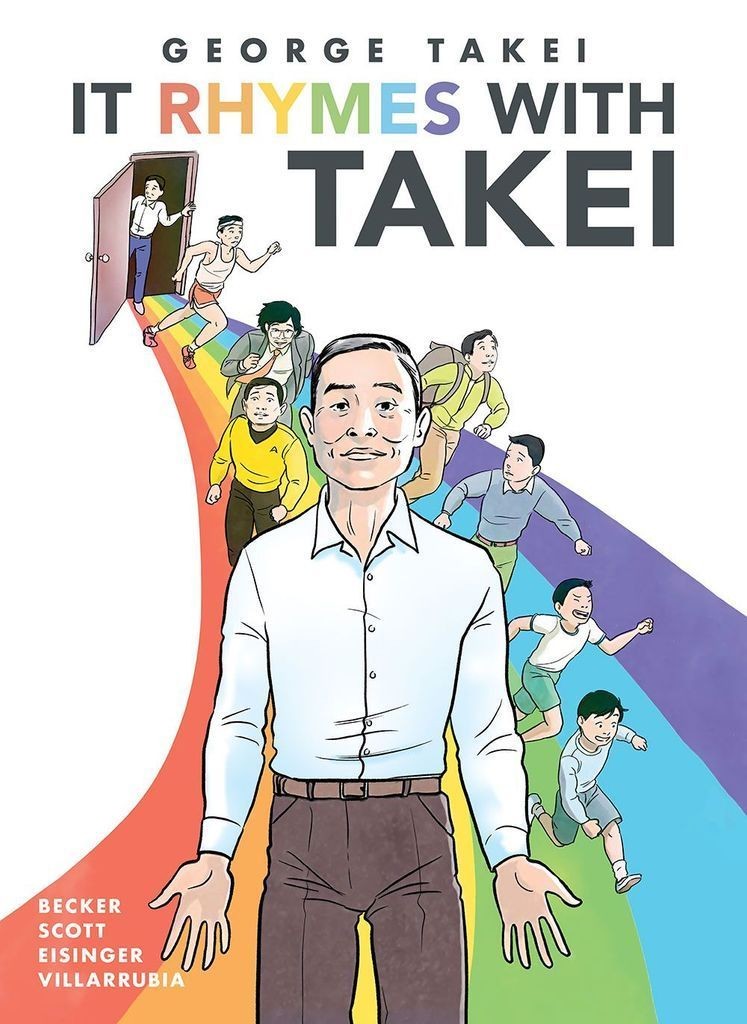
It Rhymes with Takei by George Takei

★★★★

Another great graphic memoir by George Takei. While I am a huge fan of George Takei, I'm not accustomed to reading graphic novels, so I admit this style of storytelling always takes some getting used to for me.

There are certainly LGBTQIA+ books for kids, but I would categorize this one as YA. There's nothing explicit, but the graphic novel medium was pretty effective at suggesting more extensive meaning behind a few chosen words, particularly when sexual activity was involved. Also, gay slurs do appear in the dialog.

George Takei didn't publicly come out as gay until he was 68 years old, and this graphic memoir explains why. Being gay was a constant source of fear and anxiety for him. He lived a tortured life, always in dread of being exposed, afraid that his sexuality becoming public would destroy his acting career. It may even have held him back from political aspirations. Sadly, some of his concerns were validated when a private coming out caused a distressing rift in his family.

It was comforting to read how George Takei's Buddhist upbringing helped him to accept himself and avoid the common pitfall of self-hatred. (p. 30-31) And I absolutely loved reading about how he met his husband Brad and how their relationship grew. 

In addition to chronicling George Takei's personal relationship with his own sexuality and his activism for the LGBTQIA+ community, the book also touched upon other issues such as immigration, politics, racial equity, and police brutality. In one poignant observation illustrating a common thread throughout history and current events, George Takei realized that "even my fellow Japanese Americans who had been exploited themselves, were nonetheless capable of exploiting others." (p. 37)

Bits and pieces reminded me of his 1994 autobiography To the Stars, which I read decades ago and can't remember too well anymore. I pulled out the book for a quick comparison and had fun discovering that some lines in the graphic memoir were taken from the autobiography almost verbatim! But even when telling of the same event, the perspectives presented sometimes differed between the books. For example, when recounting a college production called Portraits in Greasepaint, both books described it as a stepping stone on his career path because a casting director saw him in that performance and ended up casting him in a film; however, the graphic memoir also mentioned a romantic relationship with a fellow male cast member (p. 96), additional context that was not included in the 1994 book, which did not discuss his sexuality at all. I just might re-read To the Stars, to piece together the narratives from both books and mentally integrate them into a more complete picture. 

While overall a very inspiring book, I was a little conflicted about the ending. Much was made of how Biden defeated Trump in 2020, how the "worst policies of Trump's grievance government" were "repudiated", and how we, as a nation, "regained our deepest sense of [decency]." (p. 325) But then, the following pages acknowledged that now, in 2025, "once again, it is a heady time and a fraught time." (p. 328) The book is a timely reminder that progress is possible, and that "the strength of our nation is in its abundant diversity" (p. 333), yet there was no reckoning of what Trump's 2024 re-election says about America. 

Apropos nothing, it was surprisingly jarring to see some of the illustrations depicting the norms of an earlier time, e.g. George Takei riding a motorcycle without a helmet in 1964 (p. 128) and George Takei holding his infant nephew in his arms in the back seat of a car - no car seat! - in 1966. (p. 166)

Monday, November 22, 2021

Displacement by Kiku Hughes

★★★★½

I don't generally read a lot of graphic novels, but I really appreciate it as a medium for making certain topics, like Japanese internment camps, accessible to young readers. 

Kiku Hughes is 16 years old, half Japanese, and lives in 2016 Seattle. She doesn't know much about her Japanese American ancestry when she's suddenly and inexplicably transported to 1942 and finds herself in a Japanese internment camp, where she learns about Japanese American history by experiencing it first-hand.

I liked that the author actually used the term "incarceration camp" instead of "internment camp", a decision explained in the back of the book. I've always thought of "internment camp" as a euphemism that doesn't sufficiently convey the inhumanity of the camps.

I also really appreciated seeing a mixed-raced protagonist, which is still pretty rare in books, I think. It's hard enough trying to understand your identity as a 4th generation Asian American, and being half white just adds a whole other layer of complexity. 

And speaking of identity. Through illustrations, we know that Kiku and a friend were members of the LGBTQ community, but it wasn't mentioned in the text explicitly. 

This book explores generational and community trauma, then shows how that legacy can be used to help advance justice for other marginalized groups. The "current time" part of the book takes place during and after the 2016 presidential election. Clear parallels are drawn between the U.S. treatment of Japanese Americans during World War II and the Trump administration's anti-Muslim and anti-Latinx immigration policies. 

My only complaint is that we never learn anything at all about Kiku's grandfather or her white father. Her grandmother was apparently a single mother, and she later re-married, but I couldn't help but wonder what happened to the father of her children. Along the same lines, we also don't know anything about Kiku's white father. I understand that there's not much reason to include him for most of the book, but at the end, it would have been a nice showing of support to see him learning about Japanese American history and going to protests alongside his wife and daughter.  

Thursday, August 29, 2019

They Called Us Enemy by George Takei

★★★★

Disclaimer: I'm a huge George Takei fan, so I was probably predisposed to like this book.

I was pleased to find that even though I had read George Takei's autobiography To The Stars, seen his Broadway musical Allegiance, followed him on Facebook, read countless articles by and about him, and watched who knows how many interviews on video - still this book had details that were new to me.

The book centers on George Takei's experiences growing up in an internment camp during World War II, but it does briefly touch upon his acting and activism at the end of the book. Published just this year, the graphic novel includes a panel that draws a clear parallel to the current border crisis.

Mostly this book is an excellent way to educate new audiences about a part of American history that is still largely unknown. Telling this personalized history through illustrations and from the perspective of childhood humanizes the events. The remembrances of happy moments shed surprising warmth on an otherwise dark and painful time. Through the agonizing decisions faced by George Takei's parents, we see the injustices perpetrated by our government on our own citizens, and we see how time and time again the Japanese-Americans were in "lose-lose" positions, yet they persevered with as much dignity and resolve as they could muster.

Ultimately, I rated this book short of 5 stars because I found the storytelling choppy. The narrative jumped unexpectedly from George Takei's childhood to a TEDx talk in 2014 back to childhood flashbacks then forward to a Day of Remembrance event in 2017, etc. Even scenes that followed chronologically were sometimes difficult for me to separate as new events taking place on a new day or in a new setting. I admit that I usually do not read graphic novels, though, so I am not the target audience, and maybe I'm just not accustomed to graphic novel storytelling.

Anyway. I hope this book finds its way into many school libraries and classrooms.

Monday, March 6, 2017

March Trilogy by John Lewis, Andrew Aydin, and Nate Powell

★★★★½

Every American should read this series in order to understand the full history and current state of racism in our country. Black Lives Matter is not new. In 1964, Ella Baker gave a speech saying, "Until the killing of black mothers' sons is as important as the killing of white mothers' sons - we must keep on." (Book 3, p. 99)

March is a trilogy of graphic novels. This series is first and foremost a history of the Civil Rights Movement. Though written in the first person by John Lewis, it is not an autobiography, and we are given very little insight into John Lewis's personal relationships.

Book 1: This book sets up the model for storytelling. It is the morning of President Barack Obama's inauguration. Brief scenes of John Lewis in Washington, DC are interspersed with flashbacks as he tells stories of his childhood to constituents visiting his office early that morning. Eventually the constituents and John Lewis need to go separate ways, and the reader remains the only audience for the flashbacks. I felt this book was the most accessible in terms of being a narrative, and setting the stage of what's to come. While I knew about the main events of the Civil Rights Movement - like the lunch counter sit-ins - I really did not know, before reading this book, just how much training, preparation, and planning went into them.

Book 2: After the success of the lunch counter sit-ins, civil rights groups initiated a campaign of stand-ins to de-segregate movie theaters. But mostly this book focuses on the Freedom Rides. Again, I was familiar with the general idea, but I had much to learn. By putting themselves into life-threatening danger, participants had to apply and were extensively trained. The horrible treatment they endured is almost unthinkable, and yet, there it was, illustrated on the page. Very powerful. This book ends with the March on Washington for Jobs and Freedom, with Dr. Martin Luther King, Jr.'s "I Have a Dream" speech.

Book 3: This book is the most intense of the three, explicitly detailing the horrific events surrounding the bombing of the Sixteenth Street Baptist Church in Birmingham, AL (in which four young girls died), and also of Selma, AL, which I was somewhat more familiar with because of the 2014 movie. The accounts in this book make it clear that the Civil Rights Movement was an agonizing series of demonstrations, arrests, marches, beatings, and funerals. So many funerals. This book also touched upon the internal controversies within the Civil Rights Movement, including disagreements between organizations in regards to methods of protests, and disagreements within organizations in regards to the role of white people in the movement.

It's worth noting that this series is targeted for a teenage audience. Besides the physical violence depicted in the drawings, the first book uses the n-word, the second book uses the s-word, and the third book uses the f-word and makes a passing mention of sex.

While supremely important for everyone to read, I gave the book just shy of 5 stars because the delivery of names and dates at times felt text-book-like, even despite the graphic novel context. I think the graphic novel medium was a genius method for illustrating - especially to younger audiences - just how violent the Civil Rights Movement was. But even as an adult reading this trilogy, I got lost in the names, particularly in the way every person was introduced solely within their role in the Civil Rights Movement. We did not get to know the private, surely complex people behind the names, and I sometimes felt I would have gotten even more out of the books if I had actually known more about some of the other players already.

Also, the series seemed to end on a cliffhanger. As Book 3 progressed, SNCC (Student Nonviolent Coordinating Committee) became increasingly fractured, and one of the last lines of the story is, "It was the last day of the movement as I knew it." The trilogy ends with the passage of the Voting Rights Act of 1965, three years before Dr. Martin Luther King, Jr. was assassinated. But what happened to SNCC? What happened to John Lewis, as he adapted to the changing needs of the movement? An epilogue would have been nice. Guess I'll just have to pick up an actual biography of John Lewis to find out more about the man himself!

Saturday, September 3, 2016

American Born Chinese by Gene Luen Yang

★★★½

A bold graphic novel about racism, identity, and acceptance.

Being Chinese-American myself, my personal experience definitely played a role in my reading of this book.

American Born Chinese consists of three separate stories that eventually tie together in a meaningful way. The first involves the Monkey King, a well-known character in Chinese folk tales. I don't know enough about Chinese folk tales to know which parts of this story were authentic to Chinese legends, and which parts were made up by Gene Luen Yang. But I know just enough about the Monkey King so that this character felt very familiar to me, giving me an instant feeling of connection with the book.

The second story involves a Chinese-American boy named Jin who has trouble fitting in, mainly because he's the only Chinese boy in school. While my personal experiences were not quite as extreme as Jin's, his story was something of a mirror of my own childhood, and so I identified with him immediately.

The third story is presented as if it were a sitcom. A boy named Danny is mortified when his cousin Chin-Kee comes to visit. Yes, that's right, Chin-Kee like "chinky". This story line was cringe-worthy in its depiction of racist Chinese stereotypes, even as it was obviously meant to be a wild caricature of the worst of Chinese representation in American popular culture. (Think Breakfast at Tiffany's.)

The three seemingly unrelated stories come together in the end to help Jin deal head-on with his self-loathing and finally come to terms with the Chinese part of his identity. It was a satisfying ending, but I sort of felt like the final resolution came about a little too quickly.

There was one other thing I found interesting, and I wasn't sure what to make of it. In the Monkey King story line, there is an all-powerful creator named Tze-Yo-Tzuh. A lot of his lines sounded reminiscent of Christian Bible verses, and it was another review that tipped me off to the fact that some of his lines were actually variations of Proverbs 139.

On page 80 of my edition, Tze-Yo-Tzuh says, "I have searched your soul... I know your most hidden thoughts. I know when you sit and when you stand, when you journey and when you rest. Even before a word is upon your tongue, I have known it."

The corresponding verses in Proverbs 139: "You have searched me, Lord, and you know me. You know when I sit and when I rise. You perceive my thoughts from afar. You discern my going out and my lying down... Before a word is on my tongue you, Lord, know it completely."

Later, the Monkey King is seen having gone on a "Journey to the West" to bring gifts to Baby Jesus. It was a strange blending of Christian tradition and Chinese folk lore. Was the combining of east and west philosophies a metaphor for how Chinese-Americans must intertwine their Chinese and American identities? Or was it a statement meant to show that east and west philosophies aren't really so different? Or is the author himself Christian, and simply wanted to interject his faith into the story?

This book definitely has a place in helping to define the Asian-American experience - yes, it is actually a realistic portrayal of how many Asian-Americans feel - and I imagine it would serve as an effective window for non-Asian-Americans.

Btw, here's an interesting anecdote unrelated to my actual review... When I first read this book, there were 16 pages towards the beginning that made absolutely no sense to me. The illustration style was completely different, and I had no idea what was going on. I read the entire book, feeling a little confused all the time, never quite understanding how those 16 pages fit in. When I went to write my review, I took a peek at some other reviews to see if they could shed light on the mysterious 16 pages. Nothing I read mentioned anything like those 16 pages, but several reviews mentioned things that were definitely not in the book that I read! After some online sleuthing, I finally figured out that the copy I had read - borrowed from the library - actually included 16 pages of another book, Missouri Boy by Leland Myrick, spliced in!! They completely replaced the 16 pages that ought to have been in the book.

I got myself another copy of the book, and thankfully the second one was fine. I re-read the whole thing to make sure I got the proper experience start to finish. When I return both books to the library, I will definitely let them know about the mistake in the first copy!

Wednesday, June 22, 2016

Sisters by Raina Telgemeier

★★★

This book is sort of a companion to Smile. It was published later, but it's not quite a sequel because the events in this book take place during the summer before Raina enters high school, which is also included in Smile.

As Raina and her family take a road trip from CA to CO, we see the tension in Raina's current relationship with her younger sister Amara. Through flashbacks, we see their history. Surprisingly, despite sharing a passion and talent for art, Raina and Amara never really "got" each other; they butt heads again and again, and we never really see them bonding.

This book is a particularly fast read, even for a graphic novel. There are lots of frames without any words. I found myself frequently flipping through pages faster than expected, and I wonder if that sense of physically skimming over the pages was a factor in my impression that the book sort of only skimmed the surface of any number of issues.

Through the expressive illustrations, we see that Raina was disappointed that Amara didn't turn out to be the playmate she always wanted - but how did she handle that revelation as a child? And why was Amara so difficult, so withdrawn as a child, that she didn't even enjoy the attentions of her older sister? We see the girls bicker over just the types of things sisters will bicker about - yet we never see a moment of tenderness, not even when Amara loses her first pet. Surely both Raina and Amara must have been grappling with all sorts of mixed emotions when they arrived at the family reunion and found themselves marginalized and ignored. Yet, even then, they didn't stick together as comrades in arms might.

Overall, this book held my interest, but it was not nearly as compelling as Smile, for me. It seemed like any time anything happened, I wanted to know more, but was always disappointed when the story just quickly carried on to the next event, instead of exploring previous events more deeply. Even the character development seemed thin; I don't feel like I got to know Raina any better, and at the end of the book, it still seemed like anything I knew about Raina as a person I knew from having read Smile.

Smile by Raina Telgemeier

★★★★½

This book has a lot of the same themes as Roller Girl, which I know was published after Smile, but which I happened to read first.

Raina is a middle schooler who struggles with all the expected challenges of puberty - frenemies, boys, acne, etc. Unfortunately, she also has a freak accident in which her top two front teeth are knocked out!! Aagh!! The poor girl has to endure frequent and painful orthodontist visits and a series of uncomfortable dental procedures and equipment.

There are so many things that I like about this book! Raina is, understandably, unhappy about her dental situation, but she is not distraught and does not wallow in self-pity. She kind of just keeps picking herself up and going back to school. She is as insecure as any other middle schooler, yet she makes good decisions; if she's uncomfortable in a situation, she'll do what's best for her, and won't just follow the crowd.

I often feel that there is too much emphasis these days on people having BFFs, so I really liked the fact that Raina does not seem to have one "best friend". She has a group of friends with whom she feels comfortable hanging out.

One of the great life lessons of this book is finding out who your friends really are, and what it means to be a friend to somebody. For much of this book, I was a little underwhelmed with Raina's friendships, and I worried that these relationships were being portrayed as "typical friendships" for middle schoolers. Thankfully, by the end of the book, Raina made some pretty keen realizations, and I LOVED that she entered high school with an attitude of excitement and optimism about meeting new people and making new friends. I liked especially that the transition happened without any ill-will towards her old friends.

One small note about the cast of characters. Even though the main character and her family are Caucasian, I appreciate that other races made appearances in the book, including an African-American boy on whom Raina develops a crush. The book's diversity factor appears mainly as details in the illustrations, but it's still meaningful to see multiculturalism depicted in a normalized way.

This book would be a great selection for any upper elementary or middle school reader who is in the midst of or on the cusp of hitting puberty. There's a sense of, "Well, if Raina can get through that, then I can get through whatever is going on in my own life, too!"

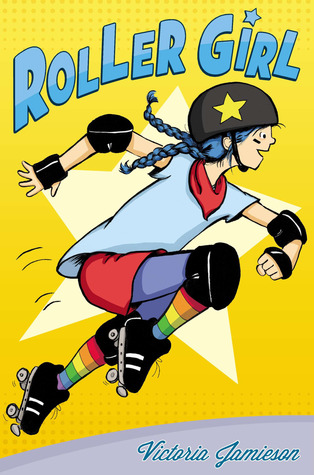
Roller Girl by Victoria Jamieson

★★★★

*** Warning!! This review contains spoilers! ***

This book was my first foray into graphic novels, and I have to admit, I enjoyed it more than I expected.

Astrid is a 12-year-old girl heading into junior high. She discovers a love for roller derby at the same time that her friendship with her best friend Nicole starts to fall apart. Suddenly, she's hit with a whirlwind of different and unfamiliar emotions and experiences. With the help of a new friend, some encouragement from a star roller derby player, and - finally - a meaningful talk with her mom, Astrid manages to find solid ground.

Through dialogue, narration, and illustrations, this book effectively portrays the range of emotions with which Astrid struggles - confusion, sadness, anger, frustration, fear, disappointment, etc. I think it would make good reading for any upper elementary school student who will one day soon enter the minefield of puberty and middle school relationships. I like that in the end, Astrid learns how to be a good friend and what it means to be on a team.

As an aside, I'll mention that Astrid appears to have a single mom - at least, there is no father figure in the book. This detail is not highlighted, but just treated matter-of-factly. I appreciate the diversity factor that this family structure offers.

The ending, however, I found too bittersweet. Sadly, I know that it is not uncommon for friendships to really end as individuals grow and develop. But after Astrid and Nicole finally cleared the air with an honest, if awkward, heart-to-heart, I hoped that they could maintain a fondness for each other, even if they did not stay close friends. One of the last frames has Astrid leaving behind a token from Nicole, and it just seemed too final, like an indication that their friendship was truly over. I can see the value in such an ending, but I would have preferred to see Astrid cherish the final token of friendship offered by Nicole, and then I would have loved to see Astrid return the thoughtful gesture at Nicole's ballet recital a week later.