Showing posts with label Jane Austen. Show all posts

Wednesday, August 13, 2025

Jane Austen Roundup

I have now read every Jane Austen novel and watched every Jane Austen screen adaptation I could find!

Here's a list of her books in order of my preference, and under each book, a list of all the screen adaptations I watched, in order of my preference. The links take you to my "reviews" - and I put that in quotes because I know I didn't actually review each movie/mini-series entirely on its own merits; how well it represented the book was a large factor in how much I liked it.

  1. Pride and Prejudice ★★★★★
    1. 1995 BBC Mini-Series with Colin Firth ★★★★★
    2. 1980 BBC Mini-Series ★★★★½
    3. 1940 Film with Laurence Olivier ★★★★
    4. 2005 Film with Keira Knightley ★★★

  2. Emma ★★★★★
    1. 1996 TV Movie with Kate Beckinsale ★★★★★
    2. 2020 Film ★★★★
    3. 1996 Film with Gwenyth Paltrow ★★★★
    4. 2009 BBC Mini-Series ★★★½
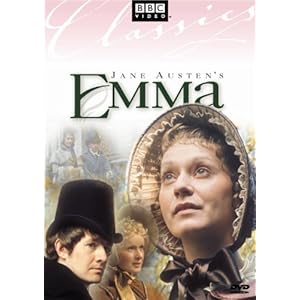
    5. 1972 BBC Mini-Series ★★★½

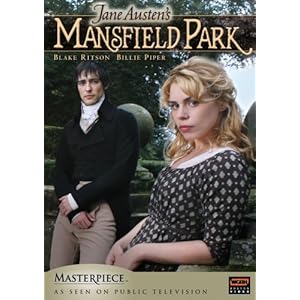
  3. Mansfield Park ★★★★½
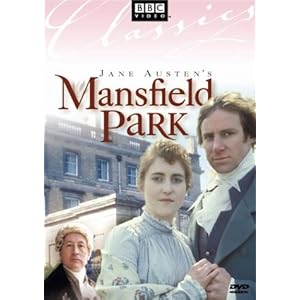
    1. 1983 BBC Mini-Series ★★★★
    2. 2007 TV Movie ★★★
    3. 1999 Film ★★★

  4. Sense & Sensibility ★★★★
    1. 1995 Film with Emma Thompson and Kate Winslet ★★★★★
    2. 1981 BBC Mini-Series ★★★★
    3. 2008 BBC Mini-Series ★★★
    4. 1971 BBC Mini-Series ★★★

  5. Northanger Abbey ★★★★
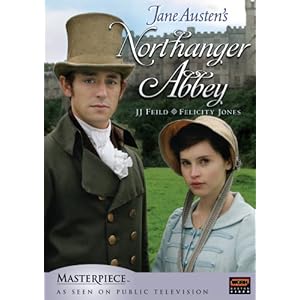
    1. 2007 TV Movie ★★★★
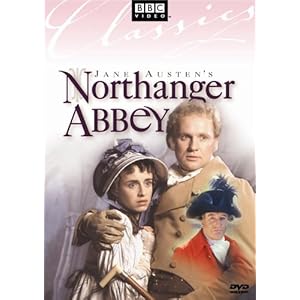
    2. 1987 TV Movie ★★½

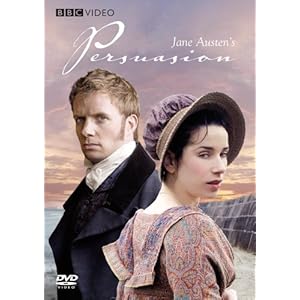
  6. Persuasion ★★★★
    1. 1971 BBC Mini-Series ★★★★★
    2. 1995 TV Movie ★★★★
    3. 2007 TV Movie ★★★
    4. 2022 Netflix Movie with Dakota Johnson ★★★

  7. Lady Susan, The Watsons, Sanditon ★★★

    The book Emma was a very close second behind Pride and Prejudice. I found Emma overall more entertaining, but Pride and Prejudice did have more wit, though less humor. And the fact that Emma was a bit of a snob - a charming and endearing snob, but a snob nonetheless - was a little off-putting sometimes.

    I also really enjoyed Mansfield Park, and I don't know if it's really fair to dock it half a star just because it wasn't quite as entertaining. I thought its characters were the most complex of all Jane Austen novels.

    And even though Persuasion is listed last, and given the place of "least favored Jane Austen novel", that's not to say that I didn't enjoy it. It is, after all, still rated four stars!

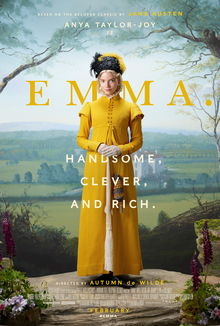
    Emma. (2020)

    ★★★★

    I happened to stumble upon this adaptation and now I wonder how many others I may have missed in the years since my Jane Austen fixation!

    At this point, I'm afraid I can't remember many details from the book anymore, so I can't do my usual book-to-screen comparison.

    I'll just say, I very much enjoyed this movie's humor and light-heartedness, as well as the elaborate costuming and gorgeous, beautifully-colored sets - and pastries! It was a lot of fun to watch. The servants especially were surprisingly comical.

    Emma was well-cast, but Mr. Knightley being light-haired threw me off, I just always imagine him to be dark-haired. I really liked the casting of Harriet; she was simpler and lower class than Emma but not made out to be frumpy. Meanwhile, Frank Churchill came across kind of sleazy, I wasn't too fond of him, and the Jane Fairfax character was not fleshed out enough (which I know is harder to do in movie adaptations than in mini-series).

    Friday, July 29, 2022

    Persuasion (2022 Netflix Movie)

    ★★★

    It's been a long time since I've read the book, so I can't remember many of the details anymore. I am pretty sure that scenes and dialogue were added to help move things along, which I know is not unreasonable, since condensing the book into one two-hour movie is a tall order.

    The race-blind casting was fun and in line with modern race-conscious sensibilities. The Anne character broke the 4th wall to address the audience directly, a method of explaining things that I really didn't mind. But the dialogue itself being modernized felt weird, and the entire movie had a playful mood that did not match what I remember of the book, which I think of as having more gravitas (except, perhaps, for sister Mary's antics).

    I think Dakota Johnson acted well, but she was too pretty to be the Anne of the book, who is supposed to be not very physically attractive. Also, I did not find Wentworth well-cast. Finally, the swoon-worthy love letter near the end is the highlight of this book for me, but the most meaningful lines were read aloud in Anne's voice, and I really wish they were read in Wentworth's.

    This movie was entertaining, but mostly it made me want to re-read the book, so I can better judge its faithfulness to the original material.

    Thursday, June 21, 2012

    Lady Susan, The Watsons, Sanditon by Jane Austen (Edited by Margaret Drabble)

    ★★★

    Three unfinished stories are included in this collection - "Lady Susan," "The Watsons," and "Sanditon" - plus a lot of additional reading under the titles of "Introduction," "Social Background," "A Note on the Text," "Notes," and "Chronology."

    Despite being called the "Introduction," I think that chapter might actually be best read after having finished each of the stories. It certainly sheds light on story lines and characters, but it's hard to follow without knowing who or what is being discussed. I found myself going back to re-read parts of the Introduction while reading each of the stories.

    "Social Background" would probably be most appreciated by a reader who has not already read other Jane Austen novels, one who doesn't totally grasp the social context of the time. But if you're not already an ardent Jane Austen fan, then this really isn't the book to be using as your introduction to her work anyway. Still, this chapter is short enough that it's worth reading, and you still might learn a thing or two about Jane Austen's era.

    "A Note on the Text" I actually found to be the most interesting bit to read before jumping into the stories. This short chapter tells a little about what kind of editing was needed to get these unfinished stories into a publishable state.

    "Notes" may very well have been my favorite part of this book! This chapter of footnotes sheds even more light on Jane Austen's writing. Very frequently, the footnotes tell you that instead of the words you just read, Jane Austen originally wrote different words, but then erased them or crossed them out. It was really fascinating to think about what kind of consideration went into Jane Austen's word choice. Additionally, this section provided interesting information, clarification, and reaction to various parts of the text.

    "Chronology" provides a nice overview of major world events that occurred during Jane Austen's lifetime, plus major events in her personal life as well.

    As for the stories themselves... "Lady Susan" came first, and it was my least favorite piece. It is an "epistolary novel" - one written as a series of letters among the main characters. It was my first exposure to such a book, and honestly, it just seems like such a constrictive way of telling a story. Maybe in a more traditional novel, the same characters could have been fleshed out to be more complex, but as they were written, many of them were one-dimensional. 

    "The Watsons" is most similar to Jane Austen's other well-known works, and it was for me the most satisfying to read. I was pulled in from the very start! I was so interested in the characters and couldn't wait to find out what would happen next - and then completely unexpectedly, I turned a page, and there was no more. It's a shame Jane Austen never finished this book, and it was but small consolation that it was followed by a brief note regarding what Jane Austen intended would happen to the main characters.

    "Sanditon," I'm afraid, got off to a very slow start for me. Jane Austen's stories focus primarily on "the young people," and "Sanditon" just took too long in introducing all the young people. I dare say I got bored while waiting for all the key players to arrive at Sanditon, and just when they did, the writing stopped. There seems to be a lot of social commentary in this piece, and having been written just before Jane Austen died, I wonder if that's why there was so much talk of health in this book.

    Overall, certainly an interesting read for the most fervent of Jane Austen fans. But if you're not interested in learning a bit more about Jane Austen's works as a whole, then there isn't as much stand-alone entertainment value in this collection as you would find in her finished novels.

    Saturday, October 1, 2011

    Austenland by Shannon Hale


    *** Warning: This review contains spoilers! ***

    This book is not for Jane Austen fans. Anyone who admires Jane Austen's writing will be sorely disappointed. Jane Austen was a master of dialogue, of showing rather than telling the reader what was going on. The relationships of her characters, the events they experienced, were engaging, meaningful, and sometimes surprising. In this book, however, the writing was uneven and poorly worded (I sometimes had to re-read sentences just to figure out what they were trying to say!), the plot development loose and predictable, and the dialogue actually cringe-worthy. If anything, Austenland is written for young, hip fans of Colin Firth as Mr. Darcy in the BBC adaptation of Pride and Prejudice.

    Austenland's main character is named Jane. Really. It's a bit much, right? And she is nothing like the main characters in Jane Austen's novels, though she flatters herself by comparing herself to them. Elizabeth Bennett was witty and clever, Emma Woodhouse was charming and poised, Fanny Price was self-aware and principled - and none of them needed a man. Even though these characters were surrounded by women who wanted nothing more than to find a suitable husband, they themselves were strong and independent, and they found love and marriage despite the fact that they didn't go looking for it. Jane Hayes, on the other hand, was co-dependent and desperate to find a man. She was the complete opposite of a Jane Austen heroine. Instead of sympathizing with her, I started to side with her ex-boyfriends. Who would want to marry her!? When two guys fell for her at Pembrook Park, I honestly couldn't figure out why. What was so great about her?

    Jane Austen's novels gave me a beautiful and charming impression of Regency England, but the "Austenland" described in this book didn't sound remotely interesting to me. Do such places really exist? If so, I hope they plan their retreats better than Mrs. Wattlesbrook did. With a one-to-one ratio of men to women, only three clients in one location at a time, and a lecherous drunk hanging around, the place sounded pathetic, boring, and even a bit creepy.

    The book almost redeemed itself with a solid ending when Jane walked away from Mr. Nobley and Martin with her head held high. THAT was a perfect ending, in which Jane learns that she is a smart, confident woman whose self-worth is NOT dependent on having a man. Unfortunately, it all got thrown out the window when the book continued on to its actual ending. Jane DOES need a man after all, and even though she hadn't really felt attracted to this man before, she would throw herself at him just as she had thrown herself at Martin less than three weeks previously. And based on the Jane I met in this book, my money is on the relationship crashing and burning within a month of the plane's landing.

    Wednesday, May 25, 2011

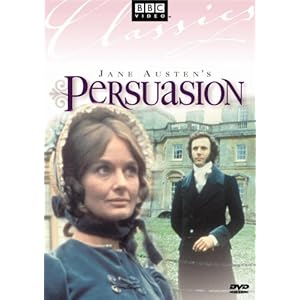
    Persuasion (1971 TV Mini-Series)

    ★★★★★

    What a delightful surprise! I admit, I didn't have very high expectations for this adaptation, what with having already been less than impressed with the other mini-series from the early 1970s. This is the last Jane Austen adaptation on my list, and I'm glad to end my viewing project on a high note.

    Every character was very well-cast, and Mrs. Clay and Lady Russell had more significant roles than in other adaptations. I was especially pleased to see that this production went so far as to try to explain why Lady Russell persuaded Anne not to marry Capt. Wentworth so long ago, and why Anne let herself be persuaded.

    The adaptation was extremely faithful, and many excellent details were included. The ending even did a good job closing out the Mr. Elliot and Mrs. Clay storyline. Only one major scene was noticeably absent - the one in which Mary's son has an accident, and Anne nurses him through dinner to avoid meeting Capt. Wentworth. But - oh, well! Anne had to see Capt. Wentworth sometime, Mary's indignant nature was well-depicted in many other scenes, and Anne's reluctance to see Capt. Wentworth again was also made clear in other ways.

    Saturday, May 21, 2011

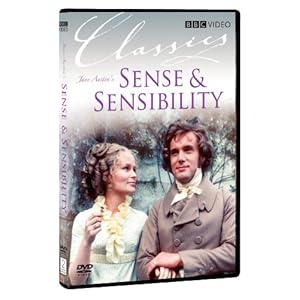
    Sense and Sensibility (1971 TV Mini-Series)

    ★★★

    This adaptation was kind of a mixed bag. On one hand, I thought pretty much all the characters were well-cast. I did not mind at all that Margaret was entirely omitted (she was only a marginal character in the book, after all), and only Willoughby was not quite as charming as he should have been. On the other hand, I kept feeling disappointed. Some events, particularly towards the beginning, were a bit jumbled. Bizarrely, Elinor and Marianne were often dressed alike, like twin children. In another odd production decision, there is a scene in which Lucy Steele and Elinor are talking, but the sound of Marianne playing the pianoforte in the background is loud and distracting.

    This adaptation's interpretation of Lucy was a bit harsh, I think. It was accurate in that Lucy's actions were always selfishly motivated, as in the book, but the mini-series took it one step further by making her transparently insincere.

    What really baffled me, though, was why the adaptation bothered changing Colonel Brandon's background story. When he explains to Elinor why he had to rush off to London so many months ago, it's a story that is entirely told in words - no additional scenes are required. To change the story coming out of his mouth seemed to be a change for change's sake.

    I liked the fourth and final episode the best. The scene in which Willoughby confesses to Elinor, when he thought Marianne was dying, was well-done. It also did a good job portraying Marianne's growing regard for Colonel Brandon. One drawback, though, is that when Edward showed up at Barton Cottage at the end, he did not adequately explain how or why Lucy's affections were transferred to his brother Robert.

    Friday, May 20, 2011

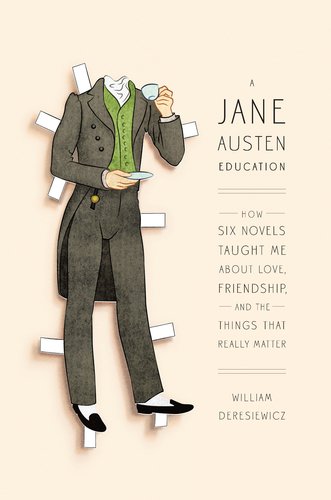
    A Jane Austen Education: How Six Novels Taught Me About Love, Friendship, and the Things That Really Matter by William Deresiewicz

    ★★★½

    When Ken first mentioned this book to me, I admit I was a bit indignant. Being just in the middle of reading all six of Jane Austen's novels, and thoroughly enjoying the experience, I thought, "I am getting so much out of these books, do I really need to read what some other random person got out of them?"

    To my surprise, my cousin Shan mailed me this book a couple days after I finished Northanger Abbey, the last of her novels that I read. I was just starting to feel a bit of Jane Austen withdrawal, and now having the book in hand, I jumped at the chance to read it. (Thank you, Shan!)

    I was immediately impressed upon realizing that the author is a man! Throughout all my readings, I totally pigeon-holed Jane Austen as the chick lit of the classics, what with her topics of love and friendship and relationships in general, her study of human nature, personal growth, and character. Approaching the book from a man's point of view would certainly give me a fresh perspective on the novels.

    Secondly, the author turned out to be not a completely random person, but a former professor of English with a PhD in literature. So, he could offer legitimate literary analyses of the books, which I had not attempted myself.

    Overall, this book is a quick and pleasant read. It is an excellent companion to the novels. I would suggest, however, that you should first read all six novels yourself before reading this book. Even though the author tries not to give away the endings, he does reveal quite a bit about characters and plot development. Also, because he frequently makes passing mention of characters from all the books no matter what book he is focused on at the time, I think readers would be better able to appreciate the author's discussion if they, too, were familiar with all the characters.

    I especially liked that the author provided bits and pieces about Jane Austen herself. He even included several excerpts from her letters, and filled in the major details of her life. In fact, before reading this book, I was thinking of reading a Jane Austen biography, but now I think my curiosity on that front might already be satisfied!

    He even made a small mention of some of the screen adaptations, which I also particularly liked because seeing all of them (and I mean all of them!) is also part of my own personal Jane Austen Project.

    The only drawback, I think, is that the author seems to stretch a bit when he tried to relate the lessons of Jane Austen to his own life. The memoir portions are kind of quaint, and I can't fault him for trying, since his learning applicable life lessons from Jane Austen was basically the whole premise of the book. Also, since he focuses on the lessons he learned, I feel like he left out quite a bit about lessons that other people might be able to learn from Jane Austen.

    All said, I think any Jane Austen fan would find this book enjoyable. If nothing else, it serves to praise Jane Austen and her works.

    Wednesday, May 18, 2011

    Pride and Prejudice (1940)

    ★★★★

    This movie was light-hearted and fun, and I was surprised by how much I liked it!

    Of all the Jane Austen screen adaptations, this one deviated the most from the novel - in dialogue, scenes, and character introductions and omissions. At times it didn't even try to condense the story, but rather, it created new scenes entirely. Interestingly, though, it seems to me now that deviations from the original source are most unforgivable when the adaptation for the most part tries to adhere to the book, but then veers away drastically for brief moments. On the other hand, it appears that I don't really seem to mind when a movie as a whole is interpreted differently, as long as it stays true to the spirit of the original story and characters - and then, in that case, any time the movie does briefly adhere closely to the book, I am pleasantly surprised.

    The movie is well-acted and well-cast. At first the women's costumes (which were more in the style of antebellum American South than British Regency) were distracting, but once I got past that, it was a pleasure to watch.

    Sunday, May 15, 2011

    Emma (1972 TV Mini-Series)

    ★★★½

    This mini-series, made in 1972, had the same production quality as other BBC mini-series made in the 1980s. I'm glad I decided to go back and watch all screen adaptations, regardless of their year of release. (Originally I planned only to watch screen adaptations made no earlier than 1980.)

    While Mrs. Weston seemed a bit young for her role, several other characters were very well-cast. Specifically, I really enjoyed Mr. Woodhouse, Mr. Knightley, Harriet Smith, Mrs. Elton, and Frank Churchill. I rather think Frank Churchill's cheery and relaxed demeanor stole every scene he was in, especially since the production as a whole was kind of serious and slow. In both the mini-series and the book, everyone good-naturedly humored Mr. Woodhouse's fretting, but in the mini-series, unfortunately, people seemed to lose patience with him, and many scenes ended by having someone walk out on Mr. Woodhouse while he was in mid-sentence! Poor Mr. Woodhouse.

    This production might have gotten four stars, but I subtracted half a star specifically because it altered the Box Hill picnic scene too much. I can live with some of the liberties a screen adaptation is bound to take - condensing several scenes into one, moving a conversation from one scene to another, or introducing some character in a more abbreviated way - but by leaving Mr. Elton and Jane Fairfax out of the picnic altogether, the scene lost quite a bit of its significance. In the book, the fact that Frank and Emma's flirtations took place in Jane's presence gave the entire scene more meaning, and Jane finally broke her reservedness by responding - with her longest speech in the book - to observations of Mr. and Mrs. Elton's quick marriage. Those parts of the picnic scene are so central to the Jane and Frank storyline that I just can't forgive this production for leaving it out - especially since, as a mini-series, they had plenty of time to be able to work it in. It seemed almost as if they dawdled so much in the first several episodes that they then had to squeeze too much into the last couple.

    Saturday, May 14, 2011

    Northanger Abbey (1987 TV Movie)

    ★★½

    This movie was, disappointingly, the least well-done screen adaptation of a Jane Austen novel I've seen yet.

    I do think most of the characters were well-cast, though both John Thorpe and General Tilney (who perhaps overacted) were made out to be worse than they were in the book. Catherine was okay, but appeared to be as young and naive at the end of the movie as in the beginning.

    Liberties of all kinds were taken. The way in which characters were introduced was quite different from the book, and events were a bit jumbled. Catherine and Isabella's friendship seems to have appeared out of nowhere. Sometimes, even as dialogue was taken from the book, the scenes were entirely changed; in significant deviations from the book, characters go to public baths, they row on a lake, and the Tilneys have visitors at Northanger Abbey. Strangely, a mysterious French woman was inexplicably added to the cast, and the Tilney men were all made to take snuff. And what was with the black servant/slave boy!? Finally, as if the filmmakers were running out of time, Catherine's departure from Northanger Abbey was practically glossed over.

    The fantasy sequences adequately showed Catherine's preoccupation with Gothic romance novels, but the music was a bit overdone. Amusingly, the music in the last scene - which deviated from the book significantly - was so clearly from the 1980s.

    Wednesday, May 11, 2011

    Northanger Abbey (2007 TV Movie)

    ★★★★

    I enjoyed this movie quite a bit! Almost all characters were perfectly cast, save John Thorpe, who looked even more lecherous than expected. The fantasy sequences did a good job portraying Catherine's fondness for Gothic romance novels, and the production as a whole was well-done. Even the music was a good fit.

    Unfortunately, besides the usual shortcuts taken to introduce characters or condense the story, and a few omitted scenes, the movie also took some liberties. In the book, Henry Tilney is so perfectly the gentleman that he takes pains to ease Catherine's mind about a folly over which she is mortified, and when she leaves Northanger Abbey, it is clear that no fault lies with her. In the movie, however, Henry's reaction is more severe, to the point that we aren't sure if maybe Catherine's behavior might have had something to do with her departure. The book's ending also allows for some reconciliation between Henry and General Tilney, which the movie does not incorporate.

    Despite these discrepancies, and even with the movie's splash of 21st century dramatization, I was pretty well-satisfied with this screen adaptation.

    Northanger Abbey by Jane Austen

    ★★★★

    My only disappointment in finishing this book is that it marks the end of my project to read all six of Jane Austen's completed novels. I have no more Jane Austen books to look forward to!

    This one reads more like a young adult novel, and in some ways it is a coming-of-age story. Catherine Morland is young and naive, but we see her grow and mature as she navigates new friendships and learns from her mistakes. While Catherine's relationship with Isabella is deftly crafted, perhaps her friendship with Eleanor Tilney could have been elaborated upon a bit more. Henry fits the bill perfectly as the object of desire, and his speech on the over-use of the word "nice" is exactly as I have always thought myself!

    Without having read any of the Gothic romance novels of which this book is a satire, it's easy to imagine what those books must be like. For the first time in a Jane Austen novel, however, I found myself losing interest as the author expounded upon a topic - in this case, some aspect of Gothic romance novels. But since even those accounts lasted only a mere paragraph or so, they weren't so much a detraction.

    As usual, the story is tied up rather nicely, and quickly, in the last few pages. And I don't care what anyone says - I love Jane Austen's "happily ever after" endings!

    Wednesday, May 4, 2011

    Mansfield Park (1999)

    ★★★

    I liked the casting for this movie so much that it's a real shame that the story deviated so much from the novel. Every character was well-acted and physically well-cast, even if the characters themselves were not true to the book. The actor who played Edmund also played Mr. Knightley in Emma, but I much preferred him in this role.

    Fanny was spirited and lively, an imaginative writer of fanciful stories - a far cry from the timid and fearful creature in the book. Eldest brother Tom Bertram was made to be even more disgraceful than in the book (though he was given the moral high ground in the movie), but the real liberties were taken with Lady Bertram - made to be an opium addict! - and Sir Thomas, who, in the movie, had a morally reprehensible role in the slave trade.

    Great liberties were taken with the story as well, though I have to admit that the movie managed to faithfully incorporate a lot of dialogue - even if, rather frequently, words were attributed to different characters. Very surprisingly, beloved brother William was entirely left out! His role was more or less replaced by sister Susan. Of course, without him, other elements of the story had to change as well. Many scenes were based on scenes in the book, but were in some way twisted around. One major deviation from the book involving Fanny and Henry Crawford had Fanny acting entirely out of character - basically negating the very principles by which her character was defined in the book. Another very flagrant alteration was in regards to Henry Crawford and Maria's relationship towards the end - the movie sensationalized their behavior, as if assuming the audience would not be entertained enough by early 19th century sensibilities.

    All told, the movie was well-made and well-paced, but not a very accurate representation of the book. I should, however, cut it some slack because the credits themselves say the movie is based not only on Mansfield Park but also on Jane Austen's "letters and early journals". It's as if they tried to fit Jane Austen into Fanny's role, which, I dare say, makes me want to find out more about Jane Austen herself.

    Monday, May 2, 2011

    Mansfield Park (1983 TV Mini-Series)

    ★★★★

    Having now seen so many other BBC adaptations of Jane Austen novels made into TV mini-series, I've become rather used to the play-like production quality.

    The casting - which I now consider perhaps the most important part of a screen adaptation of a book - was a mixed bag. I thought Fanny was very well portrayed, but I never did get used to swarthy Edmund. Henry Crawford was too stiff and had too much of an air of arrogance; he was not at all as easy going as I expected. A fine job was done with Aunt Norris and poor Mr. Rushworth, but Mr. Yates bordered on ridiculous, and Lady Bertram was downright so.

    The first episode of the mini-series depicted the childhood years well, and I liked the way the series used Fanny's letters to William to move the story along.

    After doing such a great job with the rest of the book in the first five episodes, the sixth and final episode was a little disappointing. The conclusion seemed to come about suddenly and without much basis, and we didn't see Sir Thomas's reflections on parenting, nor his ultimate satisfaction in Fanny in light of his disappointments elsewhere.

    Saturday, April 30, 2011

    Mansfield Park (2007 TV Movie)

    ★★★

    The more screen adaptations I watch, the more I realize how much of an image for each character I already have in my mind for having read the book first. In this case, I thought Miss Crawford and Edmund (the same actor who played Mr. Elton in a version of Emma) were well-portrayed, but the rest of the cast fell short of my expectations. Fanny's dark eyebrows were distracting, and she was much more gay and lively than the timid and frail creature presented in the book. Mrs. Norris was not at all the selfish, bustling busybody and Fanny's cruel oppressor that she was in the book, and she was actually rather reserved. Lady Bertram was improved upon nicely, but several characters were entirely omitted.

    The movie managed to stay very true to some scenes in the book while taking very great liberties with others. Fanny hardly seemed to be the second-class family member that was so central to her character in the book, and maybe because of that, the movie did not include her visit to her family (as it wasn't necessary for this character's development). The movie also did not include any charming childhood scenes, which set the tone in the book for Fanny and Edmund's relationship. What was included was well-done, and the movie was well-paced.

    As for the final scene - I have to admit, I'm not sure what the point was of having Edmund and Fanny show off a new style of dance, nice as it was to watch.

    Mansfield Park by Jane Austen

    ★★★★½

    I very much enjoyed Mansfield Park, even though it didn't have the wit of Pride and Prejudice nor the humor of Emma. It has a decidedly more serious tone, and it is not so much a discourse on love and marriage (as other Jane Austen books are), as it is on morals, principles, and even parenting.

    Characters are complex and well-developed. Jane Austen believably depicts shades of character, and though it was sometimes inconvenient to not know exactly how I should feel about one person or another, it was certainly a realistic portrayal of relationships - because how often, in real life, do we ever unchangingly regard other individuals in one single way, regardless of circumstances?

    My wished-for ending fluctuated as the story progressed, and at more than one point I wondered how Jane Austen would bring about the satisfactory ending that I was sure she would provide. Not surprisingly, once I finished the book, I was not disappointed!

    Tuesday, April 19, 2011

    Persuasion (2007 TV Movie)

    ★★★

    With less than two hours' running time, a bit of condensing is not unexpected. This movie goes further, though, and takes quite a lot of liberties going beyond simply omitting scenes or combining multiple scenes into one - both of which do occur in this movie. A lot of additional dialogue not in the book was created to fill in some backstory (I have to admit, at least a few scenes were well-done and added to the story's flow), and a lot of memorable dialogue in the book was unfortunately left out. Surprisingly, a particular conversation towards the end of the book that serves a very significant purpose is relocated to much earlier in the movie, and one of the speakers is substituted with another character. Moreover, the movie went so far as to create its own drama beyond that of the book. Finally, a lot of understanding that might have been conveyed through acting was instead conveniently and straightforwardly explained via an internal monologue as Anne writes in a diary.

    Except for Mary and Sir Walter - both of whom I thought overacted - the rest of the characters were well-cast. Lyme, however, was not so picturesque. The overall story, though somewhat jumbled, did follow the basic arc of the book. But I just couldn't get past all the deviations from the book. And I wasn't too fond of the shaky camera trick, either.

    Friday, April 15, 2011

    Persuasion (1995 TV Movie)

    ★★★★

    Hm. There were a few minor omissions for which I really can't fault the movie, but increasingly more liberties were taken as the movie progressed. Overall, it is faithful to the book, and it includes the most memorable dialogue from the book. Lady Russell was well-portrayed, and Admiral and Mrs. Croft were perfectly cast. Anne took quite a bit of getting used to, mainly because she was made to look so homely at the beginning. I was impressed, though, with how she became more attractive as time went on, just as she had done in the book. Other than those characters, everyone else had to grow on me - and some never did. I couldn't figure out what I was supposed to make of Mrs. Clay in the movie, and both her and Mr. Elliot's parts didn't get resolved. Elizabeth came across as over-the-top unlikeable. And what was with that circus procession at the end?!

    Persuasion by Jane Austen

    ★★★★

    It's really remarkable that Jane Austen consistently wrote so many excellent books that I honestly love. Up until now, any time I was completely won over by a book, and tried reading other books by the same author, I was disappointed. I absolutely loved A Prayer for Owen Meany, but none of John Irving's other works even came close. The same goes for Paulo Coelho; after I read The Alchemist, I kept buying more and more of his books, only to be continually disappointed. Persuasion is the fourth Jane Austen novel I've read, and I enjoyed it just as much as the first three.

    Like Sense and Sensibility, it starts off kind of slowly, giving background information on rather unlikeable characters. But, I was in no way deterred, and Jane Austen came through, as expected. I probably sound like a broken record by now, but in Persuasion - as in all of Austen's books that I've read so far - I was pleased with and entertained by how keenly Austen understood and could put into words the delicate and complicated emotions that are as common today as in her own time. Even though all her books are about young women in the English countryside and their adventures in securing a suitable husband - including perhaps a jaunt to London or Bath - Austen manages to come up with fresh characters and situations for each book. Where her other novels had young, fresh-faced, optimistic young men and women, Persuasion had mature characters who viewed love and marriage from a perspective that appreciated loss and regret.

    Persuasion is a comparatively short novel, and I dare say I didn't get quite as invested in the characters as I did with those in other Austen books. The dialogue wasn't as memorable, either. But, given the relative length of the material, I have high hopes for the screen adaptations!