Showing posts with label book: 2 stars. Show all posts

Saturday, January 7, 2023

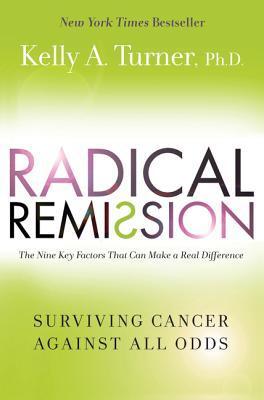
Radical Remission: The Nine Key Factors That Can Make a Real Difference: Surviving Cancer Against All Odds by Kelly A. Turner

★★

This book was mentioned by a friend who was diagnosed with glioblastoma brain cancer. Facing a bleak prognosis, she refused to resign herself to fate and has committed herself to defying the odds. This is not the type of book I usually read, however, when faced with the possibility of imminent death, I can understand the desire to grasp at all possible sources of hope, and I was intrigued.

The premise is fascinating: there are real people whose medically diagnosed cancer disappeared with no known medical reason, so let's study them and try to figure out what happened. Where the book falls short, for me, is how the investigation does not actually look for scientifically supported reasons for recovery, but instead relies almost entirely on each person's opinion on what they think caused their cancer to go away.

First, if you are the kind of person who absolutely never believes in ghosts, don't even try to read this book. There are no ghosts here, but for this book to even be readable, you have to be open to the idea that something might possibly, could be real, even if it defies all reason and there's no scientific explanation. You don't have to buy into alternative medicine, or believe in the paranormal, to get something positive out of this book, but you do need to take everything with a grain of salt.

Now, I am 100% a believer in conventional medicine and science, so I read most of this book with an attitude of, "Wow, that's interesting, not sure I believe all the details, but how amazing that that person is still alive!" The author does not exactly advocate for alternative medicine, in fact, she stated unambiguously that "most people will need conventional medicine to outrun cancer." (p. 9) But right off the bat, in the book's introduction, it's clear that she believes in alternative medicine, since her husband is a traditional Chinese medicine practitioner and studied "an esoteric form of energy healing." (p. 5) When telling the stories of survivors, she gave validity to "[t]he notion that a cancerous tumor is simply a buildup of stuck energy," (p. 94) and she reported matter-of-factly on the various alternative therapies people used, like Reiki or other forms of "energy healing", without any commentary regarding the controversy surrounding those methods.

In fact, it's that lack of transparency that led me to rate this book 2 stars. One of the featured survivors is someone who credits Brazilian John of God for curing his brain tumor. It was a very compelling account, so of course I immediately Googled John of God. Turns out, he's a convicted sex offender! The allegations first surfaced in 2018, and this book was published in 2014, so the author is off the hook for that particular oversight, however, James Randi, known skeptic of paranormal claims, discredited John of God in 2005. I think the complete omission of any reference to documented efforts to expose him as a fraud is downright negligent and detracts from this book's credibility. The author only hinted that John of God may not be legitimate when she wrote that the power of John of God's healing center "could simply be the placebo effect; in other words, our sheer belief that something powerful happens at John of God's center could have caused us to have a deeper meditation experience." (p. 250)

Another thing I wasn't fond of was the author's decision to soften the outlandishness of John of God's healing methods by using carefully chosen words. Though many online articles refer to him succinctly as a "psychic surgeon", the author described John of God as having "the ability to leave his body and go into a trance, thereby allowing the spirit of a higher being to enter his body and perform energetic healing work." (p. 237)

Not all the stories were as off-beat as the one involving John of God, but many of them had alternative medicine elements. Ultimately, I felt conflicted by the personal stories included in each chapter. On the one hand, they were very inspiring and would certainly give hope to a cancer patient with a poor prognosis; on the other hand, all the alternative medicine therapies were beyond belief, if you ask me.

Despite all that, if you can disregard the parts that you find unbelievable, there are valuable insights in this book that would benefit any cancer patient, regardless of prognosis. The nine "key factors" that radical remission patients share all sound very reasonable:

1. Radically Changing Your Diet
2. Taking Control of Your Health
3. Following Your Intuition
4. Using Herbs and Supplements
5. Releasing Suppressed Emotions
6. Increasing Positive Emotions
7. Embracing Social Support
8. Deepening Your Spiritual Connection
9. Having Strong Reasons for Living

Only two items are physically related to your body: changing your diet and taking supplements. While some diets and supplements may be more well-founded than others, at least the author periodically reminded readers to consult their doctors, e.g., "Remember, always speak to your doctor first in case your fast needs to be medically supervised." (p. 28)

If you're like me, you may be surprised that exercise is not on that list. Most health guides lead with diet and exercise, and throughout the book, I kept wondering why exercise was not singled out, especially since it was certainly mentioned in passing, e.g., "Thanks to a combination of yoga, hiking, and walking, [John] now feels like he's in the best shape of his life" (p. 39) and "[Jenny] also continued with the same daily exercise regimen she had created for herself years earlier." (p. 127) It wasn't until the very end of the book (p. 282) that the author revealed that exercise was not included as the 10th key factor because many patients were too weak to exercise when they first turned to alternative therapies, presumably either because of the cancer itself or due to side effects of having tried conventional treatment like chemotherapy. This explanation is fair, but I just wish she had said it up front at the beginning, so I didn't have to spend the entire book wondering why exercise was being glossed over.

The remaining items all fall under mental and emotional health, and even at face value it's easily conceivable that they each would have a positive effect on healing.

Every chapter concluded with actionable items that a person can do to put into practice the concepts outlined in that chapter. These suggestions were generally sensible and doable and essentially just useful advice for maintaining good mental health. In the end, it's these "Actions Steps" that made the book worth the read, in my opinion.

Thursday, October 13, 2022

The Only One Club by Jane Naliboff

★★

I saw this book recommended as a way to help support covid-cautious kids who continue to wear masks in mask-optional settings, like school. Peer pressure is real, and being the only person in a classroom wearing a mask can be isolating and intimidating.

I really, really wanted to like this book. Growing up in the 1980s, I remember the discomfort and embarrassment of being the only Asian person in my class, the only kid who wore glasses, even the only student in my class who was a member of the Brownies! Young me absolutely would have benefited from the way this book takes being "the only one" of something and turns it on its head as something to be PROUD of. When the main character, Jennifer, realized she was the only Jewish kid in her class, she immediately delighted in being "the only one" and wanted to celebrate it. That premise is fantastic! I just wish the implementation could have been better.

Right off the bat, the book felt dated. Mrs. Matthews, the teacher, had the whole class making Christmas decorations. Back in the '80s, this type of classroom activity was commonplace. Maybe it was still happening here and there in 2004, when this book was first published. But definitely in 2022, when I read this book, a teacher presumably in a public school centering a Christian holiday in the classroom just didn't feel right.

I do love how Jennifer did not for a second feel embarrassed about being the only Jewish kid in her class. Being Jewish was something that could potentially put Jennifer on the receiving end of hateful words and deeds, and being the only one made her particularly vulnerable because she had no obvious or automatic allies. For her to take pride in something that could be used as fodder for taunts or other inappropriate behavior directed towards her is what made Jennifer's attitude and actions particularly brave, meaningful, and mature.

It was strange, then, when her classmates joined The Only One Club for things like: having a last name that is also the name of a bird, having a pet iguana, and being able to jump Double Dutch. These are not the type of differences that would normally cause chidren to feel like they don't belong, as being a different race or religion, or being the sole mask-wearer, would. Moreover, some of the reasons didn't even make sense! TWO twin girls joined by being "the only one(s?)" who were twins?! And then the teacher joined because she was "the only one" who wasn't already in the club, thereby negating her reason for joining as soon as she joined!

According to the illustrations, Jennifer's class was wonderfully culturally diverse. Alongside some of the superficial differences, it would have been easy to include more substantial differences, e.g., one kid could have been the only one who was Chinese, another could have been the only one who spoke Spanish, this kid could have been the only one with glasses, or a wheelchair, and that kid could have been the only one with asthma, or a food allergy.

Speaking of food allergies, the exchange between Jennifer and Jonah during lunch nearly gave me a conniption! With a "mouth full of peanut butter", "Jonah gave her a raspberry, spraying peanut butter all over the lunch table"!!!!! The illustration literally had food particles on a trajectory to land on Jennifer's food! What if Jennifer was allergic to peanuts!? What if the next kid to sit at that table was allergic!?

Anyway. This book might be a good option for its Hanukkah theme, but as a book about inclusion, I feel it doesn't quite get across the idea that inclusion needs to extend to attributes that may make individuals feel out of place because they are atypical compared to a widely accepted norm.

Friday, December 7, 2018

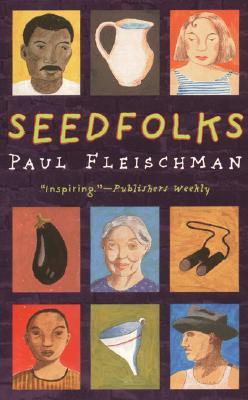
Seedfolks by Paul Fleischman

★★

My daughter read this book for school in 7th grade, but I'm not too keen on it. It's about a very diverse neighborhood coming together in the making of a community garden. Overall, the intent and the message of the book are positive. What troubles me is the delivery. Some might call this book "racist"; at the very least, the writing incorporates various levels of "racial insensitivity", or a lack of "racial awareness".

Listed below (at the end of this review) are race-related excerpts from the book that I believe are worth discussing, or at least clarifying. Each chapter is narrated in the first person by a different character, and most references are in the narrator's thoughts. No offense is intended in any of these references, but there's a lot to unpack just in reading the words in print. My concern is that the text itself does not provide enough context, and without sufficient analysis, young readers might come away from this book with misunderstandings about race-related concepts. Some of my examples might be nit-picky, but I think when a book is expressly written to showcase diversity, when it specifically shines a spotlight on race, it should go out of its way to get it right.

Having only 69 pages, the book is more of a novella. I was disappointed when I realized that each character gets only one chapter, so we don't see the individual stories developed. The garden itself is like the main character, and it's the growth of the garden that is told through the eyes of different people.

Aside from my concerns about race, the book includes references to a number of other topics that might be worth discussing with young readers as well. For example, death (some of the characters have family members who have died), marijuana, guns in schools, an armed robbery that results in physical abuse and PTSD, and a pregnant teenager who wishes to miscarry.

Anyway, here are the race-related references that caught my attention:

  • Page 4: "Gibb Street was mainly Rumanians back then."

    Rumania is an alternate spelling of Romania.

    According to Wikipedia: "In English, the name of the country was formerly spelt Rumania or Roumania. Romania became the predominant spelling around 1975."

    Source: https://en.wikipedia.org/wiki/Romania

    As an elderly person, Ana (the narrator of this chapter) would be accustomed to using the spelling she grew up with.

  • Page 5: "Then Negro families in the Depression."

    According to Merriam-Webster online, the term "Negro" is "dated, now sometimes offensive".

    Source: https://www.merriam-webster.com/dictionary/Negro

    Ana is still the narrator, and again, as an elderly person, she might be accustomed to using the terms she grew up with. In her old age, she might not understand that "Negro" is no longer an acceptable term to use to refer to African-Americans. She probably does not mean to refer to African-Americans in a belittling way, but if she said it out loud, an African-American might be offended.

    These days, "African-American" and "black" are appropriate words to use. Some African-American / black people may have a preference for which term they prefer.

    Sources:

    https://www.urban.org/urban-wire/say-african-american-or-black-first-acknowledge-persistence-structural-racism

    https://www.politico.com/blogs/media/2013/04/an-african-american-or-a-black-160773

  • Page 10: "She gave me some binoculars and told me all about the Chinese girl."

    Wendell (the narrator of this chapter) is referring to Kim, who is Vietnamese. He probably does not know Kim's ethnicity, so he guesses Chinese. He probably does not mean any harm, but if he said this out loud, Kim might be offended. Vietnamese language and culture is different from Chinese language and culture. Interchanging the two perpetuates the stereotype that all Asian cultures are the same, and not worth distinguishing one from the other. Instead, if you don't know a person's exact Asian country of origin, "Asian" is the appropriate word to use.

  • Page 14: "He doesn't speak Spanish, just an Indian language."

    Gonzalo (the narrator of this chapter) is referring to his great-uncle. Since Gonzalo is from Guatemala, he is probably not using "Indian" to refer to the Asian subcontinent of India. Instead, he means someone whose ancestry is native to a particular place. There is much debate about how we should refer to these peoples: Indians? American Indians? Native Americans? Indigenous? Members of these groups typically have their own preferences regarding what to call themselves. Since Gonzalo is talking about his own family, he is using the word he is most comfortable with.

    Source: https://en.wikipedia.org/wiki/Native_American_name_controversy

  • Page 26: "People bent over like coolies, walking sometimes three or four blocks, a gallon jug in each hand, complaining all the time about the water."

    Sam (the narrator of this chapter) studies words as a hobby, so his use of "coolie" seems particularly unexpected.

    According to Merriam-Webster online, the term "coolie" is "usually offensive".

    Source: https://www.merriam-webster.com/dictionary/coolie

    Sam is probably using the word "coolie" to mean "unskilled laborer". However, in America, the word has derogatory connotations stemming from the xenophobic treatment of Chinese immigrants during the mid-to-late 1800s. It's probably best not to use this word casually, except in historical context, especially when speaking about a group that includes Asians.

    Source: https://en.wikipedia.org/wiki/Coolie

  • Page 26: "With a few exceptions, the blacks on one side, the whites on another, the Central Americans and Asians toward the back."

    See the Politico source above related to "Negro". Using "black" as a noun is a subject of debate. The same could probably be said for using "white" as a noun. Saying "black people" and "white people" would be less controversial.

  • Page 36: Sae Young (the narrator of this chapter) is an adult from Korea. Her entire chapter is written in broken English with poor grammar.

    Though other narrators are also immigrants, this is the only chapter written in poor English. It feels like the literary equivalent of the on-screen Asian character having an accent. This kind of representation perpetuates the "other-ing" of Asians in America.

  • Page 43: "They liked to call me 'field slave' and 'sharecropper.' Ask how Massa's crops is doing."

    This is an example of explicit racism. Young readers should understand this type of behavior is not acceptable. Some may need an explanation of "Massa".

  • Page 67: "It had been such a wonderful change to see people making something for themselves instead of waiting for a welfare check."

    Not race-related, but the implication that people who receive welfare checks are lazy is troubling. This type of classism might also be worth discussing with young readers.

  • Page 69: "It was a little Oriental girl, with a trowel and a plastic bag of lima beans."

    According to Merriam-Webster online, the term "Oriental" is "dated, now usually offensive".

    Source: https://www.merriam-webster.com/dictionary/oriental

    As with the use of "Negro", Florence (the narrator of this chapter) is an elderly person who might be accustomed to using the terms she grew up with. She probably does not mean to refer to Asians in a belittling way, but if she said it out loud, an Asian person might be offended.
  • Tuesday, July 28, 2015

    Dork Diaries: Tales from a Not-So-Happily Ever After (#8) by Rachel Renée Russell

    ★★

    Isabelle has been reading books from this series on and off for a while now. She's not super into them, so I haven't felt compelled to keep reading them with her. I had a little bit of time this week, so I thought I'd read this one while she had it checked out from the library.

    In many ways, my reaction to this book is the same as it was to the first book. I really, really dislike the way Nikki refuses to take responsibility for her own actions. She is constantly blaming other people for her own problems. She carelessly threw her jacket onto a messy kitchen table, and then she blamed her sister when the mess from the kitchen ended up on her outfit by way of the jacket. There is too much emphasis put on appearances, I don't like the insults that Nikki throws at both her sister and Mackenzie, and I just don't like the way Nikki obsesses over Mackenzie. Mackenzie's a jerk, I get it, but then why waste so much time and energy on her? I just don't think young girls need that kind of example for behavior. If you don't get along with someone, just ignore them, don't waste your energy hating them.

    What I did like about this particular book was that it presented a case of "bad days happen to everybody". I think the intended audience is likely to include girls who might feel embarrassed from time to time for one reason or another. By showcasing a really bad day that included a really embarrassing situation, the opening scenes of this book normalize - in a small way - the idea that bad things happen, and it's really not the end of the world, even if it feels like it is.

    Unfortunately, this book is probably not the best one on which to judge the series as a whole. Just as the story was getting good, Nikki got knocked out in gym class. The bulk of the book is about the crazy, mixed-up fairy tale adventure Nikki had in her mind while lying unconscious on the gym floor. I actually think the story made for a good example of creative writing, but it went on just a bit too long. It was fun for a while, but I wonder if true fans of the series resented it as a distraction, since the book doesn't in any way move forward the story of the actual characters of Nikki and her friends and classmates.

    Sunday, May 4, 2014

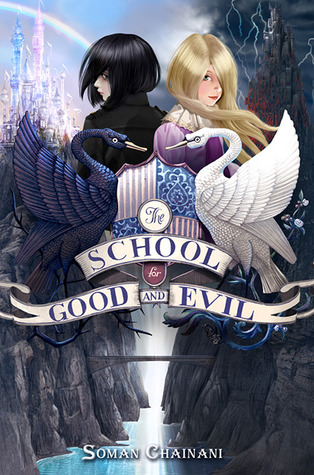
    The School for Good and Evil by Soman Chainani

    ★★

    *** Warning: This review contains spoilers! ***

    I really wanted to like this book. Isabelle reads so many books now that I can't keep up, but I specifically took the time to read this one because I wanted to see why Isabelle liked it so much. In the end, I was disappointed.

    On the surface, this book had potential. Many aspects of the book struck me as derivative - two children regularly kidnapped from Gavaldon to be thrown into a life-or-death situation reminded me of the Hunger Games; the School for Good and Evil was reminiscent of Hogwarts; every student in the school had one special "talent", kind of like the X-Men - but I was willing to accept all that precisely because those ideas proved so thrilling in the other franchises. Unfortunately, once Sophie and Agatha were settled into their respective schools, the book just seemed like a big jumbled mess to me.

    I appreciated the way the author incorporated a bit of humor every now and then, but for the most part, I was just confused. Very frequently, the book made mention of something or someone that only struck me as vaguely familiar; I was aware that I was supposed to know to what the book was referring, but whatever it was was usually something only briefly mentioned in a previous chapter, nothing that in any way appeared memorable the first time it was mentioned.

    I felt like the bulk of the story just went on too long. Very early, we realize that Sophie was "mistakenly" placed in the School for Evil, and Agatha "mistakenly" placed in the School for Good. Agatha wants to go home, but Sophie wants to stay and prove that she belongs in the School for Good so that she can have her fairy tale happily ever after ending. We have several iterations of Sophie insisting she wants to stay, Agatha convincing Sophie they need to go home, and Sophie agreeing and working with Agatha, only to change her mind at the last minute. I started to wonder when things would actually start to progress one way or the other.

    All along, the two possibilities were clear: either the girls' placements truly were mistakes, or the girls would realize that their placements were accurate. Of course, in the latter case, the situation would beg the question: Does this book really purport to segregate all people into black-and-white Good vs. Evil? Or will Sophie and Agatha somehow turn the fairy tale world upside down by showing that all people have some good and some evil in them?

    I disliked the use of the word "Evil". In real life, I prefer words like "imperfect" or "flawed". In the fairy tale context, it made sense, but in the Sophie-and-Agatha-are-human context, it was really off-putting. I also really disliked the way the book equated Good with beauty. Agatha did have one isolated conversation with Professor Dovey in which they discuss that beauty is only skin deep, but it was hardly enough to counteract the premise of the rest of the book, which was that the students in Good were all beautiful, and the students in Evil were all ugly.

    And speaking of Professor Dovey... She was only one of many characters who I had difficulty keeping straight. In my opinion, none of the students or teachers - except maybe Dot, Hort, and Tedros - were fleshed out enough so that I could identify them individually. Any time a name other than Sophie or Agatha came up, I had to stop and ask myself, "Okay, wait, is that person good or evil?"

    In the end, we had the predictable lesson you probably suspected from the very beginning, but it was delivered too quickly. It felt like 99% of the book focused on the idea that every person is either Good OR Evil, there is no in between, it is your nature and you can't change it - and then only 1% of the book said, "Oh, never mind all that. We are all the same, just human."

    The book ended so abruptly, it left me feeling dissatisfied. After Agatha and Sophie returned to Gavaldon, how would they explain everything to the other villagers? Will they be accepted back and honored? Or shunned for having crazy ideas? Can Sophie really find happiness living a "regular" life in Gavaldon, without a prince? And what about all the other students and teachers at the school? Will they all automatically give up their sides, and be one happy community in the woods? Even if all the students accept that they are all the same, neither all Good nor all Evil, how will they explain the new world order to their parents and neighbors back in their home villages? Maybe all these questions will be addressed in the sequel, which was just released, but at this point, I don't think I'll read it.

    One final thought. While the main ideas of this book are appropriate for upper elementary school readers, it's probably better suited for middle schoolers because of the use of words like "murderer" and "cannibal" and at least one explicit killing.

    Monday, April 7, 2014

    Dork Diaries: Tales from a Not-So-Fabulous Life (#1) by Rachel Renée Russell

    ★★

    To be fair, the target audience for this book (according to Amazon) is meant to be 4th through 8th graders, yet I am reading it with an eye towards 2nd graders. I volunteer in the school library during Isabelle's 2nd grade library class, and this book is very popular among her classmates. Isabelle picked it up on her own, and I felt compelled to read it, too.

    Isabelle actually read these books out of order, first reading Books #4 and #5, then #1, giving them all a 4-star rating. I have only read Book #1. If she continues with the series, I think I will, too. Just as when she was reading Ivy + Bean, I don't want to quash her enthusiasm for reading by forbidding a book that many peers are reading; but at the same time, at least in this book, there were lots of opportunities for "You know this is just a story, and you shouldn't do that in real life, right?" type discussions.

    Basically, this book is the diary of a girl, Nikki, who is starting her 8th grade year in a new private school. She doesn't have any friends yet. (Isabelle says Books 4 and 5 are better because she has friends). The book definitely conveys the drama of a middle school girl's thoughts.

    What I didn't like about the book is how much of it revolves around mean girl behavior. Not just the popular girl MacKenzie being mean to Nikki, but Nikki and her new friends being unkind towards MacKenzie as well. There is one occurrence of the word "skank", which I don't find appropriate for elementary school audiences. And now that I think of it, I'm not crazy about it for middle school audiences, either.

    I also didn't like how obsessed Nikki was about appearances, how she cared so much about having the "right" clothes and an expensive phone. She disliked MacKenzie, but at the same time, she admired and fawned over her good looks and hip fashion sense. Maybe these are themes that are common for middle school girls, but I'd rather have my daughter read about strong female characters who are comfortable in their own skin, not afraid to be themselves.

    Mostly, I disliked the way Nikki blamed her troubles on someone else. When she was too intimidated to sign up for an art competition, she actually managed to blame MacKenzie. I actually hate the idea of a book reinforcing the idea that it's okay to blame someone else for your own troubles. I would much rather have preferred Nikki to realize, at some point, that her self-consciousness and low self-esteem came from within.

    Moreover, in one anecdote, Nikki makes light of cheating. In another, she lies to her parents and gets away with it. Oh, well.

    Tuesday, February 25, 2014

    Wish You Were Eyre (The Mother-Daughter Book Club #6) by Heather Vogel Frederick

    ★★

    I like these books overall, and I really have enjoyed reading this series. But, there was one thing in this book that really turned me off.

    In every book of the series, the author consistently praises every single book mentioned and puts on a pedestal every author. In this book, even Cassidy, the reluctant reader, loves Jane Eyre. But, for some unknown reason, the author totally pans The Scarlet Letter. She could have simply not even mentioned the book, but seems to have gone out of her way to discredit it. Not a single character likes it - not the daughters, not the mothers, and not even any of their counterparts in Wyoming. What's the deal?! What does the author have against The Scarlet Letter? Both Jane Eyre and The Scarlet Letter were required reading in my high school, and as I recall, neither was especially well-received, but The Scarlet Letter was probably the less unpopular of the two simply because it had an edginess to it. Does the author object to the fact that rather than the more innocent variety of romance as seen in other book club books, The Scarlet Letter deals with the more mature topic of adultery? Was the author trying to make some kind of morality statement?! Hester Prynne may not be as proper as the other female heroines the club has met, but she is certainly a strong character - something I would think the book club members would appreciate! The Scarlett Letter is even oftentimes considered an early feminist piece, certainly worthy reading for modern young women and appropriate content for students studying classic American literature, despite the author's grievance. I seriously wondered why the author would so uncharacteristically reject such an important piece of writing - and then I realized that all other book club books were written by women! Does the author have something against male writers in general, or against Nathaniel Hawthorne in particular? Whatever. I think her blanket disdain for The Scarlet Letter was unfair - the characters never even tried to justify their dislike of the book - and out of place for a book series that not only celebrates literature in general but specifically focuses on strong women in literature. For a series that is supposed to encourage young readers to discover strong female characters in literature, the author really does a disservice by turning young audience off from The Scarlet Letter.

    Okay, rant over. Now about the book itself...

    After six books with variations on the same themes, I think I just got tired of the Mother-Daughter Book Club formula. Once again, the first adjective that comes to mind in describing this book is "over-the-top". I could accept a circle of friends that included a former supermodel, a former soap opera star, and a millionaire software entrepreneur. But now we have a group of high school sophomores that include a professional fashion designer, a published author and mayoral campaign manager, a nationally competitive singer, and a player on the nation's top girls hockey team!? Who would have thought that in the end, the most relatable and down-to-earth character would be Becca Chadwick?!

    Once again, one of the primary conflicts stems from a new girl in town with whom the girls do not get along. Once again, the girls deal with their social frustrations by engaging in a mean-spirited prank. It's lame that the girls in this series pine for their first kiss and wonder what their boyfriends are up to instead of just initiating a kiss themselves or simply talking to their boyfriends. It's lame that the girls think second cousins have no right to be friends, even though it's already been established that Annabelle and Tristan have a close relationship.

    I have to admit, though, I liked the way the book ended with Megan's sentimental round-up of Mother-Daughter Book Club moments. Despite all that I've complained about above, I think the book - and presumably the series - ended on a high note. There is a sense of finality at the end of this book, though I had originally expected the series to take the girls all the way through senior year in high school. But like I said, I think all the familiar themes have been exhausted, so if this is the last book in the series, that's just fine with me.

    I should note, also, that Isabelle didn't read this book. She lost interest and didn't finish Home for the Holidays despite the fact that they featured the Betsy-Tacy books, some of which she has read. I think the book club girls just finally got too old, and she couldn't relate to the characters anymore.

    Monday, January 20, 2014

    The Cupid Chronicles (The Wedding Planner's Daughter #2) by Coleen Murtagh Paratore

    ★★

    The first book was so much like a fairy tale that I was surprised to discover that it was only the first in a series. Usually I enjoy reading every book in a series, but The Wedding Planner's Daughter ended with such a fitting "happily ever after" that I really wasn't even curious to know what might have happened next.

    I'm all for books including topics that young female readers can identify with, and I'm sure tween-aged girls everywhere can relate to Willa's crush on JFK. There's a big message in support of community service in this book, but the central theme is clearly romance. Throw in a predictable plot, and this book just felt too much like tween chick lit. (The first book included romance, yes, but mostly it was about Willa trying to find her place in the world around her.)

    I liked some of the dialogue, especially Tina's no nonsense way of speaking. It's definitely a breezy, beachy read, and I can see how it might be a good option for an upper elementary or middle school girl who is into boys but not usually into reading.

    Overall, though, it was a disappointing follow-up for me, and I don't think I'll bother reading the rest of the series unless Isabelle picks them up herself first.

    Thursday, January 9, 2014

    My Heart is on the Ground: The Diary of Nannie Little Rose, a Sioux Girl, Carlisle Indian School, Pennsylvania, 1880 by Ann Rinaldi (Dear America Series)

    ★★

    *** Warning: This review contains spoilers! ***

    Ken picked this book up randomly from the library. Isabelle and I read it separately, and then together decided to give it 4 or 5 stars. Then, I went online... Now, I can't in good conscious give this book more than 2 stars. I am giving it 2 stars, instead of just 1, only because I really did enjoy reading it, and I have to admit, I liked the story.

    To summarize the plot: Nannie Little Rose is a 12-year-old Sioux girl who is sent to a boarding school for Native Americans in Pennsylvania. The entire book is presented as the text of her private diary. It's an interesting perspective that makes for compelling reading, especially for the young target audience of 9-to-12-year-olds. We follow Nannie Little Rose's journey as she grows from being a scared new student who longs for her Native American ways to an educated and contributing member of the school community who still holds her Native American ways dear. I especially liked one particular message comparing large acts of bravery that make people proud to small acts of kindness that make people beautiful (page 141 in my edition).

    So, what's the controversy here? Basically,the way Native Americans feel about this book is the way I, as a Chinese-American, feel about Tikki Tikki Tembo.

    Here is an article that clearly delineates the problems with this book:

    Fiction Posing As Truth: A Critical Review of Ann Rinaldi's My Heart Is on the Ground: The diary of Nannie Little Rose, a Sioux Girl

    And, for good measure, here is an article I wrote about the problems with Tikki Tikki Tembo:

    Rethinking Tikki Tikki Tembo

    In one respect, I am almost more forgiving of Tikki Tikki Tembo, which was published in 1968, before there was widespread appreciation of cultural diversity in the United States. (Still, I resent the way the book continues to be considered a "classic" and to be used as an example of Chinese culture.) My Heart is on the Ground, however, was published in 1999, well after the widely acclaimed book Bury My Heart at Wounded Knee publicized the injustices and humiliations suffered by Native Americans. To publish such a whitewashed account of Native American history at this point in American history - and to do so with seemingly good intentions! - just goes to show how deeply ignorant and racist (even if unintentionally racist) people can be.

    Of course, keeping in mind this book's target audience, I can understand toning down some of the information. For example, in describing these Native American boarding schools, perhaps it is age-appropriate to simply say that the United States government required Native American children to attend these schools, that many children did not want to go at all, and nor did their parents want them to go. Maybe third graders don't need to know that school officials, working for the federally funded boarding schools, actually kidnapped children to populate their schools. Maybe it's enough to tell them that students who clung to Native American ways, perhaps by speaking their native language, were "punished". Do they need to know that punishment consisted of severe beatings? Maybe it's understandable these types of details would be more appropriate in a young adult book or in middle or high school lessons on Native American history.

    Still, there is no excuse for the factual errors listed in the above article. Nor should the history be so whitewashed that the reader leaves with the impression that Captain Pratt was a kind of father figure (his actual motto: "Kill the Indian, save the man.") or that the boarding school was wholly beneficial for all who attended.

    To find out about the true impact and long-lasting damage done by these boarding schools, this article from The Seattle Times is as distressing as it is informative.

    After doing my research, I had to have a small follow-up discussion with Isabelle about how not everything in the book was accurate, and that even though it was a good story, it didn't really show the typical boarding school experience that actual Native Americans had.

    One final thought. If you still plan on reading this book, or giving it to an elementary school-aged child to read, you should be aware that this book does include death, and in particular, one rather disturbing death in which a girl is possibly buried alive.

    1/27/14 Update: I just came across another article about American Indian boarding schools.

    Friday, March 15, 2013

    Sky the Blue Fairy (Rainbow Magic #5: The Rainbow Fairies #5) by Daisy Meadows

    ★★

    HMMM... After Isabelle gets over this fairy phase, I think I should look for some books with more empowered girls in it.

    In this book, there were just too many instances of the girls and the fairies not stepping up to challenges.

    When the girls find Sky the Blue Fairy, she is trapped in ice that was created by the close proximity of Jack Frost's goblins. Rachel and Kirsty spent all of no time trying to come up with a way to rescue Sky by themselves, which was all the more disappointing because they did manage to melt ice to rescue Fern.

    Rachel: "Poor Sky! We have to rescue her! But how can we melt all that ice?"
    Kirsty: "I know! Why don't we look in our magic bags?"


    Rescuing Sky also involved getting some help from some friendly crabs, but I was bothered because the crabs really didn't do anything that the girls couldn't have done themselves.

    Finally, when the other Rainbow Fairies see that Sky is weak and needs help, instead of putting their heads together to figure out a way to help Sky themselves, Ruby the Red Fairy says:

    "We must think of something to help Sky! Oh, I know! Let's ask Bertram for his advice!"

    Sure, Bertram is helpful, but his solution isn't anything the fairies couldn't have come up with themselves.

    At first, I was also bothered when Bertram said, "You must all stay close to the pot so that I can protect you." But then I remembered - I think the Rainbow Fairies' magic is limited until they are all together again, so maybe they do need extra protection? Still. Did the King and Queen have to send a male protector?

    Tuesday, February 19, 2013

    Ivy + Bean Bound to be Bad (#5) by Annie Barrows

    ★★

    This book was surprisingly... boring. Other books that I've read in this series all have a solid plot to drive the story along, but this one just seemed lacking.

    Ivy was on a mission to be "pure of heart" in order to attract wild animals who would love her for her goodness. It seemed to me that Ivy's inspiration came from having seen a picture of St. Francis of Assisi, and it would have been nice if the book had mentioned him by name, like how Book 3 mentioned Mary Anning by name. Anyway, Ivy decided that the best way to be good would be for Bean to be especially bad, and then Ivy could reform her. Somehow, the story just didn't pull me in. I wasn't really interested in finding out what would happen next.

    Now, you might think, from my previous reviews of these books, that the "bad" versus "good" behavior would turn me off. Actually, I liked the tone set by the opening chapters, in which Bean's bad behavior was explicitly presented as "bad", and she finally faced clear consequences for her actions. Even when Bean - and the other neighborhood kids - were purposely trying to behave badly, I was somehow less bothered by the bad behavior in this book than in other Ivy + Bean books because in this case, the context showed that the kids clearly understood that they were behaving badly. They chose to behave badly, which means they understood that bad behavior resulted from bad decisions. (In other Ivy + Bean books, bad behavior comes across as just "regular behavior", and consequences are rare.)

    Ironically, Isabelle was turned off enough by the bad behavior in this book that she at first gave it 2 stars! But then she upgraded it to 4 stars because she admitted that she still enjoyed the book. And she did read it mostly in one sitting, with just one snack break.

    Most of the bad behavior in this book did not involve mistreating others, but when it did, I was on the one hand gratified that Ivy and Bean did not get away with their meanness (finally!), but on the other hand disappointed that the other kids returned meanness with more meanness (even if it was kind of funny).

    Wednesday, November 10, 2010

    Percy Jackson & the Olympians: The Last Olympian (#5) by Rick Riordan

    ★★

    *** Warning: This review contains spoilers! ***

    I was disappointed in this final book of the series. I know it was written for a younger audience, and maybe my expectations were too high, but I just felt it was lacking in so many ways.

    As usual, there was too much re-cap in re-introducing characters. I guess there's value in making each book a stand-alone book, but I still think it could have been done more naturally, less explicitly.

    As the series progressed, both Annabeth and Percy became torn between two love interests, and I think Riordan did a good job portraying their feelings. However, Annabeth's hypocritical behavior was nothing short of bitchy. I am loath to use profanity, but that is honestly the best word to describe her. By the end, I was rooting for Rachel (who, by the way, became one of my favorite characters). Even after all the back-and-forth with Annabeth's emotions, the closing scenes didn't give her enough credit - with a repentant Luke dying in her arms, she tells him she didn't love him, even though she pined for him through all five books?! Whatever.

    Rachel's new-found clairvoyance was a nice development, but did Riordan have to do it à la Isaac Mendez from Heroes?

    All the characters remained too one-dimensional, and Riordan unfortunately passed up opportunities for some real character development. Clarisse is given a soft side via Chris and Silena, but she remained unapologetically hot-tempered, stubborn, and proud. Silena, for her part, made a valiant eleventh-hour push to help the heroes, but her role as spy was completely brushed aside, chalked up to her naiveté and Luke's manipulation. Apparently, since she was otherwise well-liked, there was no need to be concerned about the deaths her espionage caused, including that of her boyfriend Beckendorf.

    There was a definite annoyingly Harry Potter-esque moment when Percy wanted to contact Rachel but didn't know how to do it. Apparently, the most common means of mythological communication - the Iris-message - slipped his mind.

    Throughout most of the story, the heroes are fully engaged in a war with the Titans, and much of the book describes one battle scene after another. Unfortunately, rather than making the reader feel as if he is caught up in the action as well, the battle descriptions read more like matter-of-fact reporting. And, as usual, there's a lot of being saved at the last minute by an unexpected third party.

    At the close of the series, I was unimpressed with the entire story arc. The Titan lord Kronos was re-formed only because of Luke's actions, and in the end, it was Luke himself who saved the world from Kronos. It just seems kind of lame that the potential ruin of the known world, and it's savior, came down to one person changing his mind.

    Finally, there was quite a bit of discussion about fate in the book, and how nobody, including Hermes, could have stopped Luke's fate. Love of friends, good education, not even better parenting could have helped Luke to make better decisions. This type of defeatism really bothered me, especially since the intended audience is middle schoolers; I don't like the idea of giving impressionable youth the message that no matter what they do, no matter what their parents do, no matter what path they take in life, they have one undeniable and immutable fate.

    Wednesday, December 30, 2009

    The Da Vinci Code by Dan Brown

    ★★

    From my impressions of this book before having read it, I was ready to be disappointed. While the masses loved it, most of the people whose opinions on books generally align with my own didn't like it at all. As it turned out, I didn't find it painful to read, and that was a pleasant surprise. Still, it was annoying to read.

    Dan Brown uses French unnecessarily. While a book set in Paris is sure to use some French, especially in dialogue among Parisians, is it really necessary, in a descriptive passage from the perspective of an English-speaking American, to reference "candied amandes" rather than "candied almonds"? The superfluous use of French was pretentious.

    Brown also uses italics excessively. Italicizing foreign words and a person's thoughts are common practices, but Brown further italicizes words for pure emphasis. Frequently. A well-written passage should allow the reader to infer the proper emphasis within individual sentences without the author having to blatantly hit the reader on the head with his intent.

    And, yes, Brown constantly underestimates his reader. He leaves nothing to intellect, and generally assumes his reader has none. Passing descriptions of well-known Parisian landmarks read like blurbs from a tourist's guide book. Even after he draws a particular connection - never leaving anything unsaid for fear the reader won't pick up on implicit references - he explains the point ad nauseum. If that wasn't bad enough, I read a crazy "Special Illustrated Edition" (the only copy available in the library), which further included photos and diagrams, just to make sure I really understood what was going on. (To be fair, at times the photos were a pleasant addition, especially when they showed works of art, but some of the diagrams came across more insulting than educational.)

    And finally, Brown's writing style is more suited to television than reading. He ends almost every chapter or section with a cliffhanger akin to a commercial break. What happened next wasn't always shocking or unexpected, but it always answered whatever question was previously posed.

    Despite these shortcomings, I have to admit that not only did I not lose interest, but I was even anxious to get to the end, to see how everything tied together. I was a bit confused for a few chapters, but being now familiar with Brown's writing style, I had no doubt he would lay it all out for me in the end - and he did.

    Trying to Save Piggy Sneed by John Irving

    ★★

    It's a collection of John Irving's memoirs and short stories.

    I enjoyed reading about how he came to be a writer, and his experiences with books, critics, and other writers. It also sheds some light on why prep schools, Vienna, and wrestling play such a large part in many of his novels. (He went to prep school, he spent time in Vienna, and he's an avid wrestler.) Wrestling, actually, has been such a large part of his life that much of his memoirs read like a Who's Who History of Amateur Wrestling. He gives names and dates and weight classes, scores and play-by-plays of matches. I didn't find those parts so interesting.

    The Hotel New Hampshire by John Irving

    ★★

    It's kind of a weird book. It's filled with just the sort of characters that only John Irving could dream up. It's about a family who lives and runs a hotel. Their life, which might be anything but ordinary to you or me, is all that these characters know, and so, despite the fact that their lives are dotted with tragedies, it's just what life is to them. The book is really about how each character deals with the events surrounding the family, each person dealing in his or her own way. It's written as a memoir by one of the children, now grown up, and so the entire narrative has a sense of nostalgia and sadness to it, even though parts of it are pretty chuckle-worthy.

    Anyway, like I said, it's kind of weird, the stories that are weaved together in the book.

    The World According to Garp by John Irving

    ★★

    I'm not sure I understand Garp.

    This book seems to me to be about lust, the tragic and completely avoidable consequences of misdirected lust, feminism, or the label of feminism, and individuality.

    For the first part of the book, I was thinking, "Hm, I'm not sure where this book is going." And then just as I was beginning to feel like I was getting to know the characters, the entire middle of the book had me feeling disgusted with, rather than sympathetic towards, the main players. By the end I felt that some of the characters had redeemed themselves, and it seemed to close with some messages of human kindness, tolerance, and maturity. So I did at least leave the book with a positive attitude towards it.